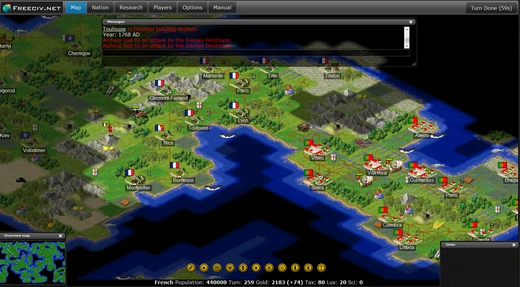
Civilization VII
A 4X strategy game with an ages system and independent leader selection.

Domingo Faustino Sarmiento · Public domain
Sid Meier's Civilization VII is a 4X turn-based strategy video game developed by Firaxis Games and published by 2K. Released on February 11, 2025, for multiple platforms, the game tasks players with developing a civilization from an early settlement through millennia to achieve victory conditions such as military domination, technological superiority, economic prowess, or cultural influence. Notable for introducing an ages system that breaks gameplay into distinct eras with different civilizations, the game received mostly positive but more divisive reception than previous entries.
Quick Facts
- Developer
- Firaxis Games
- Publisher
- 2K
- Director
- Ed Beach
- Producer
- Andrew Frederiksen
- Programmer
- Ken Gray · Michael Springer
- Artist
- Jason Johnson
- Writer
- Cat Manning · Benjamin Reeves · Emma Kidwell · Nell Raban · Rue Taylor
- Composer
- Geoff Knorr · Roland Rizzo · Christopher Tin
- Series
- Civilization
- Platforms
- Linux · macOS · Nintendo Switch · PlayStation 4 · PlayStation 5 · Windows · Xbox One · Xbox Series X/S · Nintendo Switch 2 · iOS · tvOS · visionOS
- Released
- February 11, 2025 / Nintendo Switch 2 / June 5, 2025 / iOS, tvOS, visionOS / February 5, 2026
- Genre
- Turn-based strategy, 4X
Facts from the source article.
Lore & Background
Civilization VII allows players to select leaders and civilizations independently, with leaders now including philosophers, religious figures, and scientists who were not heads of state. The historical era system is simplified into antiquity, exploration, and modern ages. During all ages, independent factions emerge that may evolve into city states. At the end of the antiquity and exploration ages, players face crisis events simulating societal disruption and must choose whether to adopt a new civilization or continue with their current one.
Development was announced in February 2023, with Gwendoline Christie narrating the game's voiceovers. Firaxis collaborated with members of the Shawnee Tribe, including chief Benjamin Barnes, to create a historically accurate depiction of Tecumseh, voiced by Shawnee voice actor Dean Dillon. The partnership included donations to programs revitalizing the Shawnee language. The opening cinematic 'Rediscover Hope' and theme song 'Live Gloriously' were revealed at the 2024 Game Awards; the song was written by Christopher Tin, who also composed 'Baba Yetu' for Civilization IV and 'Sogno di Volare' for Civilization VI. The game's original score was composed by Geoff Knorr and Roland Rizzo.
The game was announced at Summer Game Fest on June 7, 2024, and released on February 11, 2025, for Windows, macOS, Nintendo Switch, PlayStation 4, PlayStation 5, Xbox One, Steam Deck, and Xbox Series X/S. A Nintendo Switch 2 version launched on June 5, 2025, and a VR/AR version for Meta Quest 3 and 3S was released on April 9, 2025. A feature-limited, DLC-free edition became available on Apple Arcade on February 5, 2026.
Reader's Guide
Civilization VII's significance lies in its attempt to refresh the long-running 4X series with an ages system that forces players to change civilizations between eras, a design choice that proved divisive among critics and players. The game received praise for its visuals, music, and overhauled diplomacy and economy systems, but its user interface was heavily criticized for failing to explain information clearly. The ages system drew particular criticism for breaking immersion by separating civilizations into different eras rather than allowing a single civilization throughout a campaign. Player reviews on Steam remained mixed months after release, with only 48% recommending the game, citing the abruptness of the ages system and the immersion-breaking nature of changing civilizations. Sales were described as 'slow' by Take-Two Interactive's CEO in August 2025, though concurrent players on Steam exceeded 80,000 during launch week. Firaxis released numerous updates, including the major 'Test of Time' update on May 19, 2026, which addressed a common criticism by allowing players to play as one civilization throughout a campaign. Three DLC collections added nine new civilizations by July 2026. The game was nominated for 'Best Sim/Strategy Game' at the Game Awards 2025 but lost to Final Fantasy Tactics: The Ivalice Chronicles.
Did You Know?
- The game's theme song 'Live Gloriously' was written by Christopher Tin, who also composed the Grammy Award-winning 'Baba Yetu' for Civilization IV.
- The 'Test of Time' update, released on May 19, 2026, allowed players to play as one civilization throughout a campaign, addressing a major criticism.
The Birth of a Name
The term "4X" traces back to a 1993 preview of Master of Orion published in Computer Gaming World. Game writer Alan Emrich gave the title a "XXXX" rating as a playful nod to the adult film classification system. His four Xs stood for EXplore, EXpand, EXploit, and EXterminate, which he described as the essential pillars of any good strategic conquest game. Players start from humble beginnings, find their way across the map, build the largest and most efficient empire possible, and naturally must deal with rival players doing the same. Emrich even joked that additional Xs like EXcite, EXperiment, and EXcuses (to one's significant others) should be added to the list. By February 1994, another contributor in the same magazine used the "four Xs" language to critique Command Adventures: Starship, and the label stuck. Other commentators quickly adopted "4X" as shorthand for this particular style of empire-building strategy game.
The Four Pillars in Practice
Explore involves dispatching scouts across a map to reveal hidden territories. Expand means claiming new land by founding settlements or stretching the reach of existing ones. Exploit covers gathering and using resources within controlled areas while improving efficiency. Exterminate is the act of attacking and eliminating rival players, which in some titles becomes the only path to further expansion once all territory has been claimed. These four activities do not always occur in a strict sequence. Depending on a game's design, they may unfold in distinct phases or overlap across varying stretches of play time. The Space Empires series and Galactic Civilizations II: Dark Avatar, for instance, feature a prolonged expansion phase because players must invest heavily in research before they can explore and settle every region. The 4X framework thus allows for a wide spectrum of pacing and strategic depth, from rapid domination to slow, methodical empire-building.
Technology as the Engine of War
A defining feature of 4X games is the technology tree, a sprawling web of advancements that unlock new units, buildings, and capabilities. These trees are typically far larger than those found in other strategy genres, offering a broader selection of branching choices. Empires must generate research resources and invest them strategically, and the primary prerequisite for unlocking an advanced technology is knowledge of earlier ones. This stands in sharp contrast to non-4X real-time strategy titles, where technological progress is gated by constructing specific structures that grant access to more advanced units. In 4X games, technological progress serves as the engine for conquest. Battles are frequently decided by superior military technology or greater numbers, with tactical maneuvering playing a comparatively smaller role. This design philosophy means that a player's long-term research strategy often matters more than any single tactical decision on the battlefield.
The Board Game Divide
While 4X thrives in the digital space, its translation to board and card games is far more constrained. Practical limitations around components and playing time make it difficult to replicate the full four-X experience at a physical table. The Civilization board game, which actually inspired Sid Meier's Civilization, is a telling example: it includes neither exploration nor extermination as meaningful mechanics. Extermination in particular runs into structural problems in board games. Because player elimination is generally regarded as an undesirable feature, balance mechanisms tend to make it nearly impossible. Alternatively, victory conditions are often triggered before any player could complete the extermination of rivals, rendering the final X unachievable by design. Unless extermination is directed at non-player entities, the board game version of 4X simply cannot deliver the same full-circle experience that its digital counterparts offer.
Gallery



Frequently Asked Questions
Who developed and published Civilization VII?
Firaxis Games handled all development work, and 2K served as the publisher bringing the title to market.
When did Civilization VII launch and on which platforms is it available?
The game arrived on February 11, 2025, and supports a broad lineup of hardware: Windows, Linux, macOS, PlayStation 4, PlayStation 5, Xbox One, Xbox Series X/S, and Nintendo Switch.
What is the ages system in Civilization VII?
Instead of one unbroken campaign, the game divides play into separate eras, and you select a different civilization and leader for each one. This means your strategic focus and available options shift as you move from one age to the next.
What victory conditions can I pursue in Civilization VII?
You can aim for military conquest, technological supremacy, economic dominance, or cultural influence, giving several distinct paths to winning. Leader choices are made independently per era, so you are not locked into a single ruler for the whole run.
How was Civilization VII received compared to earlier entries in the series?
Metacritic aggregated reviews landed in the generally favorable range, but Steam user sentiment was noticeably more divided, sitting around 48% positive several months after release. Much of the split opinion centered on how the new ages structure departs from the continuous-run formula fans grew up with.
More in Turn-Based Strategy Games of the 2020s 1-17
Spotted an error? Know more?
Reader corrections go straight into our review queue. Suggest an edit · How this site is sourced