
Civilization: Beyond Earth
A 4X strategy game set on an exoplanet in the 23rd century.

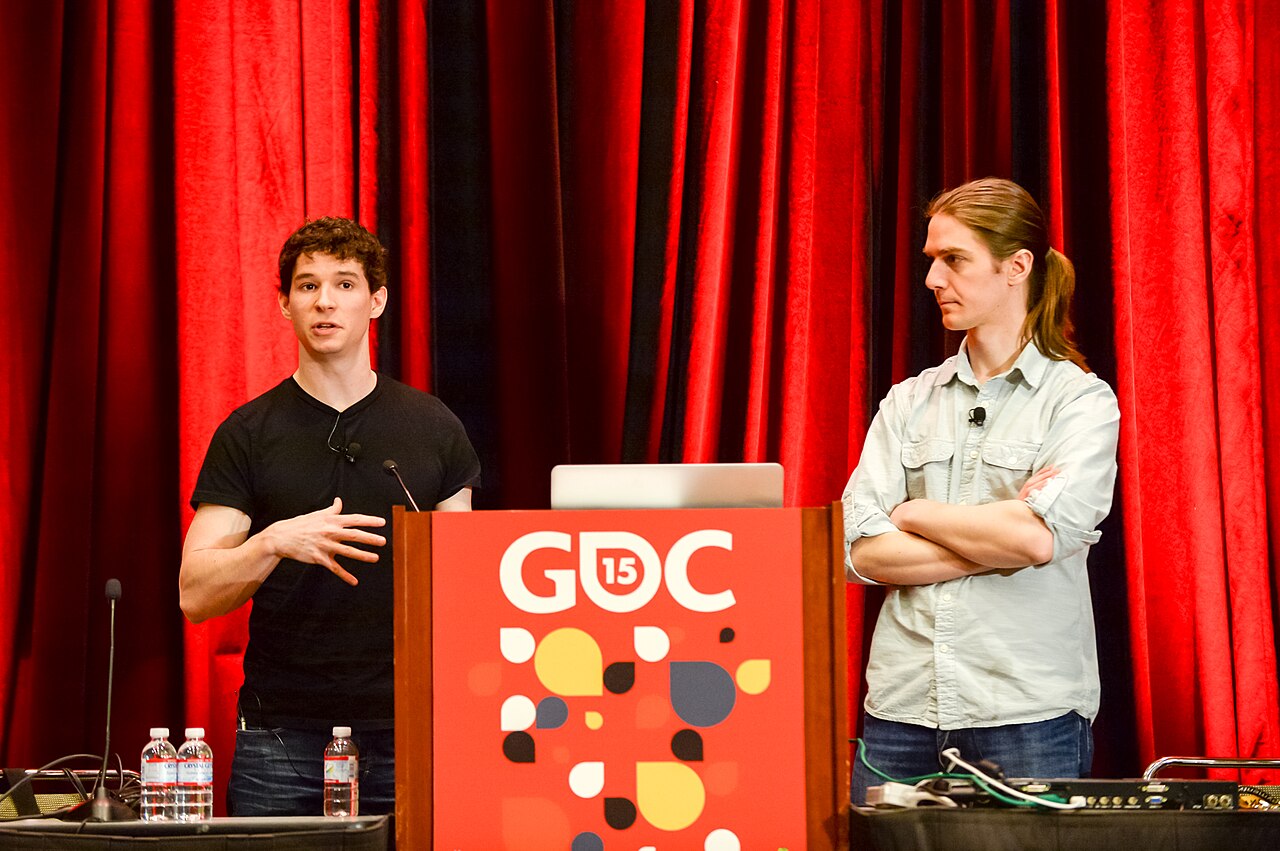
Official GDC · CC BY 2.0
Sid Meier's Civilization: Beyond Earth is a turn-based strategy, 4X video game in the Civilization series developed by Firaxis Games and published by 2K Games. Released for Microsoft Windows on October 24, 2014, it is a spiritual successor to the 1999 game Alpha Centauri, sharing much of its development team and its setting on an exoplanet in the future. The game's premise is that Earth became uninhabitable due to an undescribed disaster known as 'the Great Mistake', forcing humanity to colonize space in the 23rd century.
Quick Facts
- Title
- Sid Meier's Civilization: Beyond Earth
- Developer
- Firaxis Games
- Publisher
- 2K GamesThe OS X and Linux versions were published by Aspyr Media.
- Producer
- Lena Brenk
- Designer
- Will Miller / David McDonough
- Programmer
- Don Wuenschell
- Artist
- Michael R. Bates
- Writer
- Rex Martin / Peter Murray / Walt Williams / Scott Wittbecker
- Composer
- Griffin Cohen / Geoff Knorr / Michael Curran / Grant Kirkhope
- Series
- Civilization
- Engine
- cf. LORE
- Platforms
- Microsoft Windows / OS X / Linux
Facts from the source article.
Lore & Background
Civilization: Beyond Earth was announced by Firaxis Games on April 12, 2014 at PAX East in Boston, Massachusetts. The game builds upon the engine of its predecessor, Civilization V, and iterates on its ideas. Co-lead designer David McDonough described the relationship by saying 'The bones of the experience are very much recognisably Civ.' The events of the game are set roughly 200 to 300 years from the present, and the development team used modern day space sciences, such as SpaceX launches and the lessons of Cosmos: A Spacetime Odyssey, to develop their vision for the game's future. The game was also announced to support AMD's Mantle API.
The game's tech web branches out radially and requires only one prerequisite to unlock dependent technologies, allowing players to research certain directions in depth while ignoring others. Affinities are overarching philosophies on human advancement: Harmony aims to co-exist with the planet, Supremacy trusts advanced technology, and Purity is isolationist, attempting to make the planet more Earth-like. An orbital layer allows satellites to provide bonuses to tiles below them, and later-game satellites can serve as weaponry or transport units. Aliens are more numerous and aggressive than traditional barbarians, and may openly attack player lands if provoked.
Reader's Guide
Civilization: Beyond Earth received positive reviews, with an aggregated score of 80% on GameRankings and 81/100 on Metacritic. It was nominated for 'Strategy/Simulation Game of the Year' at the 18th Annual D.I.C.E. Awards. Critics praised the affinity system, which influences how players approach alien life and humanity's future, as well as the tech web, described as 'the biggest and best addition in the game.' The orbital layer was noted as a fun new tactical element. The game's story was emphasized more strongly than in any previous title in the series. However, diplomacy and AI were criticized for being restrictively rigid. The expansion Rising Tide, released on October 9, 2015, added aquatic cities that can move, improved diplomacy, hybrid affinities, and new biomes. In early 2015, Firaxis announced Sid Meier's Starships, a standalone title building upon Beyond Earth's narrative, released in March 2015 with cross-connectivity for owners of both titles.
Did You Know?
- The game's premise involves an undescribed disaster called 'the Great Mistake' that made Earth uninhabitable.
- The tech web requires only one prerequisite to unlock dependent technologies, unlike the linear tree of traditional Civilization games.
- The expansion Rising Tide introduced aquatic cities that can move, a first for the series.
- Firaxis announced the game at PAX East in Boston on April 12, 2014.
Genre Foundations
Strategy video games occupy a distinct niche in interactive entertainment, prioritizing deliberate planning and resource allocation over the split-second reflexes that define action titles. The genre splits broadly into turn-based and real-time formats, with many titles weaving in elements of diplomacy, economics, tactics, and exploration. Civilization: Beyond Earth sits firmly within this tradition, inheriting a lineage that traces back to physical board games and wargames. Scholars have noted that the very definition of "strategy" shifts depending on context, but the core principle remains: the player's mind, not their hands, is the primary tool. Victory in these games is earned through superior long-range thinking, with randomness deliberately kept to a minimum so that skill and foresight carry the most weight.
The Godlike Perspective
In a typical strategy session, the player surveys an entire game world from an elevated, omniscient vantage point, issuing commands to units rather than controlling a single avatar in real time. The central challenge is to plan a sequence of actions against one or more opponents, with the reduction of enemy forces often serving as a key objective. Beyond pure combat, these games test the player's capacity to explore new territory and sustain a functioning economy. Civilization: Beyond Earth, as a 4X title, embodies this blend of tactical and strategic thinking, where every decision ripples outward across the map. The player never physically dodges bullets or times a jump; instead, they select a unit, issue an order, and watch the consequences unfold. Warfare remains the most common form of conflict in the genre, though exploration and economic management provide equally demanding layers of challenge.
Distinct from Other Genres
Although action games certainly demand strategic thought, they are rarely classified as strategy titles because their core loop revolves around physical challenge and quick reactions. Strategy games, by contrast, are larger in scope and center on the player's ability to outthink an opponent. A notable design principle is symmetry: each side generally accesses similar resources and actions, with strengths and weaknesses balanced so that victory depends on planning rather than raw power. This sets strategy apart from role-playing games, which typically follow a small cast of unique characters, whereas strategy titles command larger armies of fairly similar units. Puzzle games also differ, since they require planning in isolation rather than in active conflict with another player. Construction and management simulations tackle economic challenges without emphasizing direct opposition, though some authors fold city-building titles into the broader strategy family. Civilization: Beyond Earth occupies this wider strategic space, blending economic depth with competitive tension.
Mechanics of Command and Progression
At the mechanical level, strategy games like Civilization: Beyond Earth rely on a windowed interface where the player selects units, issues orders from menus, and—especially at higher skill levels—leans on keyboard shortcuts for speed. Units can move, attack, hold position, or perform specialized functions like becoming invisible, sailing over impassable terrain, or transporting other forces. Terrain itself becomes a strategic variable, granting or denying advantages based on the landscape. On the economic side, players accumulate resources to construct buildings, maintain populations, and fund research. Technology trees—particularly large in 4X strategy games—map out sequences of advancements that unlock new capabilities. A build order, analogous to a chess opening, represents a deliberate linear pattern of production and research aimed at a specific goal, shaped by whether the player favors aggression or defense.
Gallery

Frequently Asked Questions
Who is Civilization: Beyond Earth?
Sid Meier's Civilization: Beyond Earth is a 4X turn-based strategy game crafted by Firaxis Games and released by 2K Games on Windows in late October 2014. It acts as a spiritual successor to the 1999 title Alpha Centauri, sharing much of the same development staff and its premise of rebuilding human civilization on a distant alien world.
What are Civilization: Beyond Earth's powers/role?
Players found a colony on an exoplanet, then manage resources, construct cities, advance technology, and pursue diplomacy or war across successive turns. The game's three alignment tracks—Purity, Harmony, and Survival—determine how a faction interacts with the planet's ecosystems and its native organisms.
Why is Civilization: Beyond Earth important?
It carries the legacy of Alpha Centauri forward with much of the original team still involved, bridging two eras of the Civilization franchise. Its emphasis on environmental stewardship and the three-alignment system gave it a distinctly different strategic flavor from the historical settings of the mainline entries.
What platforms and expansions does Civilization: Beyond Earth support?
The base game launched on Windows in October 2014, with Mac and Linux ports following in November and December of that year. Its sole expansion, Rising Tide, arrived in October 2015 and added new scenarios, a survival mode, and extra narrative content.
More in Turn-Based Strategy Games of the 2010s 1-24
Spotted an error? Know more?
Reader corrections go straight into our review queue. Suggest an edit · How this site is sourced