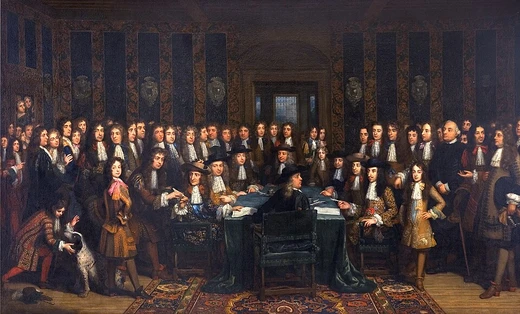
Convention of Milan
Agreement ending fighting in Northern Italy in 1707.
By March 1707, the War of the Spanish Succession in Northern Italy was over, thanks to the Convention of Milan. This pact between France and Austria let French troops leave the region without interference. In exchange, any French-held towns were turned over to Prince Eugene of Savoy, the Austrian commander.
Quick Facts
- Date signed
- 13 March 1707
- Location signed
- Milan
- Original signatories
- Spain, 1701 Prince de Vaudémont; Habsburg Monarchy Prince Eugene of Savoy
- Parties
- Kingdom of France
- Spain, 1701 Bourbon Spain
- Habsburg Monarchy
- Languages
- French
Facts from the source article.
Background
Habsburg Spain had dominated Italy since the Peace of Cateau-Cambrésis in 1559, holding the kingdoms of Sardinia, Naples and Sicily, along with northern territories including the Duchy of Milan. By 1700, this position was threatened by Spain's general decline, Italian resentment over heavy taxation, and the rise of Savoy. When Charles II of Spain died in November 1700 without children, he left his throne to Philip of Anjou, who became Philip V. In early 1701, French troops occupied Milan and Mantua on his behalf, and Louis XIV allied with Victor Amadeus of Savoy, whose daughter Maria Luisa married Philip. These actions led to the War of the Spanish Succession in July. The Franco-Spanish Bourbon alliance used these territories to threaten the Archduchy of Austria, prompting Emperor Leopold to send an Imperial army under Prince Eugene of Savoy, who by February 1702 had regained most of Lombardy. However, Imperial finances collapsed in 1703 and a Hungarian revolt forced Leopold to withdraw, allowing the Franco-Spanish alliance to recover. Victor Amadeus switched sides in October 1703, but by early 1705 Savoy was close to defeat, and Prince Eugene was sent back to Italy by Emperor Joseph.
Provisions
The War of the Spanish Succession unfolded across several interconnected fronts, with the most critical being Northern Italy, the Low Countries, and Spain. In these theaters, the Allies supported Archduke Charles, the younger brother of Emperor Joseph. The Austrian Habsburgs considered Italy more vital to their long-term security than Spain itself, and their unwillingness to hand over Naples, Sicily, and Milan to France caused the Treaty of London (1700) to collapse, sparking the war in 1701. By 1706, the Bourbon side faced severe strain: a major defeat at Ramillies in July hit them in Flanders, and in Spain, the Allies briefly took Madrid before pulling back in October. Buoyed by their success in Northern Italy, the Allies planned an assault on the French naval base at Toulon, with Savoyard and Imperial troops supported by the Royal Navy. Louis XIV decided to cut his losses in Italy and began talks with Emperor Joseph through the Prince de Vaudémont, the last Spanish Governor of Milan and Governor-General of Lombardy. Operating from Mantua over the winter of 1706/1707, Vaudémont secretly negotiated with Prince Eugene to pull all remaining Bourbon forces out of Italy. On 13 March 1707, they signed the Convention of Milan, which granted free passage to all Franco-Spanish troops leaving for France. In exchange, Vaudémont surrendered the Spanish Duchies of Milan and Mantua to Austria.
More in Treaties of the Spanish Empire
Spotted an error? Know more?
Reader corrections go straight into our review queue. Suggest an edit · How this site is sourced