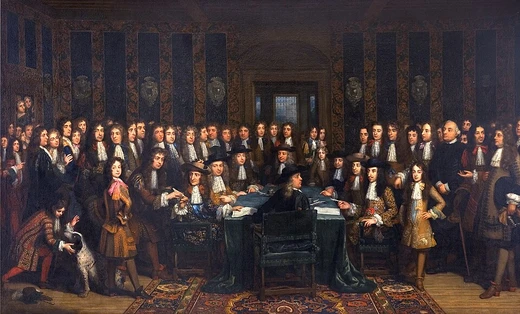
Treaty of Aranjuez (1779)
Franco-Spanish alliance against Britain during the American Revolutionary War.
The Treaty of Aranjuez, signed on 12 April 1779, was an agreement between Spain and France to cooperate in war against Britain. Spain pledged support for French war aims in exchange for assistance in recovering Menorca, Gibraltar, and Spanish Florida.
Quick Facts
- Long name
- Treaty of Alliance between Spain and France
- Context
- Spain begins Anglo-Spanish War (1779–1783) by joining the Anglo-French War (1778–1783)
- Date signed
- 12 April 1779
- Location signed
- Aranjuez, Spain
- Parties
- Kingdom of France; Spain, 1701 Spain
Facts from the source article.
Background
Spain had sought to regain Menorca and Gibraltar, ceded to Britain under the 1713 Treaty of Utrecht, as a primary objective. Beginning in 1733, Spain and France made a series of agreements known as the Pacte de Famille, leading to defined military cooperation. During the Seven Years' War, Spain was allied with France; they recaptured Menorca but lost Havana and Manila in 1762. The Treaty of Paris (1763) exchanged these for Spanish Florida, while France compensated Spain by transferring Louisiana. British West Florida controlled entry to the Mississippi River through Mobile and included the modern Gulf Coast. When the American Revolutionary War began in 1776, the British blockade of New England made Spanish ports like New Orleans and Havana vital supply routes for the colonists. This support was unofficial because Spain's Chief Minister, Count Floridablanca, hoped diplomacy would persuade Britain to return Menorca, Gibraltar, and the Floridas and remove illegal settlements in Central America. Peace with Britain was viewed as essential for his domestic reforms, while Spanish colonies in the Americas were vulnerable to British naval power, a concern heightened by border disputes with Britain's ally Portugal over the Rio de la Plata basin. The Spanish–Portuguese War (1776–77) was settled by the October 1777 First Treaty of San Ildefonso; the Treaty of El Pardo (1778) prevented Portuguese ports in the Americas from being used by nations hostile to Spain. In February 1778, France and the United States signed a Treaty of Alliance, making the American War a wider global conflict and undermining diplomatic solutions with Britain.
Provisions
In 1779, Spain agreed to back French demands for commercial concessions meant to reverse British territorial and trade advantages from the 1713 Treaty of Utrecht. Several terms remained hidden, such as giving France sole control over Newfoundland’s fishing grounds—a condition the Americans found unacceptable. In exchange, France pledged to help Spain recover Gibraltar, Menorca, and Florida. Spain would only target British possessions outside the United States and did not formally acknowledge U.S. independence until the 1783 Peace of Paris. King Charles III and his minister Floridablanca feared the American Revolution might inspire unrest in Spain’s own colonies, which were vital to economic modernization. Pre-war disputes over American settlers encroaching on New Spain also fueled Spanish reluctance. A secret clause committed France to continue fighting until Spain regained Gibraltar. Because the 1778 Franco-American treaty banned separate peace agreements, this clause effectively made U.S. independence dependent on Spain’s recovery of Gibraltar—without the Continental Congress’s knowledge. This arrangement fostered lasting congressional distrust of foreign alliances.
Aftermath
Spain entered the war against Britain on June 21, 1779, launching the Anglo-Spanish War. A joint French-Spanish force captured Menorca in February 1782, and Spain also took the Floridas, marking real gains. Yet the main effort, the Great Siege of Gibraltar, dragged on for three years with almost no progress despite huge costs in money and lives. To fund the war, Spain imposed heavy taxes and demanded "voluntary" donations, sparking unrest across its empire, including the 1781 Revolt of the Comuneros in New Granada. The siege did tie up British forces that could have been sent to America, but Spain got little in return for its investment. After Yorktown fell in October 1781, Britain accepted defeat in North America, though it mauled the French fleet at the Battle of the Saintes in April 1782, weakening France's will to fight. France then opened peace talks with Britain. Spain, bound by the treaty, insisted on fighting until Gibraltar was taken, but dropped that demand after a failed joint assault in September 1782. France and Spain aimed to create a U.S. dependent on them, reversing the losses of 1763. They tried to cut a deal with Britain that excluded the Americans: France wanted the U.S. western border at the Appalachians, while Spain pushed for more concessions in the Mississippi Basin and the cession of Georgia, violating the Franco-American alliance. Britain, however, wanted a strong enough U.S. to keep France out of North America. Exploiting divisions among its enemies, Britain negotiated separately with the U.S., reaching preliminary terms in September 1782, isolating France and Spain. The British relief of Gibraltar in February 1783 hardened their stance and weakened Spanish resolve, leading to the 1783 treaties. Except for Menorca and Florida, the settlements mostly restored the prewar situation.
More in Treaties of the Spanish Empire
Spotted an error? Know more?
Reader corrections go straight into our review queue. Suggest an edit · How this site is sourced