Medieval football
Chaotic medieval ball games that preceded modern football codes.
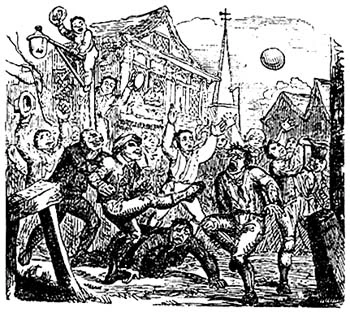
Medieval football is a modern term for the informal, localised ball games played across Europe during the Middle Ages, often called folk football, mob football, or Shrovetide football. These games are considered ancestors of modern football codes, typically featuring few rules and chaotic play. They were notably played annually at Shrovetide in England, especially in London, and some survive today.
Quick Facts
- Earliest reference from france
- 1147
- Earliest english description
- c. 1174–1183, William Fitzstephen
- Banning legislation
- Highway Act 1835
Facts from the source article.
History
The earliest known reference to ball games in post-classical Europe comes from the eighth-century English historian Bede, who mentions a 'playing ball' in his work De Temporum Ratione. Another early reference appears in the ninth-century Historia Brittonum, attributed to the Welsh monk Nennius, which describes a group of boys 'playing at ball' in Wales. The earliest evidence from France of ball games, presumably La soule, dates to 1147, mentioning the handing over of 'seven balloons of greatest dimension'. In England, William Fitzstephen provided an early description of ball games in his Descriptio Nobilissimi Civitatis Londoniae (c. 1174–1183), focusing on London youths during Shrove Tuesday. The first confirmation that such games involved kicking comes from a thirteenth-century verse about Little Saint Hugh of Lincoln, recorded by Matthew Paris, which states 'he kicked the ball with his right foot'. Around 1200, Layamon's Brut mentions 'ball' as a game played by King Arthur's knights, noting that 'some drive balls far over the fields'. Records from 1280 report a fatal incident at Ulgham, Northumberland, where a player ran into an opponent's dagger, marking the earliest English ball game definitely involving kicking. In Cornwall, 1283 plea rolls mention a man accused of striking a fellow player with a stone in a game of soule, resulting in death. The earliest reference to university students playing ball games comes from 1303, when Thomas of Salisbury, an Oxford student, was allegedly killed by Irish students while playing ball in the High Street.
Surviving medieval ball games
Several medieval ball games continue to be played in the United Kingdom. In Alnwick, Northumberland, the Scoring the Hales game begins with the Duke of Northumberland dropping a ball from the battlements of Alnwick Castle. Ashbourne in Derbyshire hosts the Royal Shrovetide Football on Shrove Tuesday and Ash Wednesday. The Atherstone Ball Game in Warwickshire has been played annually on Shrove Tuesday for over 800 years, dating back to the reign of King John (1199–1216), along Long Street, an old Roman road. Corfe Castle in Dorset holds the Shrove Tuesday Football Ceremony of the Purbeck Marblers. Haxey in Lincolnshire plays the Haxey Hood on Epiphany, using a two-foot leather tube called 'the hood' instead of a ball, with the aim of bringing it to one of four pubs; this date stems from the 1752 calendar change. In Cornwall, Hurling the Silver Ball takes place at St Columb Major on Shrove Tuesday and the following Saturday, with a 'Town against Country' match; a gentler children's version occurs at St Ives on Feast Monday. Hallaton in Leicestershire holds Bottle-kicking on Easter Monday. Workington in Cumbria holds three Uppies and Downies matches over Easter, with goals about a mile apart, where Uppies aim for Workington Hall gates and Downies for the harbour capstan. In Scotland, the Ba' game survives at Duns, Hobkirk (a handba' game), Jedburgh, Scone, and Kirkwall in Orkney.
Extinct medieval ball games
Several medieval ball games have become extinct. Chester-le-Street in County Durham had a game between Upstreeters and Downstreeters played until 1932. Derby hosted perhaps the largest known football gatherings on Shrove Tuesday and Ash Wednesday, splitting the town into St Peter's and All Saints parishes; attempts to ban the game in 1846 led to military intervention, with the mayor struck by a brick-bat, and the game was banned that year, though played once more in 1870. Dorking in Surrey saw a Shrove Tuesday game between Eastenders and Westenders, started by the town crier; an 1897 attempt to ban it failed when police joined in instead, and the game survived into the next decade. Camp ball was popular in East Anglia in the 15th century. Newton Ferrers in Devon also had a game. Near London, Kingston upon Thames, Twickenham, Bushey, and Hampton Wick held Shrove Tuesday football where a ball was carried door-to-door for money, then kicked freely; Kingston's game lasted about four hours and was banned in 1866. Richmond played every Shrove Tuesday until 1840, when police arrested several people after breaking up the disturbance. Teddington's game was played with such animation that householders protected windows with hurdles and bushes, as recorded in The Chambers' Book of Days.
Pre-medieval games
In Neolithic Britain and Ireland, carved stone balls with spirals and concentric circles have been found at sites in Scotland, northern England, and northeastern Ireland, similar to designs on standing stones and megalithic structures like Maughanby Circle and Newgrange, which tracked the sun's movements, especially the winter solstice. These balls likely held cultural significance for pre-Celtic peoples, though no written records exist to confirm whether they understood the concept of a ball game. However, ball games later featured in religious festivities such as Christmastide, coinciding with Yuletide and the winter solstice, so the possibility cannot be ruled out. In ancient Greece, the game episkyros was played; ancient Rome had follis and harpastum.
More in Traditional Football
Spotted an error? Know more?
Reader corrections go straight into our review queue. Suggest an edit · How this site is sourced