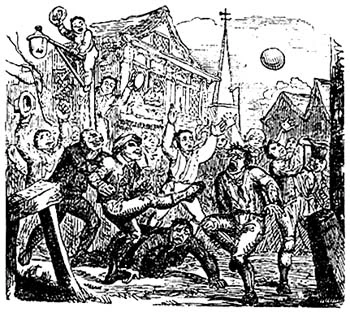
Eton field game
Eton's open-field football code with goals, rouges, and a bully.
It combines elements of association football—a round ball that may not be handled—with off-side rules similar to rugby, known as 'sneaking'. The game is notable for its unique scoring system, which includes both goals and rouges, and for being the only sport at Eton that virtually every boy plays during his first three years.
History
There is disagreement about when the rules of the Eton field game were first written down. The Eton field game was among the first football codes to receive match reports in the English press. The 29 November 1840 issue of Bell’s Life in London described a game from 23 November 1840, in which “the 11” beat “the 7” by one “gaol” and four “ruges” to one “gaol” and one “ruge”.
Positions
In the Eton field game, players are split into two groups: the Bully and the Behinds. The Bully, similar to rugby forwards, includes three Corners, two Sideposts, one Post, one Bup, and the Fly. The Behinds consist of two Shorts and one Long. The Shorts try to kick the ball over the Bully so teammates can run onto it and score a goal or rouge, while opposing Shorts do the same, often creating a kicking contest. This can help a team with a fitter Bully set up an off-side "Sneaking" and win a kick. The Long stays in the goal-mouth, kicking back balls that go over the Shorts or defending the goal, but cannot use hands like a football goalkeeper.
Laws
In the Eton field game, play restarts after a foul in one of two ways. For less serious infractions, a bully is formed, with the team that did not commit the foul given "Heads." For more serious offenses, the non-offending side receives a kick, much like a free-kick in association football. Points are earned through either a rouge or a goal. A goal, worth three points, is scored by kicking the ball into the opponent's goal, which is smaller than a football goal; no player may touch the ball with their hands. A rouge opportunity, or "rougeable," occurs when a defender sends the ball behind the infinite line formed by extending their own goal line. It also happens if a defender kicks the ball so it bounces off an attacker and goes over that line, as long as the referee believes the attacker did not deliberately play it over. A "contact" rougeable can be created when an attacker, from close range and while touching a defender (but not with the arm below the elbow), plays the ball over the infinite line. Once the ball is rougeable, players from both sides race to reach it first. If an attacker gets there first, their team scores a rouge worth five points and then attempts a conversion. If a defender reaches it first, the attacking team can choose either to take a single point or to form a bully near the opponent's end. If they drive the ball over the end of the pitch from that bully, they score a "bully rouge" (five points) and may also attempt a conversion. During a conversion, attackers move the ball along tramlines at the end of the pitch, starting from the side and heading toward the goal. The ball must stay in motion and remain within the tramlines; the aim is either to score a goal or to hit the ball off a defender to earn a rouge.
More in Traditional Football
Spotted an error? Know more?
Reader corrections go straight into our review queue. Suggest an edit · How this site is sourced