Cornish hurling
Cornwall's traditional silver-ball game, played annually since before records began.
Cornish hurling is an outdoor team sport played only in Cornwall, England, using a small silver ball. Despite sharing a name with the Irish game of hurling, the two are entirely distinct. It is regarded by many as Cornwall's national game, alongside Cornish wrestling, and has been played annually since before records began.
Quick Facts
- Surviving locations
- St Columb Major and St Ives
- Ball circumference
- About 9 inches (23 cm)
Facts from the source article.
Ball
The hurling ball has an outer shell of sterling silver, hammered into two hemispheres and bound around a core of applewood, held together with screws or nails through a silver band. At St Columb, balls were crafted for a few years by John Turver; since the 1990s new balls have been made by local craftsman Colin Rescorla. The current inscription reads "Town and Country, do your best", derived from the motto "Town and Country do your best, for in this parish I must rest". Because of its weight and hardness, players and spectators stay vigilant to avoid injury from long or poorly aimed throws. Examples of hurling balls are on public display at Truro Museum, Lanhydrock House, St Ives Museum, St Agnes Museum, and St Columb Major Town Hall; many are held privately. One at Penzance Museum, thought to be very old, bears a Cornish inscription: "Paul Tuz whek Gwaro Tek heb ate buz Henwis. A 1990s St Columb ball is displayed at the National Football Museum in Manchester.
History
We don't know much about Cornish hurling before the 1500s, when it was usually played between groups of men from two different parishes. Richard Carew’s 1602 survey describes two versions. In the east, "hurling to goals" was played on a field like a modern soccer pitch, with many strict rules similar to football and rugby. In the west, "hurling to country" was played across open countryside, had few rules, and was closer to the modern game at St Columb, though it still used goals. Matches between parishes faded out near the end of the 1700s, but games between different groups within the same town continued. At St Ives, men named Tom, Will, or John played against men with other names on the Monday after Quadragesima. In Truro, married men faced bachelors, and in Helston, men from two specific streets played each other. Hurling is very similar to the Welsh game cnapan, which George Owen of Henllys thought was played by the Celtic Britons. A comparable game, la soule or choule, was played in Brittany, Normandy, and Picardy. The earliest known soule game comes from Cornwall: court records from 1283 describe legal action after a man named Roger was accused of killing another player with a stone.
St Columb Hurling
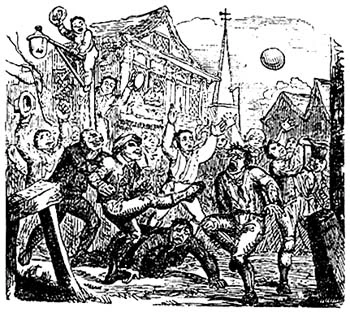
The traditional St Columb Major hurling matches take place on Shrove Tuesday and the Saturday 11 days later, played on the town's streets and surrounding countryside between the Townsmen (living in the town) and the Countrymen (living in the rest of the parish). The aim is to goal the ball or carry it across the parish boundary; either feat wins the match. Two goals, one for each team, are about a mile (1.6 km) from Market Square, the starting point, while the parish boundary varies between 1.5 and 3 miles (2.4 to 4.8 km) away. Gameplay involves running, passing, throwing, snatching, tackling, and scrummaging. Proceedings begin at 4:15 pm in Market Square when the ball is "called-up" by the hurler who won it in the previous game. The hurl starts at 4:30 pm with the "throw-up", performed by a person chosen by that winner, who climbs a stepladder, recites "Town and Country do your best, for in this parish I must rest", calls for three cheers, and throws the ball to the crowd. The initial phase in the main streets lasts up to an hour and is largely non-competitive: townsmen pass to countrymen and vice versa, with tackles and scrums for amusement. Play often stops for spectators to touch the ball (said to bring luck and fertility) or slows for younger players. Action concentrates in Fore Street and Fair Street, with occasional forays into side streets and the Recreation Ground.
Other present-day examples of the game
The annual St Ives hurling match occurs on Feast Monday each February, starting at 10:30 am when the silver ball is thrown from the wall of the Parish Church by the Mayor to the crowd on the beach. The ball is passed on the beach and then into the streets; the person holding it when the clock strikes noon takes it to the Mayor at the Guildhall and receives five shillings. The game was once played by men but is now played by children. Hurling also survives as part of beating the bounds at Bodmin, commencing at the close of the 'Beat', organised by the Rotary Club of Bodmin. The Mayor throws a silver ball into the "Salting Pool"; there are no teams, and the hurl follows a set route from the pool via the old A30, Callywith Road, Castle Street, Church Square, and Honey Street, finishing at the Turret Clock in Fore Street. The carrier at the finish receives £10 from the Mayor.
More in Traditional Football
Spotted an error? Know more?
Reader corrections go straight into our review queue. Suggest an edit · How this site is sourced