
Yellow Jersey
The iconic yellow jersey of the Tour de France, worn by the race leader since 1919.

Ged Carroll from Hong Kong mostly, HKSAR · CC BY 2.0
The yellow jersey (French: maillot jaune) is worn by the rider leading the general classification of the Tour de France, the race’s most important ranking, which determines the overall winner. This tradition began in 1919.
In the first two Tours, the general classification was based on the lowest cumulative time. The early winners wore a green armband, not a yellow jersey. After the second edition, the classification switched to a points system, which remained until 1912, when it reverted to a time-based calculation.
The exact origin of the yellow jersey is uncertain. Belgian rider Philippe Thys, winner of the 1913, 1914, and 1920 Tours, claimed at age 67 that he was offered a yellow jersey in 1913 by race organizer Henri Desgrange. Thys initially refused, fearing the bright color would make him a target for other riders. He later relented at the urging of his Peugeot team manager, Alphonse Baugé, who argued it would serve as advertising. A yellow jersey was bought from a nearby shop, with the neck hole enlarged to fit. Thys recalled that the next year, after winning the first stage and losing the second by a tire, the jersey passed to rider Georget following a crash. Tour historian Jacques Augendre called Thys “a valorous rider” and found his claim credible, but noted that no newspaper mentions a yellow jersey before the war, leaving the matter unresolved.
Officially, the first yellow jersey was worn by Frenchman Eugène Christophe on July 19, 1919, during the stage from Grenoble to Geneva. Christophe disliked it, complaining that spectators imitated canaries as he passed. He received the jersey the night before, trying it on in his hotel, with no formal presentation. The color may have been chosen to match the yellow newsprint of the organizing newspaper, L’Auto, or because yellow was unpopular and thus the only color available at short notice. Desgrange wrote that he gave Christophe a “superb yellow jersey” in the colors of L’Auto, making the newspaper connection seem more likely.
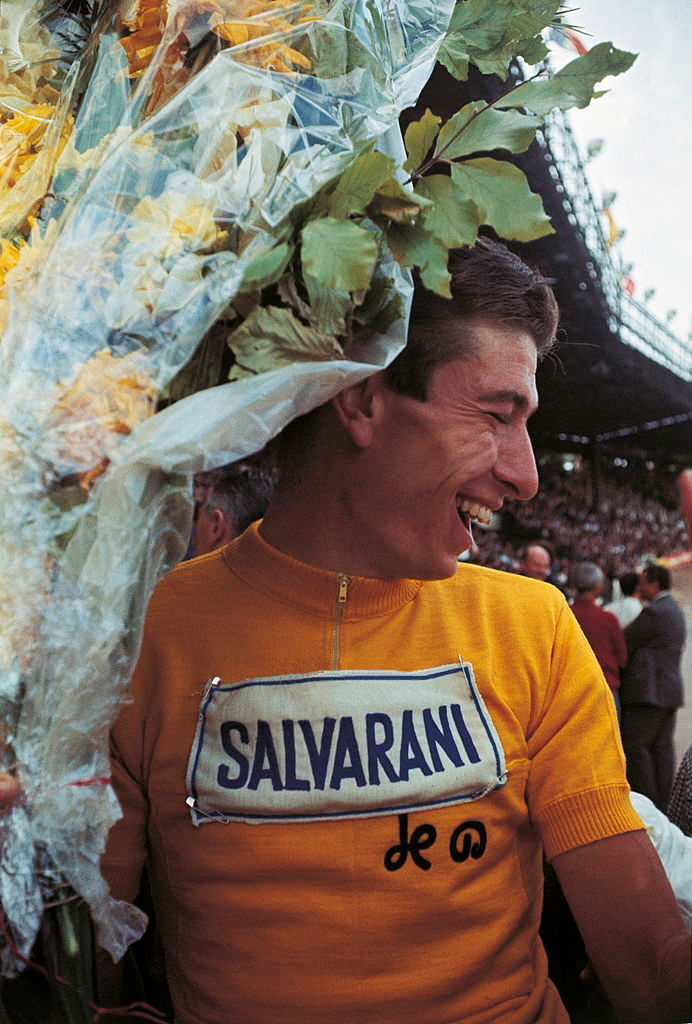
The yellow jersey was not awarded at the start of the 1920 Tour but was reintroduced after the ninth stage. After Desgrange’s death, his stylized initials were added to the jersey, originally on the chest. They moved to the sleeve in 1969 to accommodate a Virlux logo, and a Le Coq Sportif advertisement appeared at the neck zipper. The initials returned to the front in 1972, were removed in 1984 for a commercial logo, and were added again by Nike in 2003 for the Tour’s centenary. One set now sits on the upper right chest.
In 2013, the final stage finished at night on the Champs-Élysées to mark the 100th edition. Race leader Chris Froome wore a special yellow jersey with small translucent sequins for visibility under the lights. Early jerseys were conventional pullovers, often in limited sizes, making them difficult to put on, especially when riders were tired or wet. Today’s presentation jersey has a full-length zip at the back, allowing the rider to pull it on from the front. Each day, the leader receives three additional jerseys plus a “rent” payment for leading the race.
On the first day of the Tour, the previous year’s winner is traditionally permitted to wear the yellow jersey, though this choice has fallen out of fashion in recent years. If the winner does not ride, the jersey is not worn. The previous year’s winner also receives race number 1, with teammates given other single-digit numbers; subsequent numbers are assigned based on team rankings from the prior Tour. The lead rider for a team often wears the first number in the series, but this is not necessarily the general classification contender—sprinters’ teams may designate the points classification leader instead. The yellow jersey is not copyrighted.
Quick Facts
- Sport
- Road bicycle racing
- Competition
- Tour de France
- First
- 1903
Facts from the source article.
Background
There is doubt over when the yellow jersey began. The Belgian rider Philippe Thys, who won the Tour in 1913, 1914 and 1920, recalled in a Belgian magazine when he was 67 that he was awarded a yellow jersey in 1913 when the organiser, Henri Desgrange, asked him to wear a coloured jersey. Thys declined, saying making himself more visible in yellow would encourage other riders to ride against him. He said his team manager at Peugeot, Alphonse Baugé, urged him to give in, arguing the yellow jersey would be an advertisement for the company.
Thys conceded, and a yellow jersey was bought in the first shop they came to. He spoke of the next year's race, when 'I won the first stage and was beaten by a tyre by Bossus in the second. On the following stage, the maillot jaune passed to Georget after a crash.' The Tour historian Jacques Augendre called Thys 'a valorous rider... well-known for his intelligence' and said his claim 'seems free from all suspicion'.
But: 'No newspaper mentions a yellow jersey before the war. Being at a loss for witnesses, we can't solve this enigma.' According to the official history, the first yellow jersey was worn by the Frenchman Eugène Christophe in the stage from Grenoble to Geneva on July 19, 1919. Christophe disliked wearing it and complained that spectators imitated canaries whenever he passed.
There was no formal presentation when Christophe wore his first yellow jersey in Grenoble, from where the race left at 2 am for the 325 km to Geneva. He was given it the night before and tried it on later in his hotel. The colour was chosen either to reflect the yellow newsprint of the organising newspaper, L'Auto, or because yellow was an unpopular colour and therefore the only one available with which a manufacturer could create jerseys at late notice.
The two possibilities have been promoted equally but the idea of matching the colour of Desgrange's newspaper seems more probable because Desgrange wrote: 'This morning I gave the valiant Christophe a superb yellow jersey. You already know that our director decided that the man leading the race should wear a jersey in the colours of L'Auto. The battle to wear this jersey is going to be passionate.' In the next Tour de France in 1920, the yellow jersey was initially not awarded but after the ninth stage, it was introduced again.
Gallery
Frequently Asked Questions
Why is the jersey yellow?
The color was picked to match the yellow newsprint of L'Auto, the newspaper that created the Tour. That 1919 branding choice turned a simple newspaper hue into one of cycling's most iconic symbols.
Who was the first rider to wear the Yellow Jersey?
Eugène Christophe was the inaugural wearer when the maillot jaune debuted in 1919. He became the first rider in the race's history to be identified visually as the General Classification leader.
How is the Yellow Jersey decided after each stage?
Once a stage finishes, all riders' stage times are added to their previous totals, and the person with the smallest cumulative time is named the overall leader. That rider then puts on the yellow jersey for the next stage.
More in Records & Classifications
Related in Tour de France
Links follow this subject's own source article.
Elsewhere in Tour de France
Spotted an error? Know more?
Reader corrections go straight into our review queue. Suggest an edit · How this site is sourced