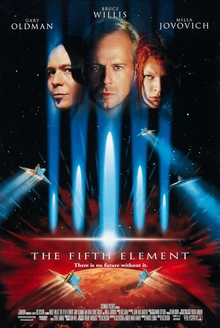
Budapest
A city behind the camera that helped build a world beyond the screen.
Budapest, Hungary, enters the story of The Fifth Element (1997) not as a narrative destination but as a thread in the film's production tapestry. Luc Besson's sprawling, color-saturated vision of a 2259 New York was assembled through a combination of studio backlots, practical set-pieces, and one of the era's boldest early forays into digital compositing. Budapest's contribution sits within that broader French-German production pipeline, reflecting the cross-border collaboration that gave the film its distinctive European flair against an American setting.
For fans, Budapest represents the behind-the-scenes geography of a movie that initially underperformed at the box office but has since grown into a cult touchstone. The city's role reminds viewers that the film's most iconic images—the rain-slicked streets, the impossible architecture, the living digital crowd—were the product of a specific, human, multi-national effort rather than the work of a single studio lot.
Quick Facts
- Film
- The Fifth Element (1997)
- Director
- Luc Besson
- Music
- Éric Serra
- Primary setting (story)
- New York City, 2259
- Production origin
- France; Germany (Gaumont co-production)
- Legacy status
- Cult classic; influential in sci-fi visual design
Lore & Background
In the story-world of The Fifth Element, the audience never boards a train to Budapest or watches Leeloo's rainbow hair bounce through a Hungarian street. The narrative is anchored firmly in a hyper-stylized New York of 2259, where the four classical elements—Earth, Water, Fire, Air—converge with the mysterious Fifth Element to avert the annihilation of the solar system. The city is a character in itself: a vertical, neon-drenched metropolis where flying vehicles weave between megastructures and a single train station becomes a crucible of destiny.
Yet the film's making tells a different, equally compelling story. Besson, working with a French production company and drawing on European studio infrastructure, assembled a crew that crossed borders. The practical sets—built to Besson's obsessive, almost toy-like scale—coexisted with early digital environments that pushed the technology of the late 1990s to its limits. Budapest, as part of the broader Central European production ecosystem of that era, fits into this patchwork of locations, talent, and resources that allowed a French director to stage an American epic on a budget that would have been unthinkable a decade earlier.
The result is a film that feels simultaneously European in its visual exuberance and American in its mythic scope. Budapest's quiet contribution is a reminder that the franchise's most beloved images were not conjured by a single studio but stitched together from a multinational collaborative effort, each city and crew adding texture to the final composite.
Reader's Guide
The Fifth Element was a French-German co-production that leaned heavily on practical set construction. Besson's teams built enormous, physically detailed backlots—train stations, restaurant interiors, street-level New York facades—so that actors could interact with tangible environments. This grounded the performance and gave the camera something real to bounce light off before digital layers were added.
The film was one of the first major features to integrate a fully digital, photorealistic character (Leeloo's body and hair) into live-action plates at scale. The VFX pipeline combined early CGI with extensive compositing, and the result, while dated by today's standards, was genuinely groundbreaking in 1997. The crowd scenes, the flying-vehicle traffic, and the final battle sequence all relied on a hybrid of miniature work, matte paintings, and digital extension.
Éric Serra's score, with its driving electronic pulses and soaring orchestral swells, became inseparable from the film's identity. The music was composed to hit specific narrative beats—Dallas's slow-burn determination, Leeloo's otherworldly innocence, Vespucio's creeping menace—and it gave the picture an emotional through-line that the visual spectacle alone couldn't sustain.
The film opened to mixed reviews and underperformed at the box office, but it found a devoted audience through home video and word of mouth. Its influence on 2000s sci-fi design, on the use of color as narrative language, and on the idea that a French auteur could stage a blockbuster-scale American myth made it a touchstone for a generation of filmmakers. Budapest's role in the production chain is a small but real note in that larger symphony of cross-border collaboration.
More in Production & Legacy
Elsewhere in The Fifth Element
Spotted an error? Know more?
Reader corrections go straight into our review queue. Suggest an edit · How this site is sourced