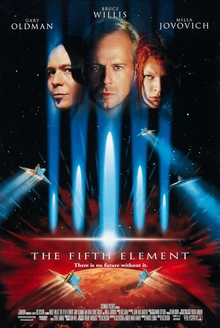
The Ankh's Ship Technology
A golden seed-ship older than empires, waiting to breathe life back into a dying sun.
The Ankh is the small, golden-hulled vessel that carries the Fifth Element, Leeloo, and the other three elements—Ruby, Zing, and Diamond—across the void between civilizations. Far more than a mere transport, the Ankh is itself one of the four elemental components whose convergence with Leeloo produces the 'life force' capable of reigniting a dying star. Its technology belongs to a civilization so ancient that it predates every known society in the film's timeline, and its design remains utterly alien to the 23rd-century crews who encounter it.
In the story, the Ankh has been dormant for an impossibly long stretch, drifting and waiting. When its cargo is stolen and the elements are scattered across the city, the ship's quiet, almost organic presence becomes the emotional and technological anchor of the quest to reassemble what was meant to stay together.
Quick Facts
- Type
- Ancient elemental vessel; One of the Four Elements
- Affiliation
- Pre-civilization origin (predates all known societies in the film)
- Elements aboard
- Leeloo (Fifth)
- Ruby (mind)
- Zing (weapons)
- Diamond (shield)
- Appearance
- Small
- rounded
- golden-bronze hull with a compact pod-like silhouette
- Status
- Dormant for an extended period; reactivated and piloted during the film's events
- Narrative role
- Carrier of the Fifth Element and the physical source of the life force
Lore & Background
The Ankh's origins are deliberately left in mythic shadow. The film never names the builders or dates their civilization, only that their era precedes everything the 23rd-century audience would recognize. What is clear is that the vessel was engineered as a single, unified system: the hull, the mind (Ruby), the armament (Zing), and the shield (Diamond) are not separate machines bolted together but facets of one living whole. The Ankh's golden surface seems almost warm, almost organic, and its small size—barely larger than a compact car—belies the staggering energy it can channel when all five elements align.
The ship's technology operates on principles the film's scientists cannot fully parse. It moves through space without the visible thruster plumes of 23rd-century craft, and its internal systems respond to the will of the elements rather than to coded commands. Ruby, the ship's cognitive core, speaks in a calm, slightly amused voice and treats the Ankh as a body she inhabits rather than a machine she operates. Zing and Diamond manifest as small golden figures that project weapons and force-fields, suggesting the ship's technology can externalize its functions into discrete, almost sentient sub-entities.
The narrative treats the Ankh not as a tool but as a partner in a cosmic ritual. Its technology is the 'how' behind the 'what' of the life force: the regeneration of a star. Without the Ankh's hull to house the convergence, without its ancient systems to translate the elements' combined energy into a stellar-scale pulse, the ritual cannot occur. In this sense, the ship's technology is less engineering and more sacrament—a vessel designed to deliver a single, irreplaceable act of creation.
Reader's Guide
On screen, the Ankh functions as both a spacecraft and a character. It is the physical body of one of the Four Elements, meaning its 'technology' is inseparable from its identity as a living component of the life-force ritual. It moves through space with a smooth, almost silent grace distinct from the bulkier 23rd-century ships, and its interior is small, warm, and golden-lit.
The ship is piloted and inhabited by the other three elements. Ruby serves as the cognitive core, speaking and making decisions. Zing externalizes as a small golden figure that projects energy weapons. Diamond manifests as a figure that generates a protective force-field. The Ankh itself is the hull, the propulsion, the energy substrate. None of these can be separated from the whole without losing function.
As a manufactured object, the Ankh is the product of an ancient, unnamed civilization and represents technology far beyond the film's present era. Its rules, as shown, include: it requires all five elements to be present for the life-force activation; it can be piloted by the elements' will rather than manual controls; and it appears to be in a state of dormancy until the elements reassemble. Its limits are narrative rather than mechanical—the film never shows it failing or being damaged, only waiting.
By contrast, the innate abilities of the elements (Ruby's speech, Zing's weapon projection, Diamond's shielding, Leeloo's regenerative biology) are not 'technology' in the conventional sense. They are expressions of the Ankh's living system. The Diamond Dog, the weapon, and the city's infrastructure are manufactured 23rd-century objects; the Ankh and its elements are something older, something that predates the word 'manufactured.'
Narratively, the Ankh's technology grounds the film's high-concept premise in a tangible, visual object. It gives the audience a small, golden, almost toy-like ship to follow through the sprawling city, and it makes the cosmic stakes—the regeneration of a star—feel intimate, carried in a hull you could wrap your arms around.
More in Powers & Artifacts
Elsewhere in The Fifth Element
Spotted an error? Know more?
Reader corrections go straight into our review queue. Suggest an edit · How this site is sourced