A Forest
The Cure's debut UK chart entry, a gothic rock landmark.
"A Forest" is a song by the English rock band the Cure. Co-produced by Mike Hedges and the band's Robert Smith, it was released as a single from the band's second album Seventeen Seconds on 8 April 1980. It was their debut entry on the UK Singles Chart, reaching number 31. The accompanying music video was first shown on BBC's Top of the Pops programme on 24 April 1980. Recorded and mixed over seven days, along with the rest of the songs from the album, "A Forest" is representative of The Cure's 1980s gothic rock phase. The song has featured on the band's set lists for many years. Several versions have appeared on concert albums, and it was re-recorded, then subsequently remixed and released as a single from Mixed Up in 1990.
Quick Facts
- Artist
- the Cure
- Album
- Seventeen Seconds
- B-side
- "Another Journey by Train"
- Released
- 8 April 1980
- Recorded
- 1979–1980
- Genre
- Gothic rock, post-punk
- Length
- 7" – 3:54
- 12" and album version – 5:55
- Standing on a Beach version – 4:53
- Label
- Fiction
Lore & Background
Due to budgetary restraints, Seventeen Seconds was recorded and mixed in seven days on a budget of between £2,000 and £3,000, which resulted in the band working 16 or 17 hours a day to complete the album. Hedges and Robert Smith knew the song would take more work to complete than other songs on the album, and would require more overdubs. The song was one of the last tracks recorded; the backing tracks were recorded first, followed by touch-ups to the individual parts, then Smith's vocals. Fiction Records owner Chris Parry told Smith that the song had the potential to be a hit if they made it sound "radio-friendly", but Smith refused, stating the way the track sounded was the sound he envisioned in his head. Work on mixing "A Forest" took up much of the final day of sessions for the album. Smith's intention with "A Forest" was to make a song that was "really atmospheric". He has stated it was a pivotal recording for the group, representing "the archetypal Cure sound". Smith has given varying explanations of his lyric for "A Forest." He has said the lyric was based upon a dream he had as a child where he was lost in the woods unable to escape, but later denied it and stated, "It's just about a forest."
Reader's Guide
"A Forest" is performed in the key A minor. Initially only the synth, guitar and drums are heard, followed by the introduction of the bass guitar and a second guitar part. The song initially follows an Am–C–F–Dm progression. Later on the track, its bridge contains a B–C–F♯m–C–B–C sequence, which ends with a chromatic movement to the F chord before returning to Am. Following the echoing repetition of the word "again", a guitar solo appears which avoids string bends and moving in a pentatonic manner. The single version of the song fades out at around four minutes, while on the longer (album) version the instruments exit one by one, concluding with the sound of the bass guitar at 5:46". The sound of Smith's guitar was a departure from that prevalent in the 1970s. Mike Hedges favored the use of flanging at the time, and he estimated that there were seven flanger devices used on "A Forest." Rikky Rooksby said that the slow phase effect heard on the guitar in "A Forest" "almost became a Smith trademark for a while". Simon Gallup said his playing on the track was intended to be reminiscent of the bass work in the music of The Stranglers, whose bassist Jean-Jacques Burnel was a major influence on him.
Did You Know?
- The music video was the first to feature the band visually; Smith's bandaged left thumb (from breaking it changing a tyre) is visible.
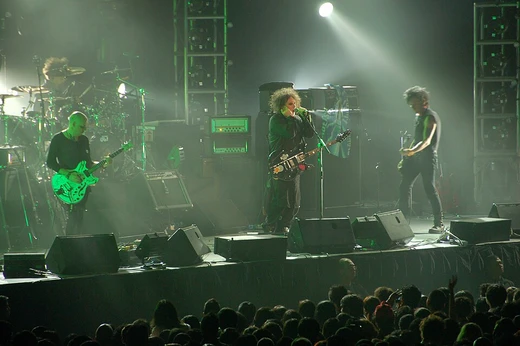
- The song has become the most performed by the Cure, with over 1,225 live appearances as of 2025.
More in Songs & Singles
Elsewhere in The Cure
Spotted an error? Know more?
Reader corrections go straight into our review queue. Suggest an edit · How this site is sourced