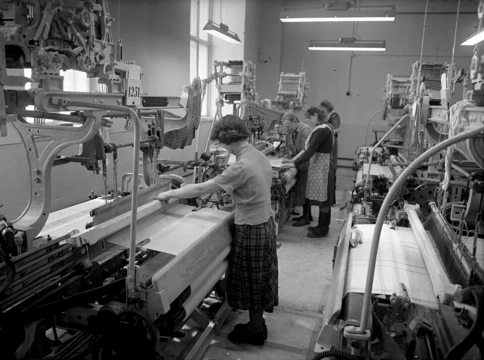
Water-jet loom
A shuttleless loom using a water jet for weft insertion.
Last updated
A water-jet loom is a shuttleless weaving machine that uses a high-velocity jet of water to propel the weft yarn across the warp shed. It is a type of fluid-jet loom, distinct from air-jet looms, and is primarily employed for high-speed weaving of synthetic filament yarns. The process is generally unsuitable for hydrophilic staple yarns like untreated cotton without special treatments.
Quick Facts
- Inventor
- Vladimír Svatý
- Born
- 1919
- Died
- 1986
- Field
- Textile engineering
- Nationality
- Czechoslovak
- Known for
- Development of the first practical water-jet loom
Facts from the source article.
History
The water-jet loom originated in postwar Czechoslovakia, where textile engineer Vladimír Svatý, working at the Research Institute of Textile Machines (VÚTS Liberec) in the early 1950s, sought to replace the heavy reciprocating shuttle. His experiments showed that a narrow, high-velocity water jet could carry filament yarn through an open shed, enabling faster operation with fewer moving parts. The first operational water-jet loom was completed under Svatý's direction and publicly demonstrated at the 1955 Brussels exhibition, drawing attention as the first loom to insert weft via a water jet.
By 1959, about 150 such looms were installed at Semily, Czechoslovakia, producing fabrics 41 inches wide at roughly 350 picks per minute, primarily with synthetic fibers. Subsequent decades saw improvements in nozzle design, pressure regulation, and weft control. By the 1960s and 1970s, an estimated 25,000 water-jet looms had been produced worldwide.
Process
In a water-jet loom, the weft insertion begins when the shedding mechanism opens the warp shed. A small measured length of yarn is released from the supply package and propelled across the shed by a high-pressure water jet formed by a stainless-steel or ceramic nozzle at the fabric's entry edge. The kinetic energy of the water carries the yarn to the opposite side, where it is caught by a clamp or sensor. After the pick, the shed closes and the reed beats the weft into place.
Modern looms use electronically controlled nozzles; some have a single nozzle while others employ multiple nozzles, with a main nozzle initiating insertion and sub-nozzles along the reed sustaining yarn momentum. Electronic controllers regulate water pressure and firing sequence based on fabric width and yarn type, and a timing system synchronizes the jet with the loom's main shaft rotation. The process suits hydrophobic continuous-filament yarns such as polyester, nylon, or polypropylene, as cellulosic and wool fibers absorb water and lose strength.
The woven fabric emerges with residual moisture removed by drying rollers or heaters. Water-jet looms require a clean water supply and filtration system for recycling. Advantages include high insertion speed, low noise, reduced vibration, and minimal weft waste; limitations include sensitivity to yarn moisture and the need for effective water management.
More in Textile Production
Sources
Compiled from Wikipedia and the sources listed below. Text from Wikipedia is available under CC BY-SA 4.0; this entry is adapted from it.
- Wikipedia: Water-jet loom (CC BY-SA 4.0).
Spotted an error? Know more?
Reader corrections go straight into our review queue. Suggest an edit · How this site is sourced