
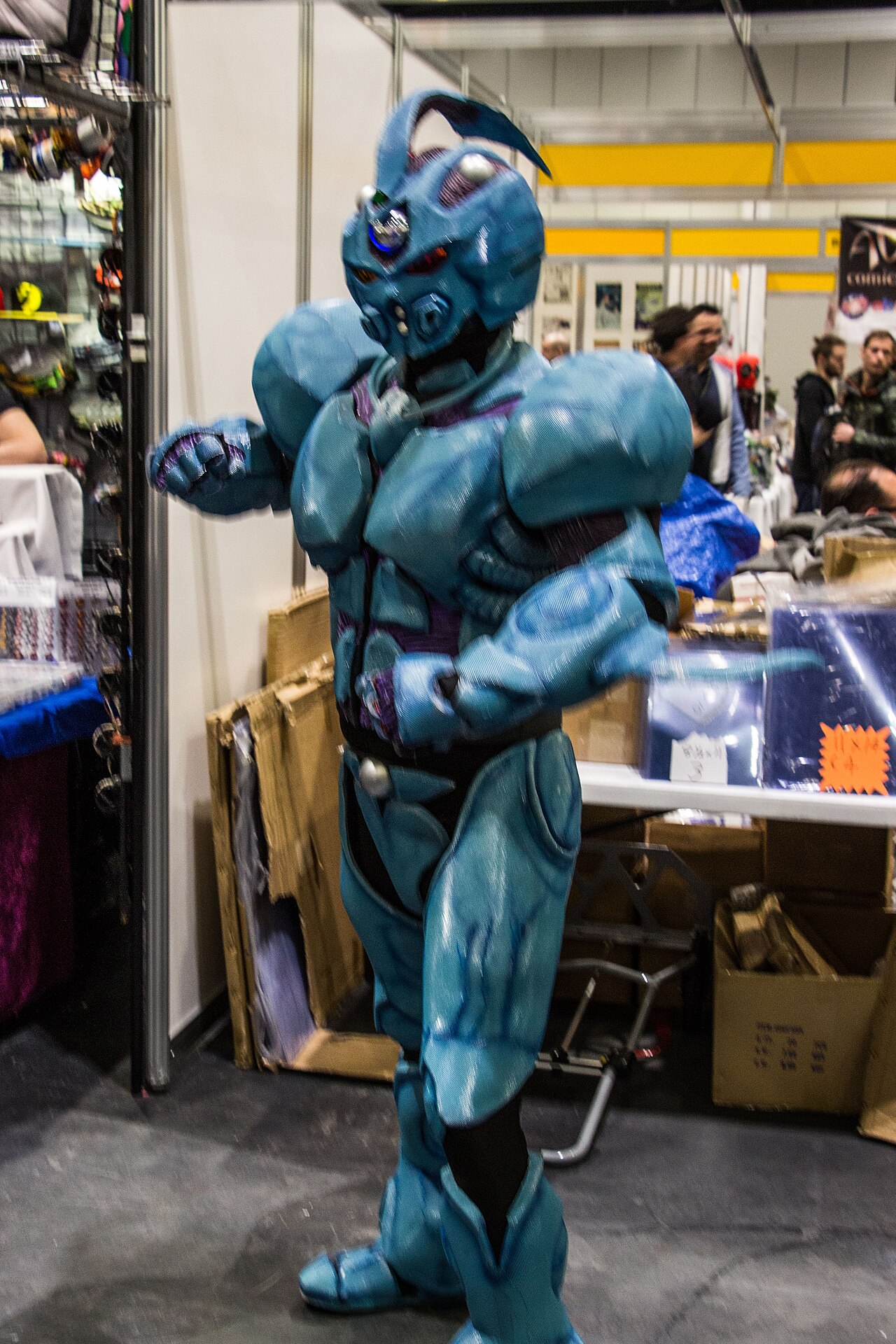
Bio Booster Armor Guyver
A symbiotic armor that bonds with its host.

Secondgardener · CC BY-SA 4.0
Bio-Booster Armor Guyver, also known simply as Guyver, is a Japanese manga series written and illustrated by Yoshiki Takaya. The series centers on a symbiotic techno-organic device called the Guyver, which enhances the capabilities of its host. First serialized in 1985 in Tokuma Shoten's Monthly Shōnen Captain, the manga continued after that magazine's discontinuation in 1997, moving to Kadokawa Shoten and later to Young Ace. The series has been adapted into multiple OVAs, anime series, live-action films, and novels.
- Creator
- Yoshiki Takaya
- First Appearance
- February 1985 in Monthly Shōnen Captain
- Genre
- Manga (science fiction, action)
- Publisher (original)
- Tokuma Shoten
- Publisher (current)
- Kadokawa Shoten
- Adaptations
- OVAs (1986, 1989–1992), live-action films (1991, 1994), anime series (2005–2006), novel (1989), light novels (1995)
Lore & Background
Shō Fukamachi, a seventeen-year-old second-year student, fights Cronos to protect his friends and family. His closest friend is Tetsurō Segawa, a highly intelligent science fiction fan, and he cares deeply for Tetsurō's sister, Mizuki Segawa. Agito Makishima, a third-year student and anti-hero, later leads a resistance organization called Zeus' Thunderbolts after Cronos takes over the world. Other characters include Shizu Onuma, who becomes the proto-zoalord Griselda; Fumio Fukamachi, Shō's father turned into a Guyver-killer Zoanoid; and Aptom, a renegade battle creature with the ability to absorb DNA and regenerate.
Reader's Guide
Bio-Booster Armor Guyver is significant as a long-running manga series that has spawned multiple media adaptations across different decades and countries. Its core concept—a biomechanical armor that bonds symbiotically with a host—has influenced later works in the science fiction and body horror genres. The series explores themes of identity, control, and resistance against a powerful global organization. The manga's move from Monthly Shōnen Captain to Kadokawa Shoten after the former's discontinuation in 1997 demonstrates its enduring popularity. The adaptations, including two American live-action films and multiple anime series, show its cross-cultural appeal. The detailed lore, including the Zoanoids, Zoalords, and the Guyver's unique weaknesses, provides a rich universe that has engaged readers and viewers for decades.
Did You Know?
- The manga was originally serialized in Monthly Shōnen Captain starting in February 1985.
- The Guyver's only weak point is the Control Metal; if critically damaged, the host is consumed by the unit.
- Aptom can regenerate from even the smallest remaining piece of his tissue and can clone himself.
- The series has been adapted into two American live-action films: The Guyver (1991) and Guyver 2: Dark Hero (1994).
From Shōnen Captain to the World
Yoshiki Takaya's Bio Booster Armor Guyver first saw print on the pages of Tokuma Shoten's Monthly Shōnen Captain, with its debut issue dated February 18, 1985. For over a decade the series occupied a steady slot in that magazine before the title was discontinued in 1997. Rather than letting the work simply vanish, Kadokawa Shoten stepped in, absorbing the entire back catalogue of previously published tankōbon volumes and giving readers a seamless way to continue following the story. The manga now finds its home in Kadokawa's Young Ace magazine, where it continues to run. The series' reach extended well beyond Japan's borders: Viz Media, Star Comics, and Chuang Yi Publishing each secured licensing rights, introducing Takaya's biomechanical saga to English-speaking and Chinese-language audiences. What began as a single high-schooler's accidental bonding with a scattered unit of alien technology thus became a multilingual, multi-decade publishing phenomenon that outlived its original home magazine by more than a quarter-century.
The Symbiotic Trap: How the Guyver Works
At its core, the Guyver is a symbiotic techno-organic device — a biomechanical organism that bonds irreversibly to a human host and dramatically amplifies their physical capabilities. In combat the armor is essentially invulnerable, yet Takaya built a brutal counterbalance into its design. A component called the Control Metal serves as the unit's single critical weak point. While that part remains intact, the Guyver can reconstruct its host from biological data it has stored, effectively rebuilding them after severe injury. But if the Control Metal suffers critical damage, the dynamic inverts: the unit devours the host from the inside, killing them. For Shō Fukamachi, this paradox is the story's emotional engine. He fights not out of a desire for justice but to shield the people he loves, and yet he can never stop wondering whether the thing fused to his body will one day consume him. Meanwhile Cronos escalates its Zoanoid deployments, making each defense of his friends a higher-stakes battle.
A Web of Loyalties: The Core Cast
The narrative's emotional architecture rests on a tight circle of high-school students at Narisawa. Shō, a slim seventeen-year-old with black hair, becomes Guyver I almost by accident and fights to protect his family and friends rather than to punish enemies. His closest confidant is Tetsurō Segawa, a large-framed, bespectacled third-year whose passion for science fiction and leadership of the school's sci-fi club give him an uncanny ability to deduce the mechanics of Zoanoids and Cronos. Tetsurō's younger sister Mizuki, a slender girl with a page-boy haircut, initially harbors a crush on Agito Makishima but gradually shifts her affections toward Shō. Agito, a muscular third-year who looks older than his peers, is the series' sharpest anti-hero: calculating, ruthless, and formerly a candidate for the Cronos Elite before becoming their declared traitor. After Cronos conquers the world, he commands the resistance cell Zeus' Thunderbolts, while Shizu Onuma — a lifelong servant of the Makishima household — sacrifices her own lifespan to become the proto-zoalord Griselda, shielding the Liberatus from Cronos' psychic domination.
From OVA to Tokusatsu: The Guyver on Screen
Takaya's manga has been adapted across an impressive range of media formats over four decades. The earliest screen adaptation was the 1986 OVA Guyver: Out of Control, a loose take on the first volume. A more substantial 12-episode OVA series followed between 1989 and 1992, covering roughly the first four volumes. The franchise then crossed into live-action territory with two American-produced tokusatsu films: The Guyver in 1991 and its sequel Guyver 2: Dark Hero in 1994. A full 26-episode television anime aired from 2005 to 2006, adapting the first ten volumes of the manga. Beyond animation and film, the story also expanded into prose: a novel appeared in 1989, and two light novels followed in 1995. Together these adaptations demonstrate how the Guyver concept — a human merged with a techno-organic war machine hunted by a corporate empire — proved flexible enough to translate into animation, practical-effects cinema, and literary fiction, each medium offering its own interpretation of Takaya's original vision.
Gallery

Frequently Asked Questions
What is Bio Booster Armor Guyver?
It is a Japanese science-fiction manga created by Yoshiki Takaya, first serialized in February 1985 in Monthly Shōnen Captain. The story revolves around the Guyver, a symbiotic techno-organic device that bonds with a human host and vastly amplifies their physical and combat abilities.
Who created Guyver and when did it debut?
Yoshiki Takaya both wrote and drew the series from its very first chapter in February 1985. He has remained the sole creative force behind the manga throughout its entire run.
What TV and film adaptations of Guyver exist?
The franchise spawned OVAs in 1986 and a longer OVA run from 1989 to 1992, plus two live-action feature films released in 1991 and 1994. An anime television series also aired from 2005 to 2006, and the property has been expanded into novels and light novels.
Which publishers have handled Guyver over the years?
The manga originally ran under Tokuma Shoten in Monthly Shōnen Captain beginning in 1985. After that magazine shut down in 1997, the series transferred to Kadokawa Shoten and subsequently to Young Ace, where it has continued.
Why is Guyver considered a landmark in the action-sci-fi genre?
Its near-continuous publication spanning almost four decades makes it one of the longest-running manga of its type. The core concept of a living, self-repairing armor that merges with a human host has become a widely imitated template in later techno-organic fiction.
More in Television series about genetic engineering 1-23
Spotted an error? Know more?
This is a living reference — every entry is fact-audited, and reader corrections feed straight into our audit queue. Suggest an edit · See this site's audit record