Phylum
A taxonomic rank below kingdom and above class.
In biology, a phylum is a taxonomic rank below kingdom and above class. The animal kingdom contains about 32 phyla, the plant kingdom about 14, and the fungus kingdom about eight. Current research in phylogenetics is uncovering relationships among phyla within larger clades such as Ecdysozoa and Embryophyta.
Quick Facts
- Coined by
- Ernst Haeckel
- Year coined
- 1866
- Etymology
- Greek phylon (race, stock)
- Botanical equivalent
- division
Facts from the source article.
General description
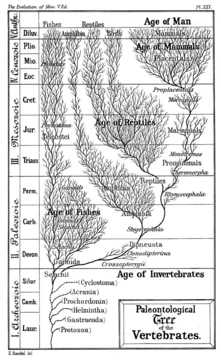
The term phylum was introduced in 1866 by Ernst Haeckel, who derived it from the Greek word phylon, meaning 'race' or 'stock', and related to phyle, meaning 'tribe' or 'clan'. Haeckel observed that species constantly evolve into new species that retain few consistent features, and he proposed that a self-contained unity could be the aggregate of all species evolving from one common original form, such as all vertebrates, which he called a Stamm or Phylon. In plant taxonomy, August W. Eichler in 1883 classified plants into five groups named divisions, a term still used for plants, algae, and fungi. The definitions of zoological phyla have evolved from the six Linnaean classes and the four embranchements of Georges Cuvier. At its most basic, a phylum can be defined in two ways: a phenetic definition based on morphological or developmental similarity, or a phylogenetic definition based on evolutionary relatedness. A phenetic definition is useful for morphological questions, but defining a Linnean level without evolutionary relatedness is unsatisfactory. The minimal requirement for a phylum is that all its organisms be clearly more closely related to one another than to any other group, though this depends on knowledge of relationships. As molecular studies provide more data, phyla may be merged or split; for example, bearded worms were originally described as the phylum Pogonophora but later found to be annelids, while the phylum Mesozoa was divided into Orthonectida and Rhombozoa when their distinct evolutionary placements were discovered.
Known phyla
Total numbers of species within phyla are estimates that vary widely among authors, partly because some figures are based on described species and others on extrapolations to undescribed species. For instance, around 25,000 to 27,000 nematode species have been described, but estimates of total nematode species range from 10,000–20,000 up to 100 million. The kingdom Plantae is defined variously by biologists; all definitions include living embryophytes, and some add the green algae divisions Chlorophyta and Charophyta to form Viridiplantae. The Cavalier-Smith system equates Plantae with Archaeplastida, which includes Viridiplantae, Rhodophyta, and Glaucophyta. Plant division classification varies; some sources place horsetails in Arthrophyta and ferns in Monilophyta, while others place both in Monilophyta. The division Pinophyta may be used for all gymnosperms or for conifers alone. Since the APG system in 1998, many sources treat ranks above orders as informal clades, reducing traditional divisions to lower levels. Phylum Microsporidia is generally included in Fungi, though its exact relations are uncertain and it is considered a protozoan by the International Society of Protistologists. Molecular analysis has found Zygomycota to be polyphyletic, leading to a proposal to abolish it and divide its members between Glomeromycota and four new subphyla incertae sedis.
More in Taxonomy & Evolution
Spotted an error? Know more?
Reader corrections go straight into our review queue. Suggest an edit · How this site is sourced