Kingdom (taxonomy)
Second highest taxonomic rank, below domain.
Last updated
Kingdom is the highest principal rank in biological classification, placed above phylum or division.[1] The term was introduced by Carl Linnaeus in 1735 for the rank-based system of nomenclature.[2] Some modern cladistic classifications have abandoned the term because traditional kingdoms are not always monophyletic.[3]
Quick Facts
- Introduced by
- Carl Linnaeus
- Year introduced
- 1735
- Rank position
- second highest, below domain
- Subdivisions
- subkingdom
- infrakingdom
- branch
- Alternative terms
- superkingdom
- empire
- domain
Facts from the source article.
Key facts and history
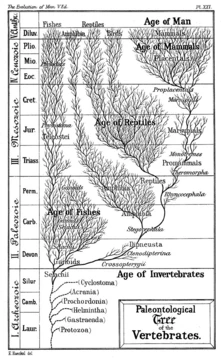
In 1860 John Hogg proposed a third kingdom, Protoctista, for "all the lower creatures".[4] Ernst Haeckel proposed the kingdom Protista in 1866 for "neutral organisms" that were neither animal nor plant.[4] Herbert F. Copeland created the kingdom Monera for prokaryotic organisms in 1938.[5] Carl Woese and colleagues proposed splitting prokaryotes into Eubacteria and Archaebacteria in 1977.[6]
In his work History of Animals, Aristotle (384–322 BC) categorized animal species, while his student Theophrastus (c. 287 BC) authored a corresponding botanical text, Historia Plantarum.[7] The terms "prokaryote" and "eukaryote" were coined by Édouard Chatton in 1937.[8] Robert Whittaker's 1969 five-kingdom classification included a distinct kingdom for Fungi.[9] Above the kingdom rank, the domain level was added in 1990.[2]
Starting in 2024, the Prokaryotic Code designates Bacteria and Archaea as domains, each containing four kingdoms, resulting in eight kingdoms total.[10] For virus classification, the ICTV employs "kingdom" as a rank that sits below realm and subrealm.[11]
What the research sources say
The declaration urges state leaders and citizens to create legal protections for fungi "to state the equal significance of fungi among the kingdoms of life".[12] The International Association for Plant Taxonomy lists kingdom as the first principal rank in the descending sequence of taxa.[1] Formal taxonomic names of kingdoms are printed in italics with the first letter capitalized.[11] The ICTV Code mandates that kingdom-level taxon names for viroids end with "-viroidae", for satellite nucleic acids with "-satellitae", and for viriforms with "-viriformae".[11]
References
- "article 3.1", International Association for Plant Taxonomy, 2006. facts only, no text reused. ibot.sav.sk
- Wikipedia, "Kingdom (taxonomy)" (CC BY-SA 4.0), which cites: Linnaeus, C., "Systemae Naturae, sive regna tria naturae, systematics proposita per classes, ordines, genera & species", 1735; "article 3.1", International Association for Plant Taxonomy, 2006 (we also read that source) en.wikipedia.org
- Wikipedia, "Kingdom (taxonomy)" (CC BY-SA 4.0), which cites: "IUCN SSC acceptance of Fauna Flora Funga", Fungal Conservation Committee, IUCN SSC, 2021; "Re:wild and IUCN SSC become first global organizations to call for the recognition of fungi as one of three kingdoms of life critical to protecting and restoring Earth", International Union for Conservation of Nature (I (we also read that source) en.wikipedia.org
- Wikipedia, "Kingdom (taxonomy)" (CC BY-SA 4.0), which cites: Scamardella, "Not plants or animals: a brief history of the origin of Kingdoms Protozoa, Protista and Protoctista", International Microbiology, 1999, p. 207–16; Scamardella, "Not plants or animals: a brief history of the origin of Kingdoms Protozoa, Protista and Protoctista", International Microbiology, 1999, p. 207–16; Scamardella, "Not plants or animals: a brief history of the origin of Kingdoms Protozoa, Protista and Protoctista", International Microbiology, 1999, p. 207–16 (original not read by us) en.wikipedia.org
- Wikipedia, "Kingdom (taxonomy)" (CC BY-SA 4.0), which cites: Scamardella, "Not plants or animals: a brief history of the origin of Kingdoms Protozoa, Protista and Protoctista", International Microbiology, 1999, p. 207–16; Sapp, "The Prokaryote-Eukaryote Dichotomy: Meanings and Mythology", Microbiology and Molecular Biology Reviews, 2005, p. 292–305 (original not read by us) en.wikipedia.org
- Wikipedia, "Kingdom (taxonomy)" (CC BY-SA 4.0), which cites: Balch, "An ancient divergence among the bacteria", Journal of Molecular Evolution, August 1977, p. 305–311; "The Six Kingdoms", www.ric.edu; Case, "Teaching Taxonomy: How Many Kingdoms?", American Biology Teacher, 2008-10-01, p. 472–477; Ruggiero, "A Higher Level Classification of All Living Organisms", PLOS ONE, April 29, 2015 (original not read by us) en.wikipedia.org
- Wikipedia, "Kingdom (taxonomy)" (CC BY-SA 4.0), which cites: Singer, "A Short History of Biology, a General Introduction to the Study of Living Things", Clarendon Press, 1931 (original not read by us) en.wikipedia.org
- Wikipedia, "Kingdom (taxonomy)" (CC BY-SA 4.0), which cites: Sapp, "The Prokaryote-Eukaryote Dichotomy: Meanings and Mythology", Microbiology and Molecular Biology Reviews, 2005, p. 292–305 (original not read by us) en.wikipedia.org
- Wikipedia, "Kingdom (taxonomy)" (CC BY-SA 4.0), which cites: Whittaker, "New concepts of kingdoms or organisms. Evolutionary relations are better represented by new classifications than by the traditional two kingdoms", Science, January 1969, p. 150–60 (original not read by us) en.wikipedia.org
- Wikipedia, "Kingdom (taxonomy)" (CC BY-SA 4.0), which cites: Göker, "Valid publication of names of two domains and seven kingdoms of prokaryotes", International Journal of Systematic and Evolutionary Microbiology, 22 January 2024 (original not read by us) en.wikipedia.org
- "ICTV Code", talk.ictvonline.org. facts only, no text reused. ictv.global
- "Re:wild and IUCN SSC become first global organizations to call for the recognition of fungi as one of three kingdoms of life critical to protecting and restoring Earth", International Union for Conservation of Nature (I. facts only, no text reused. iucn.org
Each numbered sentence above was checked against the source it cites before publication. Sentences citing Wikipedia adapt text from the English Wikipedia article Kingdom (taxonomy) (contributors), used under CC BY-SA 4.0; this entry is available under the same licence. Other sources were used for facts only; no text or images are copied from them.
More in Taxonomy & Evolution
Sources
Compiled from Wikipedia and the sources listed below. Text from Wikipedia is available under CC BY-SA 4.0; this entry is adapted from it.
- Wikipedia: Kingdom (taxonomy) (CC BY-SA 4.0).
- Word definitions: the , each quoted from its Wikipedia article.
Spotted an error? Know more?
Reader corrections go straight into our review queue. Suggest an edit · How this site is sourced