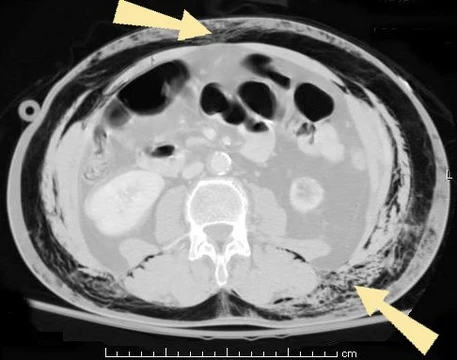
Elephantiasis
Enlargement and hardening of body parts due to lymphatic obstruction.

Elephantiasis, sometimes mistakenly called elephantitis, involves the abnormal enlargement and stiffening of limbs or other body areas due to fluid retention. This swelling, known as edema, results from blocked lymphatic vessels, leading to thickened, fibrous skin and underlying tissues. The condition can also affect the genitals. While the term commonly describes symptoms from parasitic worm infections, it actually covers several diseases that cause body parts to swell to extremely large sizes.
Various conditions can lead to elephantiasis. One type, elephantiasis nostras, stems from long-term chronic lymphangitis. Another, elephantiasis tropica (or lymphatic filariasis), is caused by parasitic roundworms, most often *Wuchereria bancrofti*. Nonfilarial elephantiasis, also called podoconiosis, is an immune disorder affecting lymph vessels. Leishmaniasis can also be a cause. In breast cancer patients, grade 3 lymphedema may appear as elephantiasis. Genital elephantiasis can result from lymphogranuloma venereum. Proteus syndrome—a genetic disorder famously linked to Joseph Merrick, the so-called Elephant Man—is another cause. Additional triggers include repeated streptococcal infections, lymph node removal, hereditary birth defects, and pretibial myxedema. Other diseases, like the rare Klippel–Trénaunay syndrome, may initially be mistaken for elephantiasis. It has been suggested that the skin condition described in the biblical figure Job may have been elephantiasis.
Quick Facts
- Field
- Infectious disease, general surgery
- Symptoms
- Swelling of the skin
Facts from the source article.
Lore & Background
Elephantiasis is characterized by edema, hypertrophy, and fibrosis of skin and subcutaneous tissues resulting from obstruction of lymphatic vessels. The condition may affect the genitalia. While often associated with parasitic worm infections, the term can refer to a variety of diseases that cause massive swelling. Causes include elephantiasis nostras from chronic lymphangitis; elephantiasis tropica (lymphatic filariasis) caused by nematode worms such as Wuchereria bancrofti; nonfilarial elephantiasis (podoconiosis), an immune disease; leishmaniasis; grade 3 lymphedema in breast cancer patients; genital elephantiasis from lymphogranuloma venereum; and Proteus syndrome, a genetic disorder possibly experienced by Joseph Merrick, the so-called Elephant Man. Other causes include repeated streptococcal infection, lymphadenectomy, hereditary birth defects, and pretibial myxedema. Diseases such as Klippel–Trénaunay syndrome can initially be misdiagnosed as elephantiasis. The condition may have been the skin condition suffered by the Biblical character Job.
Reader's Guide
Elephantiasis represents a significant medical condition due to its disfiguring effects and varied causes. The article notes that more than 120 million people, mostly in Africa and Southeast Asia, are affected by elephantiasis tropica (lymphatic filariasis), highlighting its global health impact. The condition's association with parasitic worms, particularly Wuchereria bancrofti, underscores its prevalence in tropical regions. However, the term also encompasses non-infectious causes such as Proteus syndrome, which gained notoriety through Joseph Merrick, the so-called Elephant Man. The article emphasizes that elephantiasis may result from multiple underlying diseases, including immune disorders, cancer-related lymphedema, and genetic conditions. Its legacy includes historical references, such as the possible affliction of the Biblical character Job, and ongoing diagnostic challenges, as conditions like Klippel–Trénaunay syndrome can be initially misdiagnosed as elephantiasis. The condition's diverse etiology requires careful clinical evaluation to distinguish between filarial and nonfilarial forms.
Clinical Definition and Presentation
Elephantiasis, frequently and incorrectly referred to as elephantitis, describes a condition in which limbs or other body parts undergo dramatic enlargement and hardening. At its core, the disorder involves the progressive swelling of tissues, a process medically termed edema. The hallmark features include edema, hypertrophy, and fibrosis affecting both the skin and the subcutaneous layers beneath it. These changes arise when lymphatic vessels become obstructed, a condition known as lymphedema, which prevents normal fluid drainage and causes tissues to thicken and stiffen over time. The condition is not limited to the extremities; it may also involve the genitalia. While the term is most commonly associated with symptoms produced by parasitic worm infections, it actually encompasses a wide range of diseases capable of swelling a person's body parts to exceptionally massive proportions. In essence, elephantiasis is less a single disease than a descriptive label for a constellation of conditions sharing one striking physical outcome.
Parasitic Origins and Global Burden
The most widely recognized form of elephantiasis, known as elephantiasis tropica or lymphatic filariasis, is driven by parasitic nematode worms. Among these, Wuchereria bancrofti stands out as the principal culprit. The scale of this parasitic affliction is staggering: more than 120 million people worldwide carry the condition, with the heaviest concentration of cases found across Africa and Southeast Asia. The World Health Organization has long tracked lymphatic filariasis as a major public health concern. In the body, these microscopic worms obstruct the lymphatic vessels, and over time the resulting blockage triggers the cascade of edema, tissue thickening, and fibrosis that gives the condition its dramatic physical appearance. The name tropica itself signals the geographic pattern of the disease, which is overwhelmingly concentrated in specific regions rather than distributed evenly across the globe. This parasitic form remains the most commonly cited cause when the term elephantiasis enters medical and public discourse, even though the label itself extends far beyond filarial infection to encompass a wide variety of swelling disorders affecting the body.
A Spectrum of Non-Parasitic Causes
Far from being exclusively a worm-borne illness, elephantiasis can emerge from a remarkably diverse set of underlying conditions. Elephantiasis nostras, for instance, develops as a consequence of longstanding chronic lymphangitis, in which persistent inflammation of the lymph channels gradually impairs drainage. Podoconiosis, sometimes called nonfilarial elephantiasis, is an immune-mediated disease that damages lymph vessels without any parasitic involvement. Leishmaniasis, a separate infectious disease, can also produce the characteristic swelling. In oncology, Grade 3 lymphedema, a severe complication that may arise in patients undergoing treatment for breast cancer, presents with the same dramatic tissue changes. Genital elephantiasis has been linked to lymphogranuloma venereum. Repeated streptococcal infections, surgical removal of lymph nodes, hereditary birth defects, and pretibial myxedema all figure among the recognized triggers. Proteus syndrome, a rare genetic disorder, produces asymmetric overgrowth that can mimic the condition. Even Klippel-Trénaunay syndrome, a vascular malformation, is sometimes initially misdiagnosed as elephantiasis before the true nature of the disease becomes clear.
Cultural Memory and Historical Resonance
Elephantiasis has left a deep imprint on cultural and medical memory that extends well beyond the clinic. The most famous association in popular imagination is Joseph Merrick, the Victorian-era figure known as the Elephant Man, whose condition has been linked to Proteus syndrome, a genetic disorder that causes asymmetric overgrowth of body parts. The sheer visual impact of his deformity made him an enduring symbol of both medical mystery and human dignity. In religious and literary tradition, some have speculated that the skin affliction endured by the Biblical character Job may have been a form of elephantiasis, lending the condition an ancient, almost mythic dimension. The term itself has a long pedigree in medical literature, appearing as early as the 1878 edition of the Encyclopædia Britannica, where it was catalogued alongside other tropical and parasitic diseases. The persistent misnaming of the condition as elephantitis in everyday language underscores how the visual spectacle of the disease has shaped public perception more than precise medical terminology. Together, these cultural threads show that elephantiasis has always been as much a story told about the human body as a clinical diagnosis.
Frequently Asked Questions
Who is Elephantiasis?
Elephantiasis is a condition marked by the abnormal swelling and hardening of body parts—most often the limbs or genitals—triggered by fluid pooling when lymphatic channels become obstructed. It is sometimes mislabeled as 'elephantitis,' though that is not the correct medical term.
What are Elephantiasis's powers/role?
Its signature 'power' is progressive enlargement: blocked lymph vessels cause fluid to accumulate, and over time the skin and deeper tissues thicken into dense, fibrous, rigid structures. It can strike any region where lymph drainage is compromised, not just the legs.
Why is Elephantiasis important?
More than 120 million people worldwide—predominantly in sub-Saharan Africa and Southeast Asia—live with this condition, making it one of the most widespread causes of chronic disability in those regions. In its most common parasitic form, the responsible agent is the nematode Wuchereria bancrofti, spread by mosquito bites.
What's Elephantiasis's origin story?
The condition can arise from several distinct causes: parasitic worm infection (the classic 'tropica' form), chronic non-parasitic lymphatic blockage known as elephantiasis nostras, or other diseases that impede lymph flow. Despite the different root causes, they all converge on the same end result—progressive edema and tissue fibrosis.
More in Symptoms and Signs: Skin and Subcutaneous Tissue 1-16
Spotted an error? Know more?
Reader corrections go straight into our review queue. Suggest an edit · How this site is sourced