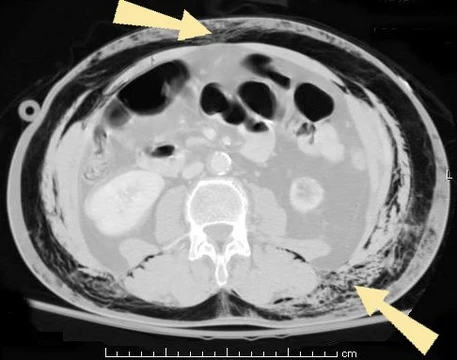
Anasarca
Severe generalized edema indicating underlying disease.

Anasarca is a severe, whole-body form of edema where the subcutaneous tissues swell from head to foot. While ordinary edema is common, often mild, and usually limited to one or two areas, anasarca is a sign of serious disease and can also fill the body's cavities.
**Signs and symptoms**
The physical appearance includes puffiness around the eyes and mouth, swelling in the upper and lower limbs, and fluid in the abdomen (ascites). The shins and feet are also commonly swollen. These changes can lead to trouble opening the eyes or blurred vision, shortness of breath (especially when lying down or exerting), chest pain, and extreme discomfort or debilitation.
**Cause**
Anasarca typically results from a drop in oncotic pressure. Common underlying causes include organ failure (liver, kidney, or right-sided heart failure), malignancy, severe protein deficiency, and systemic conditions such as nephrotic syndrome, protein-losing enteropathies, and capillary leak syndrome. In utero, it can occur in Hb Barts disease because the blood's high oxygen affinity starves tissues of oxygen. It can also be caused by giving too much intravenous fluid.
**Diagnosis**
Anasarca is diagnosed clinically by its extent and severity. Unlike milder edema, which affects one or two body regions, anasarca involves multiple areas and is the most severe form, with swelling from head to feet. No single test confirms it, but a low albumin level is often present. A 2001 study linked anasarca to low-voltage ECG readings (QRS complexes under 5 mm in limb leads and under 10 mm in precordial leads).
**Treatment**
Since anasarca is a symptom of an underlying condition, the best approach is to treat that cause. However, several measures can help remove fluid and prevent further buildup. Diuretics (loop, thiazide, thiazide-like, and potassium-sparing) are a mainstay of treatment. Dietary changes also help: reducing salt and simple sugars limits fluid retention and boosts diuretic effectiveness, while a high-protein diet provides the building blocks for albumin, which maintains oncotic pressure. Bulking fiber (both soluble and insoluble) absorbs water in the gut and slows sugar absorption.
Quick Facts
- Field
- Internal medicine
Facts from the source article.
Lore & Background
Anasarca is diagnosed clinically and differentiated from edema by extent of body involvement and severity. Whereas edema is usually graded on a mild/moderate/severe scale and affects one or two regions, anasarca affects several regions of the body. Physical appearance can include periorbital edema, perioral edema, upper extremity edema, ascites, lower extremity edema, pre-tibial edema, and pedal edema. Physical manifestations may include impaired vision, difficulty opening eyes, shortness of breath, dyspnea on exertion, orthopnea, chest pain, extreme discomfort, and debilitation.
Reader's Guide
Anasarca is often caused by decreased oncotic pressure, and can result from organ failure (liver, kidney, right-sided heart failure), malignancy, severe protein deficiency, nephrotic syndrome, protein-losing enteropathies, capillary leak syndrome, or in utero conditions such as Hb Barts. It can also be iatrogenic from administration of exogenous intravenous fluid. Although there is no definitive test, anasarca is most often seen with low albumin levels. A research paper demonstrated a linkage between low-voltage ECG and anasarca. Treatment focuses on addressing the underlying cause, with diuretics (loop, thiazide, thiazide-like, potassium-sparing) as a mainstay. Dietary measures include decreasing salt and simple sugar intake, following a high protein diet, and using bulking fiber to absorb water and slow absorption of simple sugars.
Did You Know?
- Anasarca is a pathological process reflecting a severe disease state, unlike typical benign edema.
- It can involve body cavities in addition to subcutaneous tissues.
- A low-voltage ECG (QRS <5 mm in limb leads, <10 mm in precordial leads) has been linked to anasarca.
- Anasarca can occur in utero in Hb Barts due to poor oxygen delivery to peripheral tissues.
Defining the Condition: Beyond Ordinary Swelling
Anasarca represents the most extreme end of the edema spectrum—a severe, generalized swelling of subcutaneous tissues that extends across the entire body rather than being confined to one or two areas. While mild edema is a common, often harmless experience that nearly everyone encounters at some point, anasarca is fundamentally different in nature. It is not a benign fluctuation but a pathological signal indicating that a serious underlying disease process is at work. The condition can extend beyond soft tissues to involve the body's internal cavities as well, making it a whole-body phenomenon. Clinically, anasarca is distinguished from ordinary edema by both its severity and its geographic reach. Where typical edema is graded on a mild-to-severe scale and tends to localize in the legs or hands, anasarca presents as a head-to-toe involvement of subcutaneous tissue, marking it as the most severe manifestation of fluid accumulation in the body.
The Patient's Experience: A Whole-Body Burden
The physical toll of anasarca is both visible and deeply felt. Patients present with a constellation of swelling patterns: puffiness around the eyes and mouth, distension of the upper arms and hands, fluid pooling in the lower legs, shins, and feet, and the accumulation of free fluid in the abdominal cavity known as ascites. Beyond the visible distension, the condition imposes severe functional limitations. The periorbital swelling can impair vision and make it difficult to open the eyes at all. Respiratory compromise is a hallmark—patients report shortness of breath, worsening dyspnea with even minimal exertion, and the inability to breathe comfortably while lying flat (orthopnea). Chest pain and a pervasive sense of extreme discomfort compound the picture, while the overall effect is profound debilitation. The combination of restricted mobility, compromised breathing, visual impairment, and constant physical distress makes anasarca not merely a cosmetic concern but a profoundly disabling state that affects nearly every major system simultaneously.
Root Causes: When the Body's Fluid Balance Collapses
At its core, anasarca most often stems from a drop in oncotic pressure—the osmotic force that normally keeps fluid within blood vessels. When that pressure falls, fluid leaks into surrounding tissues and cavities. The triggers for this collapse are varied and serious. Organ failure stands at the top of the list: liver failure, kidney failure, and right-sided heart failure each disrupt the body's ability to manage fluid and protein balance. Malignancy can similarly drive the process forward. Nutritional causes matter too—severe protein deficiency deprives the body of the raw materials needed to maintain plasma protein levels. Systemic conditions such as nephrotic syndrome, protein-losing enteropathies, and capillary leak syndrome create analogous pathways of fluid loss. In rare prenatal cases, hemoglobin Barts produces a high oxygen affinity that impairs oxygen delivery to peripheral tissues, triggering anasarca in the developing fetus. Even medical intervention can be a culprit, as the administration of exogenous intravenous fluid has been identified as an iatrogenic cause.
Diagnosis and the Path to Relief
Because anasarca is a clinical diagnosis—identified by the extent and severity of body involvement rather than a single confirmatory lab test—physicians rely on a combination of physical examination and supportive investigations. Low serum albumin is a frequently observed finding, and a 2001 research paper demonstrated a notable association between anasarca and low-voltage ECG patterns, specifically QRS complexes measuring under 5 mm in limb leads and under 10 mm in precordial leads. Treatment philosophy centers on addressing the root cause, since anasarca is a severe symptom rather than a standalone disease. Diuretics form a cornerstone of fluid management, with loop diuretics, thiazides, thiazide-like agents, and potassium-sparing diuretics all playing roles in helping the kidneys excrete excess fluid. Dietary modification is equally important: reducing sodium and simple sugar intake limits the body's tendency to retain fluid, while a high-protein diet supplies the substrates needed to synthesize albumin and restore oncotic pressure. Bulking fibers, both soluble and insoluble, can further assist by absorbing water in the gut and slowing the absorption of simple sugars.
Frequently Asked Questions
What exactly is Anasarca in the skin and subcutaneous tissue category?
Anasarca is the most severe form of edema, characterized by generalized subcutaneous tissue swelling that extends from the head all the way down to the feet. Unlike milder, localized edema, it represents whole-body fluid accumulation that signals a serious underlying condition.
How does Anasarca differ from ordinary edema?
While typical edema tends to be mild and confined to one or two areas, anasarca involves the entire body's subcutaneous tissues and can also fill internal body cavities with fluid. It sits at the extreme end of the edema spectrum in terms of severity and extent.
What are the visible signs of Anasarca?
Patients display puffiness around the eyes and mouth, swelling in both upper and lower limbs, and fluid accumulation in the abdomen (ascites). The shins and feet are commonly affected as well, and the facial swelling can make it difficult to open the eyes or cause blurred vision.
What lab and ECG findings are associated with Anasarca?
A hallmark laboratory finding is a low serum albumin level, which contributes to fluid leaking into the tissues. On ECG, anasarca is linked to low-voltage QRS complexes—measuring under 5 mm in limb leads and below 10 mm in precordial leads.
Why is Anasarca considered a red-flag sign rather than a standalone diagnosis?
Anasarca is not a disease in itself but a severe generalized edema that points to an underlying systemic illness. Its presence, especially when fluid also collects in body cavities, indicates that a significant pathological process is driving the retention.
More in Symptoms and Signs: Skin and Subcutaneous Tissue 1-16
Spotted an error? Know more?
Reader corrections go straight into our review queue. Suggest an edit · How this site is sourced