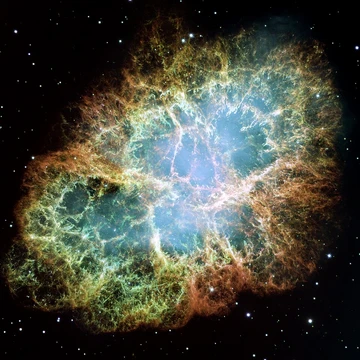
Simeis 147
A faint supernova remnant discovered in 1952 using a Schmidt camera.
Simeis 147—also cataloged as the Spaghetti Nebula, SNR G180.0-01.7, or Sharpless 2-240—is a supernova remnant located in the Milky Way, lying across the boundary between the constellations Auriga and Taurus. It was first identified in 1952 by Grigory Shajn and his team at the Crimean Astrophysical Observatory, using a Schmidt camera paired with a narrowband filter tuned near the Hydrogen Alpha emission line. The discovery came during a survey conducted between 1945 and 1955, likely employing captured German equipment, as the observatory had been largely destroyed during World War II. The Schmidt camera provided a field of view of 175 arcminutes, and this method revealed many previously unknown hydrogen nebulae that do not show up clearly in standard photographs. The object is challenging to see because its surface brightness is extremely low.
The nebula takes the form of a nearly spherical shell with a filamentary structure. Its apparent diameter measures about 3 degrees, and at an estimated distance, it spans roughly 160 light-years. The remnant is thought to be approximately 40,000 years old. A rapidly spinning neutron star, the pulsar PSR J0538+2817, is believed to reside in the nebula’s core, emitting a strong radio signal.
Quick Facts
- Snrtype
- Mixed-morphology
- Host
- Milky way
- Constellation
- Taurus
- Discovery
- 1952
- Distance
- 3000 ly
Facts from the source article.
Lore & Background
The remnant was discovered in 1952 at the Crimean Astrophysical Observatory by Grigory Shajn and his team using a Schmidt camera with a field of view of 175', equipped with a narrowband filter close to the Hydrogen Alpha transmission line. This discovery was part of a survey conducted between 1945 and 1955, most likely using captured German equipment, as the observatory was practically destroyed during World War II. Many previously unknown hydrogen nebulae were discovered this way, as they are not readily visible in regular photographs.
The nebulous area has an almost spherical shell and a filamentary structure. It is believed that the stellar explosion left behind a rapidly spinning neutron star known as pulsar PSR J0538+2817 in the nebula core, emitting a strong radio signal.
Reader's Guide
Simeis 147 holds significance as a supernova remnant discovered during a post-war survey that utilized captured German equipment at the Crimean Astrophysical Observatory. Its extremely low surface brightness made it a challenging target, and its detection via a narrowband Hydrogen Alpha filter demonstrated a technique for revealing faint hydrogen nebulae invisible in standard photographs. The remnant's large angular size of about 3 degrees and its estimated age of approximately 40,000 years place it among the older known supernova remnants. The presence of the pulsar PSR J0538+2817 within its core provides a link between the original stellar explosion and a rapidly spinning neutron star, contributing to the understanding of neutron star formation and the evolution of supernova remnants. Its legacy includes being a subject of astronomical imagery, with references in amateur astronomy literature and multiple Astronomy Picture of the Day features.
More in Supernova Remnants
Spotted an error? Know more?
Reader corrections go straight into our review queue. Suggest an edit · How this site is sourced