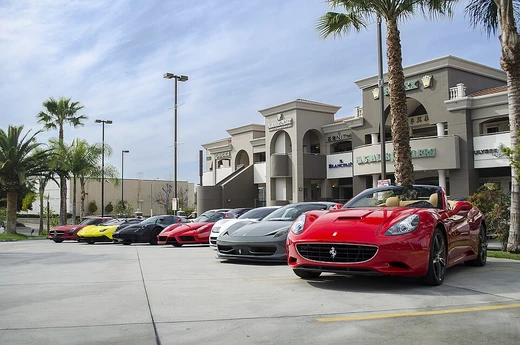
LaFerrari
Ferrari's first mild hybrid and definitive flagship sports car.

Calreyn88 · CC BY-SA 4.0
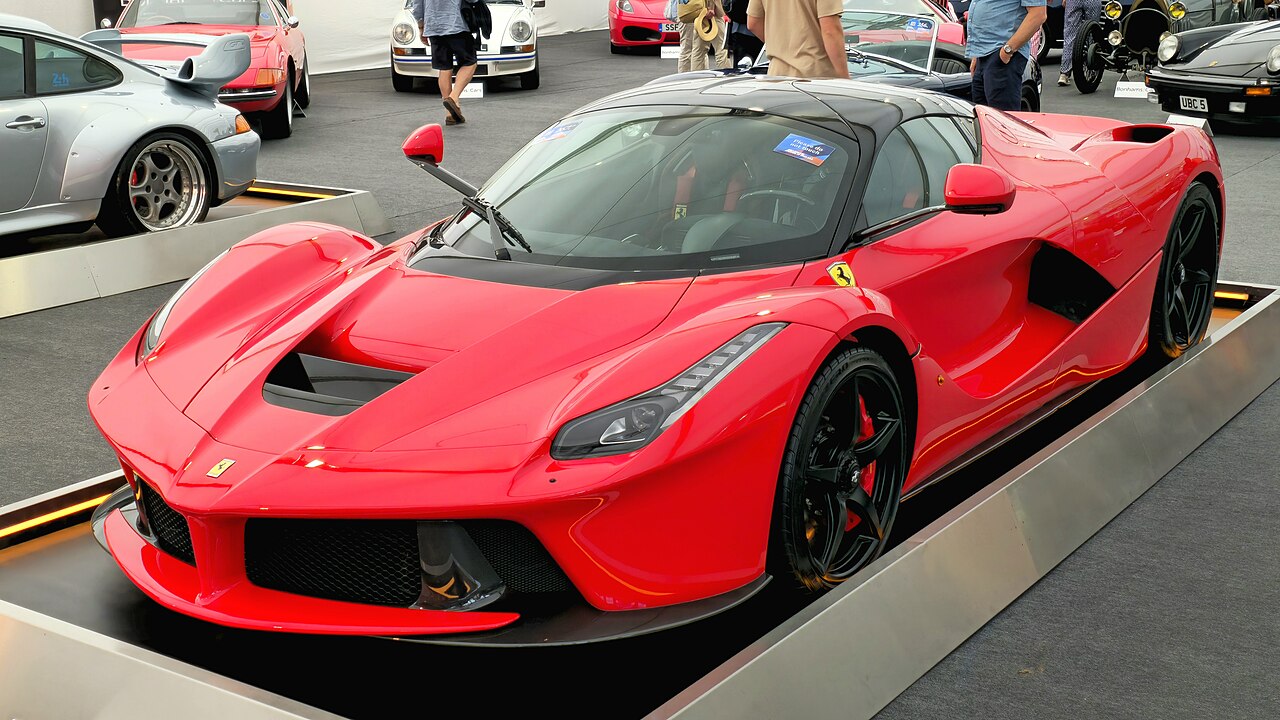
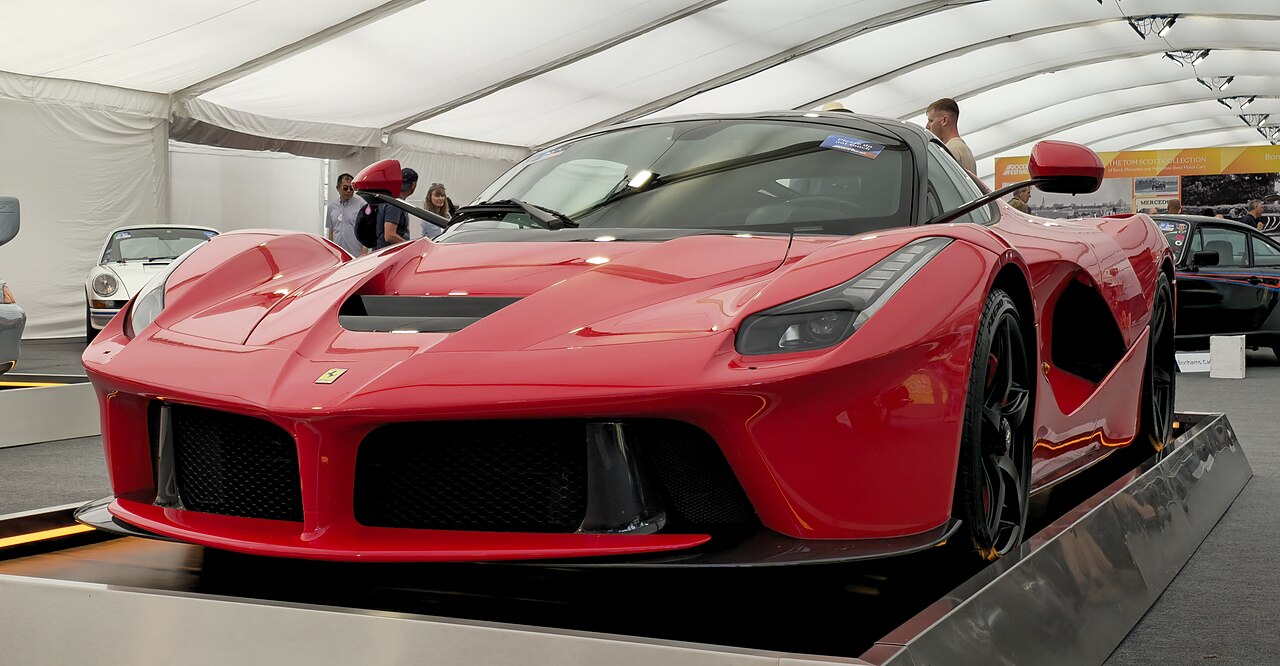
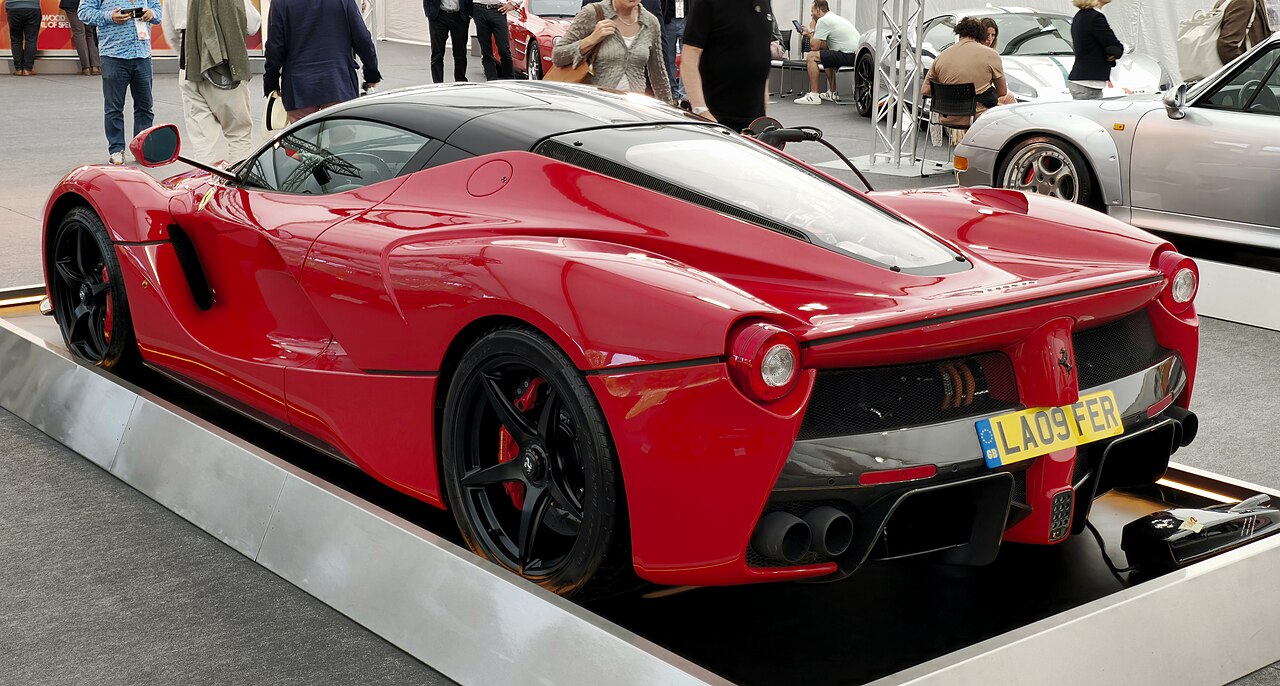
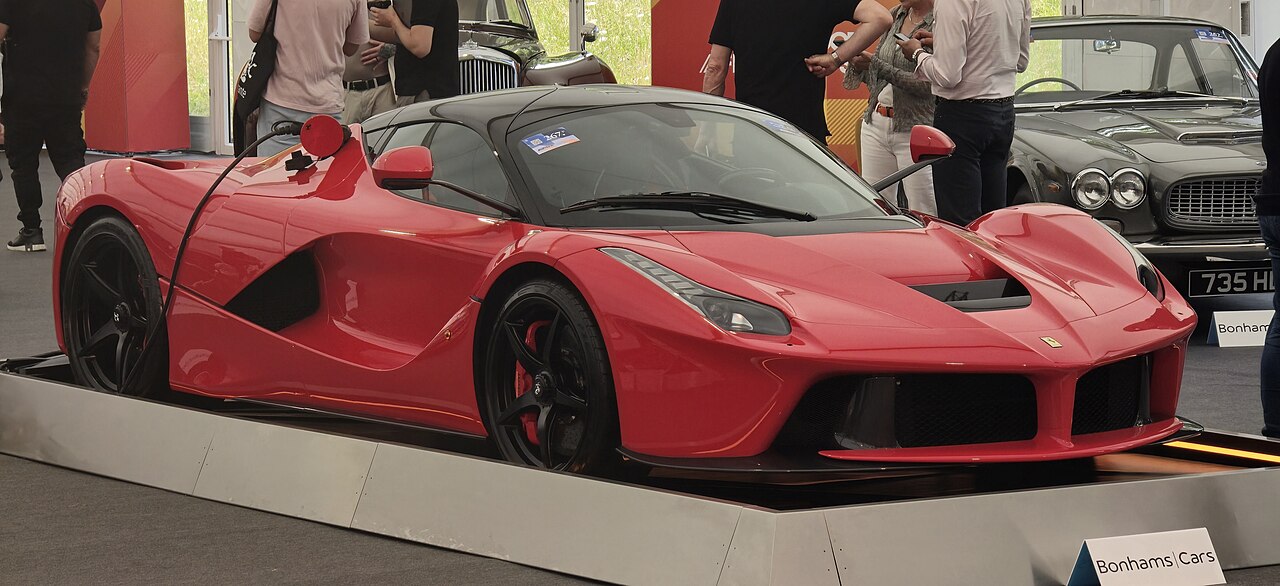
The LaFerrari, internally known as the F150, is a mid-engine, mild hybrid sports car from Ferrari. Its Italian name translates to "The Ferrari," reflecting its purpose as the brand's ultimate model. It was Ferrari's first full hybrid, achieving the highest power output of any road-going Ferrari while cutting fuel consumption by 40 percent.
Design and development began in 2011 with nine conceptual studies, later narrowed to five—three from Ferrari Centro Stile and two from Pininfarina. Two full-scale concepts were built: the LaFerrari Concept Manta (Model 2) and the LaFerrari Concept Tensostruttura (Model 3), shown at the Ferrari Museum in Maranello and Ferrari World in Abu Dhabi. The final production design closely follows the Manta concept. Subsequent Ferrari Centro Stile models, like the SF90 Stradale, borrow design cues from the Tensostruttura concept.
The standard LaFerrari (2013–2016) drew from the FXX development prototype and research from the University of Modena's Millechili Project, which initially suggested a weight under 1,000 kg, though dry weight was claimed at around 1,255 kg. Only 499 units were built, each costing over 1 million Euros. It debuted at the 2013 Geneva Auto Show, followed by other events in Shanghai, Japan, and Italy.
The LaFerrari Aperta (2016–2018) is the open-top variant. Initially, 200 cars were sold, with nine reserved for Ferrari's 70th anniversary celebrations and one later auctioned. It features a removable carbon-fiber hardtop and canvas soft top, plus revised control electronics, re-angled radiators, a longer front air dam, L-shaped flaps on the windshield pillars, altered door angles, and new wheel arches. It was unveiled at the 2016 Paris Motor Show. All 200 units were pre-sold by invitation.
The FXX-K (2015–2017) is a research and development vehicle based on the LaFerrari, not intended for competition. Its "K" denotes the kinetic energy recovery system (KERS). It produces 1,050 PS (772 kW; 1,036 hp) total—860 PS from the V12 and 190 PS from the electric motor—with over 900 N⋅m of torque. Dry weight is 1,165 kg, and downforce reaches 540 kg at 200 km/h. It has four driving modes: Qualify, Long Run, Fast Charge, and Manual Boost. Technology includes an E-Diff, F1-Trac traction control, and racing ABS, controlled via a Manettino. Like earlier XX cars, it is part of Ferrari's Client Test Driver program. The front features a large splitter and twin-profile spoiler; the rear has a higher tail with an electronically operated spoiler, tail fin, and small wing. Top speed is 350 km/h. Forty units were built, unveiled at the Yas Marina Circuit in late 2014.
The FXX-K Evo (2017–2019) is an aerodynamic package for the FXX-K, unveiled at Ferrari's Finali Mondiali 2017 in Florence during the 70th anniversary. It produces 23% more downforce than the standard FXX-K and 75% more than the road-legal LaFerrari, thanks to a modified front fascia, large rear wing, and underbody diffusers. Weight is estimated to decrease by 90 kg. On 29 August 2018, unit number 54 was shown at the Formula 1 Milan Festival with former driver Giancarlo Fisichella.
The LaFerrari's internal combustion engine is a longitudinally rear-mounted 6.3-liter V12 (F140) producing 800 PS at 9,000 rpm and 700 N⋅m of torque at 6,750 rpm. A 163 PS HY-KERS unit adds short power bursts, bringing total output to 963 PS.
Quick Facts
- Manufacturer
- Ferrari
- Model Code
- F150
- Production
- 2013–2018
- Model Years
- 2013–2016 (coupé) / 2016–2018 (Aperta)
- Assembly
- Italy: Maranello
- Designer
- Ferrari Styling Centre under Flavio Manzoni
- Class
- Sports car (S)
- Layout
- Rear mid-engine, rear-wheel-drive
- Related
- Ferrari FXX-K / Ferrari Daytona SP3
- Engine
- 6.3 L F140 FE V12
- Motor
- 1 electric motor and KERS
- Transmission
- 7-speed dual-clutch automatic
Facts from the source article.
Lore & Background
Two full-size concepts were built: LaFerrari Concept Manta and LaFerrari Concept Tensostruttura, unveiled at the Ferrari Museum in Maranello, Italy and Ferrari World in Abu Dhabi. The final design is similar to the Manta concept. The car's design was developed in collaboration with Pininfarina. The car uses a carbon fibre monocoque designed by Ferrari's F1 technical director Rory Byrne, with active aerodynamics controlled by numerous onboard computers.
Reader's Guide
The LaFerrari represents a pivotal moment in Ferrari's history as its first full hybrid production car, setting new benchmarks for power and efficiency. Its development drew from the Millechili Project at the University of Modena and testing of the FXX prototype, though initial speculation of a sub-1,000 kg weight proved inaccurate. The car's design broke a long-standing collaboration with Pininfarina, with Ferrari's in-house Centro Stile taking full responsibility—a shift that continued in subsequent models like the SF90 Stradale. Its significance extends beyond the road car: the FXX-K and FXX-K Evo variants served as testbeds for Ferrari's racing technology, including advanced KERS systems and aerodynamic packages. However, the originally announced 0–300 km/h time of 15 seconds was later debunked by multiple sources, with a verified time of 21.99 seconds. The car's limited production and high cost made it an instant collector's item, and its hybrid architecture foreshadowed Ferrari's broader electrification strategy.
Did You Know?
- The LaFerrari's name means 'The Ferrari' in Italian, intended to be the definitive Ferrari.
- The car's design was developed in collaboration with Pininfarina.
The Design Journey: From Nine Studies to One Icon
LaFerrari's visual identity was not born overnight. By April of that year, the field had been narrowed to five proposals—three developed by Ferrari's in-house Centro Stile studio and two by the legendary Pininfarina. Both were displayed publicly at the Ferrari Museum in Maranello and at Ferrari World in Abu Dhabi. The production car that eventually reached showrooms in 2013 drew its closest visual cues from the Manta concept. Yet the Tensostruttura's design language did not vanish; years later, elements reminiscent of its sculptural approach reappeared on subsequent Centro Stile creations such as the SF90 Stradale, proving that both concepts left a lasting fingerprint on Ferrari's evolving design vocabulary.
Engineering the Definitive Hybrid
Under the project code F150, Ferrari set out to build what it called the definitive Ferrari—a mid-engine, mild hybrid combining the emotional roar of a naturally aspirated V12 with the instant torque of an electric motor. Paired with a seven-speed dual-clutch gearbox, the powertrain made LaFerrari the first full hybrid in Ferrari's road-car lineup while simultaneously cutting fuel consumption by 40 percent.
From Open Top to Track Weapon: The Variant Family
LaFerrari's lineage extended well beyond the closed coupe. The Aperta, unveiled at the 2016 Paris Motor Show, offered a roofless interpretation with both a removable carbon-fiber hardtop and a canvas soft top. Its aerodynamic package was reworked specifically for the open configuration: radiators were re-angled to channel airflow along the underbody, a longer front air dam added downforce, and L-shaped flaps on the windscreen pillars mitigated cabin compression. Ferrari confirmed all 200 units were pre-sold by invitation, with nine additional cars reserved for the 70th Anniversary and one more later sold at auction. The FXX-K Evo, presented at the 2017 Finali Mondiali in Florence, added a 23 percent downforce increase over the standard FXX-K and an estimated 90 kg weight saving.
A Limited Legacy: Production, Pricing, and Cultural Impact
The name itself—simply 'The Ferrari' in Italian—signals the ambition behind the project: not merely another model, but the definitive expression of the marque. Unveiled at the 2013 Geneva Auto Show and subsequently shown in Shanghai, Japan, and other international venues, the car immediately cemented its status as a modern icon. Its F1-derived technology, including the HY-KERS system and the E-Diff electronic differential found on the FXX-K, fed directly into Ferrari's broader engineering pipeline through the Client Test Driver program, which allowed owners to log track data that informed future road and race cars. The design language established during LaFerrari's development cycle continued to ripple through the brand, with the Tensostruttura concept's influence visible on later Centro Stile models. In this way, the LaFerrari family—coupe, Aperta, FXX-K, and Evo—functions less as a single car and more as a multi-year research platform that reshaped what a hypercar could be.
Common Misconceptions (Editorial)
Some believe the LaFerrari's name is simply a model designation like "F40" or "Enzo," but it actually means "The Ferrari" in Italian, as it was intended to be the definitive Ferrari. Others think the car's design was entirely Ferrari's own work, but it was actually developed in collaboration with Pininfarina. There is also a misconception that the production car was the only concept built; in fact, two full-size concepts—the Manta and Tensostruttura—were created before the final design was settled.
Why It Matters (Editorial)
The LaFerrari matters because it represents Ferrari’s bold step into hybrid technology without sacrificing raw performance, delivering the highest power output of any Ferrari road car while cutting fuel consumption by 40 percent. Its collaboration with Pininfarina and involvement of F1 technical director Rory Byrne tie it directly to the brand’s motorsport legacy, making it not just a supercar but a statement of engineering ambition and design excellence that defines an era.
Gallery
Frequently Asked Questions
What is LaFerrari?
LaFerrari is a limited-production, mid-engine supercar built by Ferrari under the internal project code F150. Ferrari positioned it as the ultimate expression of their marque, sitting at the very top of their road-car lineup.
What makes LaFerrari's powertrain unique?
It is the first road car Ferrari has ever equipped with a mild hybrid electric system. That setup produces the highest output of any Ferrari road car while simultaneously cutting fuel consumption by about 40 percent.
Why is LaFerrari significant in Ferrari's history?
It introduced hybrid electrification to Ferrari's road-car range for the first time, breaking a long stretch of purely internal-combustion flagships. At the same time, it was explicitly branded as the definitive, singular statement of what a Ferrari can be.
What does the name 'LaFerrari' actually mean?
In Italian, 'La' is simply the definite article, so the name translates to 'The Ferrari.' Ferrari chose the phrasing to signal that this one car embodies the entire identity of the brand rather than being just another model in a line-up.
More in Supercars 1-20
Spotted an error? Know more?
This is a living reference — every entry is fact-audited, and reader corrections feed straight into our audit queue. Suggest an edit · See this site's audit record