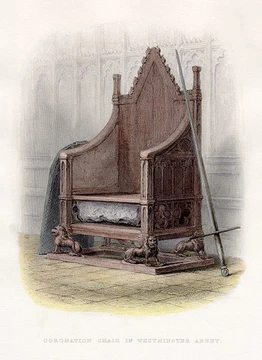
Scone Palace
Gothic Revival seat of the Earls of Mansfield.
Last updated

via Wikipedia: Scone Palace · see source
Where it is
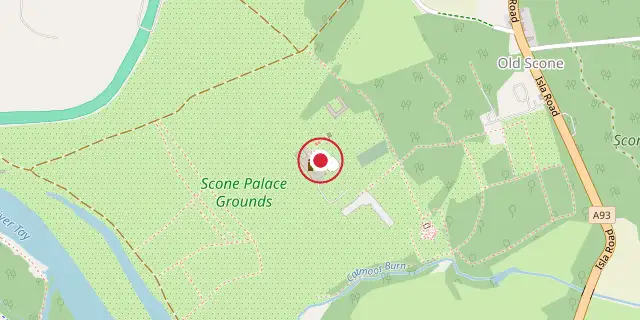
Coordinates: 56°25′23″N 3°26′17″W (56.4230, -3.4380) · Open in OpenStreetMap
Coordinates and connected clubs: the infobox of Wikipedia: Scone Palace (CC BY-SA 4.0). Map: drawn by Codexery from OpenStreetMap tiles.
Scone Palace, a red sandstone Gothic Revival house with a castellated roof, is the ancestral home of the Earls of Mansfield near Perth, Scotland. Its grounds once held Scone Abbey, where the Stone of Scone was kept and early Scottish kings, including Robert the Bruce and Charles II, were crowned. The palace is a Category A-listed building.
History of Scone
Scotland was among the last kingdoms to adopt written records and the legal systems they supported, with significant growth in record keeping only occurring near the end of the 11th century. Property rights began to be logged via legal charter, and royal government practices were noted in writing. Some documents may have existed before the 11th century, but Scotland's turbulent history likely caused the loss or destruction of many. The earliest hard evidence relating to Scone is a charter dating to 906.
The origin of the name "Scone" is uncertain; over the last ten centuries it has been recorded in numerous spellings including Scon, Scoon, Schone, Skuyn, and Sgàin. Scone lay at the heart of the ancient Pictish kingdom, and the name is thought to derive from the Pictish language, which Bede's early 8th-century Historia ecclesiastica gentis Anglorum identifies as distinct from Brittonic, Irish, and English. It has been proposed that "Scone" comes from the P-Celtic word "Sken" meaning "cut" or "cutting", later Gaelicized as "Sgàin".
The meaning "cutting" could refer to what is now called the Friars' Den. Modern analysis of place names in eastern Scotland supports the argument that an Insular Celtic language related to the southern P-Celtic Brittonic languages was spoken in Pictavia, rather than a Q-Celtic language.
Did You Know?
- Robert the Bruce was crowned at Scone in 1306, and Charles II was the last king crowned there, accepting the Scottish crown in 1651.
- Scone Abbey was severely damaged in 1559 during the Scottish Reformation after a mob led by John Knox came from Dundee.
- The Moot Hill at Scone is also called 'Boot Hill', possibly from a tradition where nobles brought earth from their own lands in their boots to swear fealty.
- King Constantine II and Bishop Cellach met at the Hill of Belief near Scone in 906, pledging to keep the laws of the faith and churches.
Frequently Asked Questions
Where is Scone Palace?
Scone Palace is located in Perth, Perth and Kinross, Scotland.
Who designed Scone Palace?
Scone Palace was designed by William Atkinson.
More in Stone of Scone
Sources
Compiled from Wikipedia and the sources listed below. Text from Wikipedia is available under CC BY-SA 4.0; this entry is adapted from it.
- Wikipedia: Scone Palace (CC BY-SA 4.0).
Spotted an error? Know more?
Reader corrections go straight into our review queue. Suggest an edit · How this site is sourced