Kingdom of Candia
Venetian overseas territory on Crete from 1205 to 1669.
Last updated
The Kingdom of Candia (also called the Duchy of Candia) was the name for Crete when it was ruled by Venice, starting with the Venetian takeover between 1205 and 1212 and ending when the Ottomans conquered it in the Cretan War (1645–1669). At the time and into the early modern period, the island was usually called Candia, after its capital city, Candia or Chandax (now Heraklion). Greek historians today refer to this era as the Venetocracy.
Establishment
Crete was part of the Byzantine Empire until 1204, when the Fourth Crusade broke up the empire and split its lands among the crusaders. Crete was first given to Boniface of Montferrat, but he could not control it and soon sold his rights to Venice. Venetian troops first landed on the island in 1205, but it was not fully secured until 1212, mainly because of resistance from Venice’s rival, Genoa.
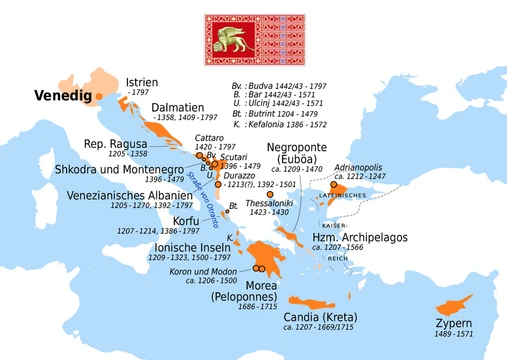
The new colony was then organized: the island was split into six provinces, named after the districts of Venice itself, while the capital Candia was directly under the central government. The islands of Tinos and Cythera, also Venetian, were included in the kingdom. In the early 1300s, this system was changed to four provinces, which closely matched the four modern prefectures.
Society
In the first two centuries of Venetian rule, the native Orthodox Greek population often rebelled against the Catholic Venetians, sometimes backed by the Empire of Nicaea. There were fourteen revolts between 1207 and the last big one, the Revolt of St. Titus in the 1360s, which brought together Greeks and Venetian colonists against heavy taxes from Venice. After that, despite occasional uprisings and Turkish raids, the island mostly did well, and Venetian rule gave it access to the Italian Renaissance. This led to an artistic and literary revival unmatched elsewhere in the Greek world: the Cretan School of painting, which reached its peak with El Greco, mixed Italian and Byzantine styles, and a rich body of literature in the local dialect appeared, including the early 1600s romances Erotokritos and Erophile.
After the Ottomans took Cyprus in 1571, Crete was Venice’s last major overseas possession. Venice’s relative military weakness, along with the island’s wealth and its strategic position controlling eastern Mediterranean sea routes, drew Ottoman attention.
In the long and destructive Cretan War (1645–1669), the two sides fought for Crete: the Ottomans quickly overran most of the island but could not capture Candia, which held out with help from Venice’s navy and Ottoman distractions elsewhere, until 1669. Only the three island forts of Souda, Gramvousa, and Spinalonga stayed Venetian. Attempts to retake Candia during the Morean War failed, and these last Venetian strongholds were finally taken by the Turks in 1715, during the final Ottoman–Venetian War.
Venice had long traded with Crete; the island was one of many Greek places where Venetians had tax-free trade thanks to repeated Byzantine imperial decrees, starting in 1147 (and formalizing earlier practice), and confirmed as late as 1198 in a treaty with Emperor Alexios III Angelos. These same places were largely given to Venice in the division of the Byzantine Empire after the Crusaders took Constantinople in April 1204: besides the Ionian Islands, the Saronic Gulf islands, and the Cyclades, Venice got several coastal spots on the Greek mainland useful for its sea trade. Then, on 12 August 1204, the Venetians beat their old rivals the Genoese to buying Crete from Boniface of Montferrat. Boniface had supposedly been promised the island by Emperor Alexios IV Angelos, but since he had little use for it, he sold it for 1,000 silver marks, a yearly share of the island’s revenues worth 10,000, and a promise of Venetian support for his claim to the Kingdom of Thessalonica.
To enforce their claim, Venice landed a small force on the offshore island of Spinalonga. But the Genoese, who already had a trading colony on Crete, moved faster: led by Enrico Pescatore, Count of Malta, and backed by the local people, they soon controlled the eastern and central parts of the island. A first Venetian attack in summer 1207 under Ranieri Dandolo and Ruggiero Premarino was repelled, and for the next two years Pescatore ruled nearly all of Crete except a few isolated Venetian garrisons. He even appealed to the Pope and tried to get himself confirmed as king of the island.
But while Venice was determined to take Crete, Genoa gave Pescatore little support. In 1209, the Venetians captured Palaiokastro near Candia (Greek Chandax, modern Heraklion), but it took until 1212 to drive Pescatore out, and his lieutenant Alamanno da Costa held out even longer. Only on 11 May 1217 did the war with Genoa end in a treaty that left Crete firmly in Venetian hands.
Giacomo Tiepolo became the first governor of the new province, with the title "duke of Crete," based in Candia. To strengthen Venetian control, Tiepolo proposed sending colonists from Venice; they would receive land and, in return, provide military service. The proposal was approved, and...
Lore & Background
The island of Crete had been part of the Byzantine Empire until 1204, when the Fourth Crusade dissolved the empire. Crete was initially allotted to Boniface of Montferrat, but he sold his rights to Venice. Venetian troops first occupied the island in 1205, but it took until 1212 to secure it, especially against opposition from Genoa.
The colony was divided into six provinces (sestieri) named after the divisions of Venice itself, while the capital Candia was directly subjected to the Commune Veneciarum. In the early 14th century, this division was replaced by four provinces, almost identical to the modern prefectures. The islands of Tinos and Cythera also came under the kingdom's purview.
Reader's Guide
The Kingdom of Candia was Venice's major overseas possession for over four centuries, serving as a crucial base for eastern trade and the Balkan slave trade. During the first two centuries, revolts by the native Orthodox Greek population against Roman Catholic Venetians were frequent, with fourteen revolts counted between 1207 and the Revolt of St. Titus in the 1360s. Thereafter, despite occasional revolts and Turkish raids, the island largely prospered, and Venetian rule opened a window into the Italian Renaissance.
This led to an artistic and literary revival unparalleled elsewhere in the Greek world: the Cretan School of painting, culminating in the works of El Greco, and a widespread literature in the local idiom, including the early 17th-century romances Erotokritos and Erophile. After the Ottoman conquest of Cyprus in 1571, Crete was Venice's last major overseas possession. The long and devastating Cretan War (1645–1669) ended with the fall of Candia in 1669; only the fortresses of Souda, Gramvousa, and Spinalonga remained Venetian until 1715.
More in Stato da Màr
Sources
Compiled from Wikipedia and the sources listed below. Text from Wikipedia is available under CC BY-SA 4.0; this entry is adapted from it.
- Wikipedia: Kingdom of Candia (CC BY-SA 4.0).
Spotted an error? Know more?
Reader corrections go straight into our review queue. Suggest an edit · How this site is sourced