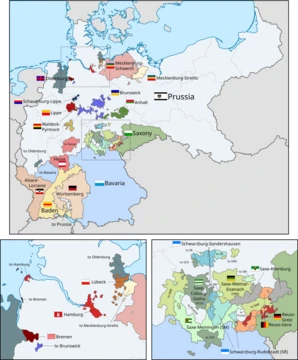
Principality of Waldeck and Pyrmont
A German principality lasting from the 12th century to 1929.
The Principality of Waldeck and Pyrmont was a state of the Holy Roman Empire and its successors from the late 12th century until 1929. It gained Imperial immediacy in 1349 and was raised to a principality in 1712. After the abolition of the monarchy in 1918, the Free State of Waldeck-Pyrmont existed until 1929, when it was divided between Hannover and other Prussian provinces.
Quick Facts
- Common name
- Waldeck and Pyrmont
- Era
- Middle Ages
- Empire
- Holy Roman Empire
- Title leader
- Prince
- Established
- 1180
- Dissolved
- 1918
- Event start
- Established as a County
- Event end
- German Revolution
Facts from the source article.
History
The House of Waldeck, later the Princes of Waldeck and Pyrmont, traced its male line back to the Counts of Schwalenberg, starting with Widekind I. Waldeck Castle, overlooking the Eder, was first recorded in 1120. In 1180, Volkwin II of Schwalenberg gained the castle through marriage to Luitgard, heiress of Waldeck, and his branch took the castle's name. The territory began as a fief of the Electorate of Mainz, then became a Reichslehen county in 1379. After Count Henry VI died in 1397, the family split into the Landau and Waldeck lines, which sometimes fought. Both lines fell under Hesse's sovereignty in 1431 and 1438 due to debt. The Waldeck line split again in 1486 into Wildungen and Eisenberg branches, and the Landau line ended in 1495, its lands divided. Philip IV and Philip III converted their counties to Lutheranism in 1526 and 1529. After further partitions, the new Wildung line reunited the lands in 1692. The family inherited the County of Pyrmont in 1626, thereafter calling themselves Counts of Waldeck and Pyrmont.
Military
Waldeck first raised a battalion of infantry in 1681. For most of the period before the Napoleonic Wars, its rulers hired out soldiers as auxiliaries to foreign powers. The single battalion grew to two in 1740, three in 1744, and four in 1767. Most notably, these troops served the Dutch, and after a 1776 agreement with Great Britain, the 3rd Waldeck Regiment was formed for the American War of Independence. This regiment, called 'Hessians' like all Germans in that conflict, was captured by French and Spanish forces aiding the Americans; only a few soldiers ever returned to Germany. When Napoleon conquered the region, the Waldeck regiments in Dutch service were dissolved after the Batavian Republic became a kingdom under Napoleon's brother Louis. Reduced to battalion size, they became the 3rd battalions of the 1st and 2nd Infantry Regiments of the Kingdom of Holland. In 1812, the 6th Confederation Regiment was reorganized, with three companies from Waldeck. By 1814, the Dutch-service battalions were gone, and Waldeck provided three infantry companies and one Jäger company to the newly formed German Confederation.
More in States of the German Empire
Spotted an error? Know more?
Reader corrections go straight into our review queue. Suggest an edit · How this site is sourced