Duchy of Brunswick
A German duchy from 1815 to 1918, centered on Braunschweig.
The Duchy of Brunswick (Herzogtum Braunschweig) was a historical German state that existed from 1815 until 1918, with its capital at the city of Brunswick (Braunschweig). It was established as the successor state of the Principality of Brunswick-Wolfenbüttel by the Congress of Vienna in 1815. The duchy was part of the German Confederation, the North German Confederation, and from 1871 the German Empire.
Quick Facts
- Common name
- Brunswick
- Era
- Modern era
- Government
- Constitutional monarchy
- Established
- 1815
- Dissolved
- 1918
- Event start
- Restoration
- Event end
- German Revolution
- Date end
- 8 November
Facts from the source article.
Did You Know?
- In 1905, 92.5% of the population adhered to the Evangelical Lutheran Church in Brunswick.
- The Duchy of Brunswick State Railway was the first state railway in Germany, opening its first section on 1 December 1838.
- In 1905, out of 1,000 residents, 455 worked in the industrial sector, mining or construction.
History
The title Duke of Brunswick and Lüneburg was held from 1235 by various members of the Welf family, who ruled several small territories in northwest Germany. These holdings were neither compact nor indivisible; lands were divided among sons, reallocated when branches became extinct, or exchanged. The unifying element was male-line descent from Duke Otto I (ruled 1235–1252). After early divisions, the duchy re-unified under Duke Magnus II (died 1373). Following his death, his three sons jointly ruled, but after the murder of Frederick I, brothers Bernard and Henry redivided the land, Henry receiving Wolfenbüttel. From 1432 the Principality of Wolfenbüttel became the capital. From 1546 there were two dynastic lines: the senior from Brunswick-Wolfenbüttel and the younger from Calenberg-Hanover. Ruling monarchs governed from Wolfenbüttel until 1754, when the Brunswick principality was used as a capital temporarily. The territory of Wolfenbüttel was recognized as a sovereign state by the Congress of Vienna in 1815. In 1702, the Prince of Calenberg and Celle averted extinction through a marriage with Eleonore d'Esmier d'Olbreuse, who passed a united Lüneburg to her successors, later the Elector of Hanover. The princes of Wolfenbüttel maintained supremacy over Lüneburg but recognized its semi-sovereignty.
Geography
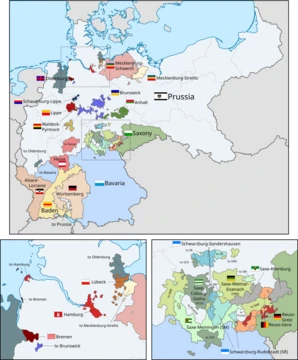
The Duchy of Brunswick was a patchwork of territory, made up of three main areas and seven smaller exclaves. The largest section, centered around Braunschweig, Wolfenbüttel, and Helmstedt, stretched from the Aller River in the north down to the Harz mountains in the south. A western part, including Holzminden, ran from the Weser River eastward to the Harz Foreland. A southern piece, containing Blankenburg, sat within the Harz. The smaller exclaves included Thedinghausen, Harzburg, Calvörde, Bodenburg, Östrum, Ostharingen, Ölsburg, and a small forest near the Fallstein. The western region fell within the Weser Uplands, while the central and southern parts were in the northern Harz Foreland and the Harz mountains. The northern area lay where the North German Plain meets the Central Uplands. The Wurmberg, at 971 meters, was the highest point. Key rivers were the Weser, Aller, Leine, Oker, Bode, and Innerste.
Sports
MTV Braunschweig, founded in 1847, was the first sports club in Brunswick. Konrad Koch, a school teacher from Braunschweig, wrote the first German version of football rules and, with August Hermann, arguably organized the first football match in Germany in 1874 between pupils of his school Martino-Katharineum. The Duchy of Brunswick Football Association was founded in May 1904. Eintracht Braunschweig, founded in 1895, became a leading club in Northern Germany; its colours blue and yellow derive from the flag of Brunswick.
Coat of arms
The Duchy of Brunswick-Lüneburg came from lands held by the senior line of the House of Brunswick, a family that traced its roots to the Italian House of Este. That family gained the Guelph inheritance through marriage around the year 1000, when Azzo II wed Kunigunde of Altdorf, daughter of Welf II. In 1235, they were officially made Dukes of Brunswick-Lüneburg. The house split in 1269 into the Lüneburg and Brunswick branches, the latter later becoming Brunswick-Wolfenbüttel. The Principality of Calenberg, which would become the Electorate of Hanover, broke away from Brunswick in 1432 and absorbed Lüneburg in 1705. Both branches used the same coat of arms: two Brunswick lions, a blue Lüneburg lion, and the white Saxon steed. The lion as a Guelph symbol dates to Henry the Lion in the 1100s, though he used just one. Stories that the English king granted the two golden lions are now considered false. Henry’s sons, Emperor Otto IV and Count Palatine Henry V, adapted the English royal arms; Otto used three lions, Henry used two, and those two became the Guelph emblem. John I of Lüneburg based his blue lion on Denmark’s coat of arms to show his kinship with Danish kings. Later, the Brunswick dukes added that blue lion to their own arms to assert their claim to Lüneburg.
More in States of the German Empire
Spotted an error? Know more?
Reader corrections go straight into our review queue. Suggest an edit · How this site is sourced