Grand Duchy of Mecklenburg-Schwerin
A grand duchy in northern Germany, ruled from Schwerin.
The Grand Duchy of Mecklenburg-Schwerin, a northern German territory, was governed by the House of Mecklenburg from its capital in Schwerin. It existed as a sovereign member of the German Confederation before joining the North German Confederation and, by 1871, the German Empire as a federated state.
Quick Facts
- Common name
- Mecklenburg-Schwerin
- Government
- Feudal monarchy (1815–1849; 1851–1918), Constitutional monarchy (1849–1851)
- Established
- 1815
- Dissolved
- 1918
- Event start
- Congress of Vienna
- Date start
- 14 June
- Event end
- German Revolution
- Date end
- 14 November
Facts from the source article.
Geography
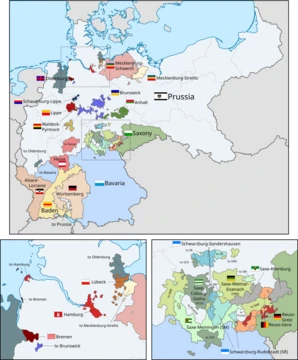
The grand duchy comprised the larger central and western parts of the historic Mecklenburg region, while the smaller southeastern part belonged to the Mecklenburg-Strelitz branch, which also held lands of the former Prince-Bishopric of Ratzeburg in the far northwest. It was bounded by the Baltic coast to the north and the Prussian province of Pomerania to the northeast, with the border running along the Recknitz river, the Peene, and Kummerower See. To the south lay the Prussian Province of Brandenburg, including the exclaves of Rossow and Schönberg near Wittstock, and to the southwest the Amt Neuhaus district of the Kingdom of Hanover, which became part of the Prussian Province of Hanover after 1866. In the west, the Duchy of Holstein was incorporated into the Schleswig-Holstein Province, leaving Mecklenburg almost entirely surrounded by Prussian territory. Besides the capital at Schwerin, the grand duchy included the coastal cities of Rostock and Wismar, the latter held by Sweden until 1803, and the inland towns of Parchim and Güstrow.
History
Duke Frederick Francis I remained neutral during the early French Revolutionary Wars and regained Wismar from Sweden in 1803. After Napoleon's victory at Austerlitz and the dissolution of the Holy Roman Empire in 1806, he joined the Confederation of the Rhine in March 1808. Napoleon later offered the duchy to Swedish heir apparent Jean Bernadotte for his support during the invasion of Russia. Frederick Francis was the first confederation member to abandon Napoleon, sending a contingent to his armies and then fighting against the French in the War of the Sixth Coalition. His new allies Prussia and Russia then offered the duchy to Denmark, but Denmark received Swedish Pomerania instead under the 1814 Peace of Kiel, and Mecklenburg rule remained intact. At the 1815 Congress of Vienna, Frederick Francis joined the German Confederation and was elevated to grand duke, as was his Strelitz cousin Charles II. Serfdom was abolished in 1819. Governance was determined by the 1755 inheritance agreement, which upheld the medieval estates hierarchy and affected social and economic development. During the 1848 revolutions, agitation for a liberal constitution led Grand Duke Frederick Francis II to grant a new Basic law on 10 October 1849, drafted by his First Minister Ludwig von Lützow. In the subsequent reaction, backed by the Strelitz grand duke George, all democratic concessions were withdrawn and further restrictive measures were introduced in 1851 and 1852.
More in States of the German Empire
Spotted an error? Know more?
Reader corrections go straight into our review queue. Suggest an edit · How this site is sourced