
Branched string lettuce (Ulva prolifera)
Source-cited species reference: taxonomy from WoRMS, biology from SeaLifeBase, occurrence map from GBIF, description from Wikipedia.
Ulva prolifera (previously Enteromorpha prolifera), also known as the branched string lettuce, is a species of seaweed algae in the family Ulvaceae that can be found worldwide.
- Scientific name
- Ulva prolifera
- Authority
- O.F.Müller, 1778
- Family
- Ulvaceae
- Order
- Ulvales
- Habitat zone
- sessile
- Gbif occurrence records
- 7,140
Classification (WoRMS)
Full classification as recorded by WoRMS: Kingdom: Plantae · Phylum: Chlorophyta · Class: Ulvophyceae · Order: Ulvales · Family: Ulvaceae · Genus: Ulva.
Accepted name: Ulva prolifera · Authority: O.F.Müller, 1778 · Taxonomic status: accepted · AphiaID: 234476.
Synonyms and superseded combinations recorded for this taxon: Enteromorpha clathrata f. denudata (Ahlner) Kylin, 1907; Enteromorpha clathrata f. ramulifera (Ahlner) V.J.Chapman, 1877; Enteromorpha clathrata var. procera (Ahlner) Hauck, 1884; Enteromorpha compressa var. prolifera (O.F.Müller) Greville, 1830; Enteromorpha compressa var. trichodes Kützing, 1845; Enteromorpha crinita f. procera (Ahlner) Sjöstedt, 1927; Enteromorpha polyclados (Kützing) Kützing, 1856; Enteromorpha procera K.Ahlner, 1877; Enteromorpha procera f. chlorotica (J.Agardh) V.J.Chapman, 1956; Enteromorpha procera f. denudata K.Ahlner; Enteromorpha procera f. ramulifera Ahlner, 1877; Enteromorpha procera var. minuta V.J.Chapman, 1940; Enteromorpha procera var. prolifica V.J.Chapman; Enteromorpha prolifera (O.F.Müller) J.Agardh, 1883; Enteromorpha prolifera f. simplex K.L.Vinogradova, 1974; Enteromorpha salina Kützing, 1845; Enteromorpha salina var. polyclados Kützing, 1845; Enteromorpha simplex (K.L.Vinogradova) R.P.T.Koeman & Hoek, 1982; Ulva compressa var. prolifera (O.F.Müller) C.Agardh, 1823; Ulva enteromorpha f. prolifera (O.F.Müller) Van Heurck; Ulva procera (K.Ahlner) H.S.Hayden, Blomster, Maggs, P.C.Silva, Stanhope & Waaland, 2003; Ulva simplex (K.L.Vinogradova) H.S.Hayden, Blomster, Maggs, P.C.Silva, Stanhope & Waaland, 2003.
Source: World Register of Marine Species (WoRMS) — https://www.marinespecies.org/aphia.php?p=taxdetails&id=234476 (CC BY 4.0). Accessed 2026-09-23.
Biology and life history (SeaLifeBase)
Measured values published by SeaLifeBase for Ulva prolifera. Only fields the database actually holds for this species are shown; these are database values, not aquarium guidance.
Habitat zone: sessile.
SeaLifeBase notes: Occurs in shallow intertidal to subtidal (Ref. 80999). Found in river mouths and brackish inner bays (Ref. 115112). Caused the world's largest drifting microalgal bloom (green-tide) in late June 2008, covering about 600 square kilometers off Qingdao coastline. Alteromonadales, Flavobacteriales, Rhodobacterales dominated the epiphytic bacterial assemblage over the course of the bloom (Ref. 115148).
Source: SeaLifeBase species summary (SpecCode 110935) — https://www.sealifebase.se/summary/Ulva-prolifera.html (CC BY-NC 3.0 — non-commercial use only). Accessed 2026-09-23.
Distribution and occurrence records (GBIF)
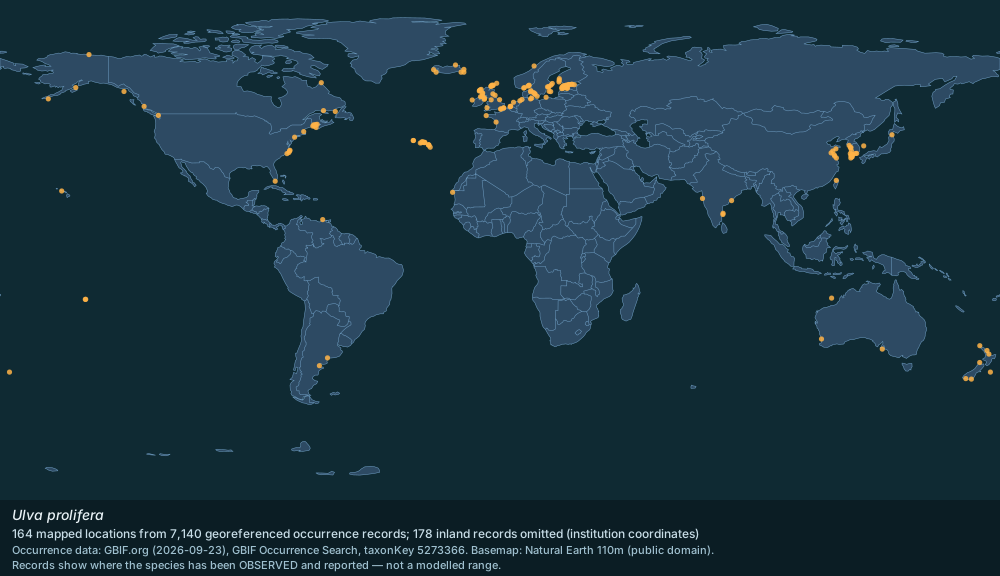
7,140 georeferenced occurrence records for Ulva prolifera are published through GBIF from 70 countries or marine areas. The map above plots 164 distinct locations from a sample of 3,000 records, omitting 178 inland records that carry an institution's coordinates rather than a collection site; it shows where the species has been observed and reported, not a modelled range.
Most records by country or area: United States of America (1,601); United Kingdom of Great Britain and Northern Ireland (894); Portugal (741); Estonia (633); Netherlands (435).
The full country table, WoRMS marine regions and the sampling notes are on this species' Distribution page.
Source: GBIF Occurrence Search (taxonKey 5273366) — https://www.gbif.org/occurrence/search?taxon_key=5273366&has_coordinate=true (records CC0 / CC BY); WoRMS distribution records (MarineRegions) — https://www.marinespecies.org/aphia.php?p=taxdetails&id=234476 (CC BY 4.0); Natural Earth 110m basemap — https://www.naturalearthdata.com/ (public domain). Accessed 2026-09-23.
Description and natural history (Wikipedia)
U. prolifera is visually filamentous and intertwined together by accumulation after an algae bloom. However, the species is actually in tubular form and can grow to half to several meters in length. Typically its diameter does not exceed 5 mm, the actual growth parameters of Ulva prolifera depend on the magnitude of the algal bloom that it is associated with. Its color spans from light green to the color of grass. The species can be found at the coastline after being carried onto the seashore after low tides as it floats along the movements of the seawater.
In Europe, it can be found in such countries as Bulgaria, France, Great Britain, Greece, Ireland, Portugal, Romania, Slovenia, Spain and on Lolland island of Denmark. It is also common on African islands such as Canary and Madeira islands, and in the US states such as Alaska, California, Florida, Texas and Washington. Besides the states, Africa and Europe, it is common in Central American countries such as Costa Rica, El Salvador, Panama, and Cuba, with Mexico occasionally getting them on the Pacific side.
The species mostly occurs as wild algae, although some are cultivated in Japan, Korea, China and other countries. China had its largest recorded bloom of the algae in 2013, in the Yellow Sea off the coast of Qingdao.
The green tides caused by the overgrowth of Ulva prolifera in the Yellow Sea of China have been occurring every summer since 2007. The green tide is a major environmental concern that involves the impacts from natural, anthropogenic, physicochemical and algae factors along with the warming of local water. The dynamics of these factors can explain the sudden bloom of U. prolifera off the east coast of China in 2007. This continued as an annual problem for about a decade and caught additional attention in 2008, when the sailing games of the Beijing Olympics was hosted in the city of Qingdao and the green tides can cause great economical and ecological impacts. Every spring since 2007, U. prolifera have initially occurred along the Jiangsu coast with small-scale floating algae, then migrated northward along the coast of the Yellow Sea driven by monsoons and ocean currents, accumulating in the near-shore waters of the Shandong Peninsula in June and July, and then declined gradually. Analysis of meteorological and environmental data and local aquaculture activities strongly supports the hypothesis that the U. prolifera blooms in the Yellow Sea originated from the water off of the coast of Jiangsu. Due to the development of Porphyra yezoensis aquaculture and the excess nutrients deployed for its growth, the water condition is made suitable for algal bloom and green tides when the appropriate seasons come. After harvesting of P. yezoensis and cleaning of ropes, rafts and other attachments, the thalli of U. prolifera were scraped and thrown away by farmers. The free-floating U. prolifera kept growing and drifted to the northern part of Yellow Sea by tides and winds. Such activities give the starting population of such organisms which can reproduce and populate vast areas on top of the ocean.
Overgrowing algae bloom at the surface of seawater is an environmental hazard to the coastal underwater biome. Surface algae overextension can block the entry of sunlight below the infected water region, creating a much shallower aphotic zone. The disappearance of sunlight can be fatal for the plants and organisms living below the surface that require sunlight. Phytoplankton photosynthesis will be heavily reduced due to the lack of sunlight which is caused by the overgrowing algae blockade. Insufficient primary production in an ocean biome is devastating for maintaining the local food web.
Additionally, algal respiration is increased for such algal explosion in biomass. The lack of oxygen in the local water area is harmful for all living organisms. The algae washed ashore is also an environmental hazard during degradation by releasing noxious smell into the air. Accumulation of overgrown algae like U. polifera is not only harmful for the environment but also local underwater biome and tourism value.
Traditionally, the most direct and intuitive way of blooming algae moving onshore is collecting them from the coast and dispose, or setting up nets offshore to stop the green tide from approaching the coast. Nowadays, there is research being done on the usage of microbial complex formulation spray that promotes rapid degradation.
The species have common names in other countries of the world:
Source: Wikipedia: Ulva prolifera — https://en.wikipedia.org/wiki/Ulva_prolifera (CC BY-SA 4.0). Accessed 2026-09-23.
Gallery
Related in Branched string lettuce
Links follow this subject's own source article.
Elsewhere in Branched string lettuce
Spotted an error? Know more?
Reader corrections go straight into our review queue. Suggest an edit · How this site is sourced