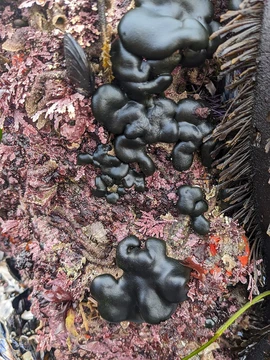
Ulva australis
Last updated
Ulva australis, commonly known as the southern sea lettuce, is a species of bright green seaweed in the family Ulvaceae. It is notable for its presence in waters around Australia, its edibility, and its research applications in environmental protection, medicine, and pharmacology.
Scientific classification
- CladeEukaryota
- CladeArchaeplastida
- CladeViridiplantae
- ClassUlvophyceae
- OrderUlvales
- FamilyUlvaceae
- GenusUlva
- SpeciesUlva australis
Named by Areschoug, 1854
Close relatives
Other species of Ulva with a Codexery entry.
- Ulva flexuosa Ulva flexuosa
- Ulva intestinalis Ulva intestinalis
- Ulva lactuca Ulva lactuca
- Ulva linza Ulva linza
- Ulva paschima Ulva paschima
- Ulva prolifera Ulva prolifera
Sources: Wikipedia taxobox: Ulva australis (CC BY-SA 4.0) · order, family and genus agree with WoRMS AphiaID 660661 (CC BY 4.0)
Where the ulva australis has been recorded
Each dot is a place where the species has been observed and reported (3,148 records, half-degree grid) — not a modelled range. 43 inland records left out (institution coordinates).
Map: drawn by Codexery. Data: GBIF occurrence search (records CC0 / CC BY) · Natural Earth basemap (public domain)
Quick Facts
- Species
- australis
Facts from the source article.
Background
Ulva australis was first described by Swedish botanist Johan Erhard Areschoug from samples collected in Southern Australia. Its general characteristics include a smooth surface, distromatic blades, lobed fronds, and a thallus color ranging from dark green to light grass green. It can be free floating or attached by a single holdfast, and its cells are irregularly arranged with rounded edges and shapes such as rectilinear, square, and pentagonal. Ulva rigida has sometimes been confused with this species.
The origin of Ulva australis has been a subject of study. DNA analysis showed that Ulva pertusa from Japan has almost identical DNA sequences to Ulva australis, with very small sequence divergence. The hypothesis that U. australis is an independent species was rejected because its natural habitat along the shoreline is suppressed by U. pertusa populations. It is concluded that Ulva australis is a species introduced to Australia that originated in Japan, though researchers hypothesize it was not directly introduced from Japan but from non-indigenous populations elsewhere in northeastern Asia.
Factors affecting its growth were tested experimentally: higher carbon dioxide (750 ppm) and nutrient levels (PES medium) increased growth and photosynthesis. Irradiance effects differed by life stage: germlings favored higher irradiance (100 μmol photons m−2 s−1), while other stages preferred lower irradiance (50 μmol photons m−2 s−1).
More in Marine Green Macroalgae
Sources
Compiled from Wikipedia and the sources listed below. Text from Wikipedia is available under CC BY-SA 4.0; this entry is adapted from it.
- Wikipedia: Ulva australis (CC BY-SA 4.0).
- Classification: the source article's taxobox; order, family and genus checked against WoRMS, the World Register of Marine Species (CC BY 4.0).
- Occurrence records: GBIF (CC0 / CC BY). Basemap: Natural Earth (public domain).
Spotted an error? Know more?
Reader corrections go straight into our review queue. Suggest an edit · How this site is sourced