
Flat-tube sea lettuce (Ulva linza)
Source-cited species reference: taxonomy from WoRMS, biology from SeaLifeBase, occurrence map from GBIF, description from Wikipedia.
Ulva linza is a green alga in the family Ulvaceae that can be found in British Isles.
- Scientific name
- Ulva linza
- Authority
- Linnaeus, 1753
- Family
- Ulvaceae
- Order
- Ulvales
- Habitat zone
- sessile
- Gbif occurrence records
- 7,678
Classification (WoRMS)
Full classification as recorded by WoRMS: Kingdom: Plantae · Phylum: Chlorophyta · Class: Ulvophyceae · Order: Ulvales · Family: Ulvaceae · Genus: Ulva.
Accepted name: Ulva linza · Authority: Linnaeus, 1753 · Taxonomic status: accepted · AphiaID: 234474.
Synonyms and superseded combinations recorded for this taxon: Enteromorpha ahlneriana Bliding, 1944; Enteromorpha bertolonii Montagne, 1846; Enteromorpha bertolonii var. lanceolata (Linnaeus) Grunow, 1867; Enteromorpha bulbosa var. japonica Yoshida et al., 1990; Enteromorpha crispata (Bertoloni) Piccone, 1878; Enteromorpha linza (Linnaeus) J.Agardh, 1883; Enteromorpha linza f. lanceolata; Enteromorpha linza var. angusta Unknown authorities; Enteromorpha linza var. crispata (Bertoloni) Hylmö, 1916; Enteronia linza (Linnaeus) Chevallier, 1836; Phycoseris crispata (Bertoloni) Kützing, 1843; Phycoseris linza (Linnaeus) Kützing, 1843; Phycoseris smaragdina Kützing, 1843; Phyllona lanceolata (Linnaeus) Wiggers, 1780; Scytosiphon intestinalis var. plynthodes Wallroth, 1833; Solenia linza (Linnaeus) C.Agardh, 1824; Ulva bertolonii C.Agardh, 1823; Ulva crispata Bertoloni, 1810; Ulva enteromorpha f. crispata (Bertoloni) Le Jolis, 1863; Ulva enteromorpha var. lanceolata (Linnaeus) Le Jolis, 1863; Ulva fasciata S.F.Gray, 1821; Ulva intybacea Lamarck, 1779; Ulva lanceolata Linnaeus, 1767; Ulva linza var. angusta Kützing; Ulva linza var. lanceolata Kützing.
Source: World Register of Marine Species (WoRMS) — https://www.marinespecies.org/aphia.php?p=taxdetails&id=234474 (CC BY 4.0). Accessed 2026-09-23.
Biology and life history (SeaLifeBase)
Measured values published by SeaLifeBase for Ulva linza. Only fields the database actually holds for this species are shown; these are database values, not aquarium guidance.
Habitat zone: sessile.
Source: SeaLifeBase species summary (SpecCode 126739) — https://www.sealifebase.se/summary/Ulva-linza.html (CC BY-NC 3.0 — non-commercial use only). Accessed 2026-09-23.
Distribution and occurrence records (GBIF)
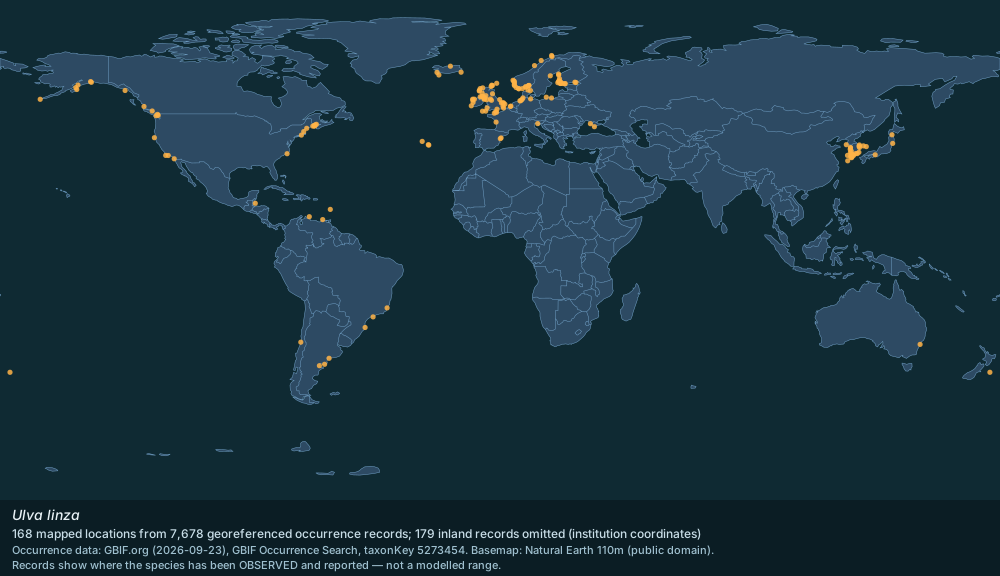
7,678 georeferenced occurrence records for Ulva linza are published through GBIF from 67 countries or marine areas. The map above plots 168 distinct locations from a sample of 3,000 records, omitting 179 inland records that carry an institution's coordinates rather than a collection site; it shows where the species has been observed and reported, not a modelled range.
Most records by country or area: United States of America (1,888); Korea, Republic of (1,190); United Kingdom of Great Britain and Northern Ireland (955); Sweden (590); Canada (487).
The full country table, WoRMS marine regions and the sampling notes are on this species' Distribution page.
Source: GBIF Occurrence Search (taxonKey 5273454) — https://www.gbif.org/occurrence/search?taxon_key=5273454&has_coordinate=true (records CC0 / CC BY); WoRMS distribution records (MarineRegions) — https://www.marinespecies.org/aphia.php?p=taxdetails&id=234474 (CC BY 4.0); Natural Earth 110m basemap — https://www.naturalearthdata.com/ (public domain). Accessed 2026-09-23.
Description and natural history (Wikipedia)
Ulva (Enteromorpha) linza (Linnaeus) is a 30 cm (sometimes 45 cm) long green alga that grows in bright green clusters of tubes or flat strips. It has unbranched thalli that often have a frilled margin. The thallus middle is greater than its base and can be as wide as 5 cm. Its ruffled blades are 1 - 4 cm long while its cells are 10 - 15 in diameter.
Ulva linza found in Rhode Island have branched or unbranched flattened tubes. The thallus length ranges from 1.9 –36 cm with a mean length of 18.6 cm. The thallus width ranges from 0.2 to 4.8 cm with a mean width of 1.4 cm. Ulva linza can be distinguished by its smooth thallus, most with a ruffled margin. Ulva linza can tolerate a wide range of salinities and water qualities. Laboratory experiments have shown a broad tolerance to the environmental conditions of irradiance, temperature, salinity, and a wide range of nitrogen and phosphorus concentrations.
Ulva linza alternates between sexual (gametophyte producing gametes) and asexual (sporophyte producing zoospores) stages. Spores with two or four flagella are released from the thalli. Zoospores with four flagella (quadriflagellated zoospores) rapidly settle on surfaces. Biflagellate spores are typed as female (+) gametes, male (-) gametes, or asexual biflagellate zoospores.
Ulva species have been reported as a dominant species leading to blooms of green macroalgae often referred to as “green tides.” These green tides and marine fouling are attributed to their thallus morphological characteristics, fast growth rates in eutrophic ecosystems, and rapid uptake and assimilation of nutrients. These blooms are generally explained by eutrophication caused by increased nutrient loads (i.e., nitrogen and phosphorus) from events such as runoff, sewage outflow, and upwelling.
They are littoral and sublittoral species which grow in muddy estuaries attached to pebbles or docks. They also can be found on rocks or in rock pools. Ulva linza can be found in the upper intertidal zone of seashores.
Ulva linza has been found in Wembury beach, UK, Narragansett Bay, Rhode Island, the British Isles, and China.
The species is edible and therefore can be used as food and in cosmetic products. Ulva linza is used as a model organism for biofouling in marine environments. It has been found on a variety of man-made structures including ships’ hulls.
Source: Wikipedia: Ulva linza — https://en.wikipedia.org/wiki/Ulva_linza (CC BY-SA 4.0). Accessed 2026-09-23.
Gallery
Related in Flat-tube sea lettuce
Links follow this subject's own source article.
Elsewhere in Flat-tube sea lettuce
Spotted an error? Know more?
Reader corrections go straight into our review queue. Suggest an edit · How this site is sourced