
Sea lettuce (Ulva lactuca)
Source-cited species reference: taxonomy from WoRMS, biology from SeaLifeBase, occurrence map from GBIF, description from Wikipedia.
Ulva lactuca, also known by the common name sea lettuce or broadleaf sea lettuce, is an edible green alga in the family Ulvaceae. It is the type species of the genus Ulva. A synonym is U. fenestrata, referring to its "windowed" or "holed" appearance.
- Scientific name
- Ulva lactuca
- Authority
- Linnaeus, 1753
- Family
- Ulvaceae
- Order
- Ulvales
- Maximum length
- 100 cm
- Depth range
- 0–108 m
- Habitat zone
- sessile
- Gbif occurrence records
- 34,709
Classification (WoRMS)
Full classification as recorded by WoRMS: Kingdom: Plantae · Phylum: Chlorophyta · Class: Ulvophyceae · Order: Ulvales · Family: Ulvaceae · Genus: Ulva.
Accepted name: Ulva lactuca · Authority: Linnaeus, 1753 · Taxonomic status: accepted · AphiaID: 145984.
Synonyms and superseded combinations recorded for this taxon: Monostroma lactuca (Linnaeus) J.Agardh, 1883; Phycoseris fasciata (Delile) Montagne, 1856; Phycoseris lobata Kützing, 1847; Phyllona lactuca (Linnaeus) F.H.Wiggers, 1780; Ulva costata (M.Howe) Hollenberg, 1971; Ulva crassa Kjellman, 1877; Ulva fasciata Delile, 1813; Ulva fasciata f. costata M.Howe, 1914; Ulva fasciata f. lobata Setchell, 1901; Ulva lactuca f. fasciata (Delile) Hering, 1846; Ulva lactucaefolia S.F.Gray, 1821; Ulva lobata (Kützing) Harvey, 1855; Ulva nematoidea Bory de Saint-Vincent, 1828; Ulva rotundata Bliding, 1968; Ulva tenera Kornmann & Sahling, 1994.
Source: World Register of Marine Species (WoRMS) — https://www.marinespecies.org/aphia.php?p=taxdetails&id=145984 (CC BY 4.0). Accessed 2026-09-23.
Biology and life history (SeaLifeBase)
Measured values published by SeaLifeBase for Ulva lactuca. Only fields the database actually holds for this species are shown; these are database values, not aquarium guidance.
Maximum length: 100 cm · Depth range: 0–108 m · Habitat zone: sessile · Vulnerability index: 60 of 100 · Fishery importance: commercial.
SeaLifeBase notes: Edible. Used as medicine and source of vitamins E, A, and B1 (Ref. 80758). Also has the potential use as animal feeds in the form of ground meal (Ref. 26875). Grows in intertidal areas exposed to air during low tide, in shallow water near shores, or attached to other seaweed species such as Sargassum (Ref. 80758). Often detached and free-floating at midtide (Ref. 801). Abundantly found in areas with varying salinity, and develops rapidly in nutrient-rich waters; thus, common in polluted areas (Ref. 26875).
Source: SeaLifeBase species summary (SpecCode 122514) — https://www.sealifebase.se/summary/Ulva-lactuca.html (CC BY-NC 3.0 — non-commercial use only). Accessed 2026-09-23.
Distribution and occurrence records (GBIF)
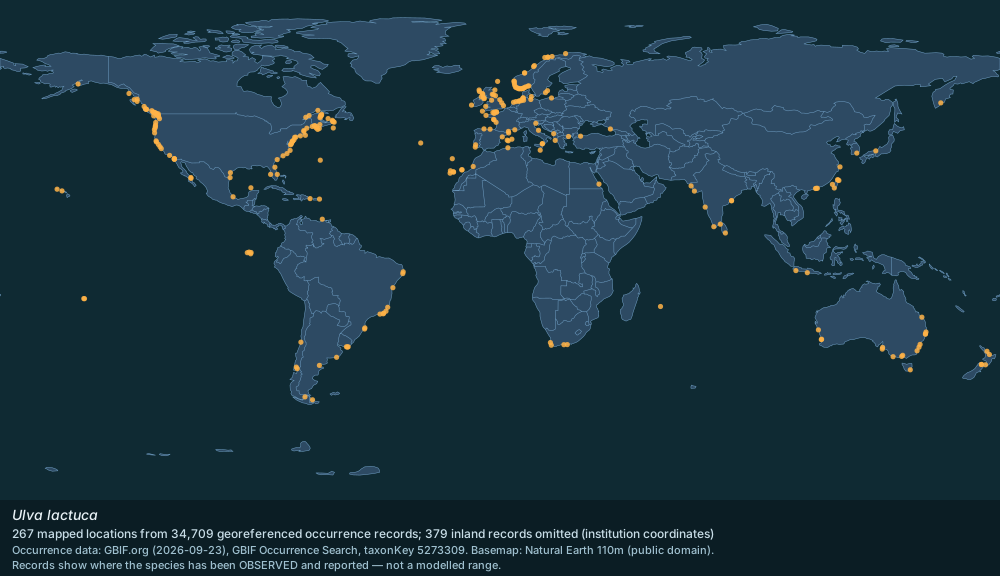
34,709 georeferenced occurrence records for Ulva lactuca are published through GBIF from 114 countries or marine areas. The map above plots 267 distinct locations from a sample of 3,000 records, omitting 379 inland records that carry an institution's coordinates rather than a collection site; it shows where the species has been observed and reported, not a modelled range.
Most records by country or area: United Kingdom of Great Britain and Northern Ireland (9,081); Australia (7,386); United States of America (5,509); Canada (3,436); Brazil (1,006).
The full country table, WoRMS marine regions and the sampling notes are on this species' Distribution page.
Source: GBIF Occurrence Search (taxonKey 5273309) — https://www.gbif.org/occurrence/search?taxon_key=5273309&has_coordinate=true (records CC0 / CC BY); WoRMS distribution records (MarineRegions) — https://www.marinespecies.org/aphia.php?p=taxdetails&id=145984 (CC BY 4.0); Natural Earth 110m basemap — https://www.naturalearthdata.com/ (public domain). Accessed 2026-09-23.
Description and natural history (Wikipedia)
Ulva lactuca is a thin flat green alga growing from a discoid holdfast. The margin is somewhat ruffled and often torn. It may reach 18 cm or more in length, though generally much less, and up to 30 cm across. The membrane is two cells thick, soft and translucent, and grows attached, without a stipe, to rocks or other algae by a small disc-shaped holdfast.
Green to dark green in colour, this species in the Chlorophyta is formed of two layers of cells irregularly arranged, as seen in cross-section. The chloroplast is cup-shaped in some references but as a parietal plate in others with one to three pyrenoids. There are other species of Ulva which are similar and not always easy to differentiate.
The sporangial and gametangial thalli are morphologically alike. The diploid adult plant produces zoospores by meiosis – making them haploid. These settle and grow to form haploid male and female plants similar to the diploid plants. When these haploid plants release gametes they unite to produce the zygote which germinates, and grows to produce the diploid plant.
The distribution is worldwide: Europe, North America (west and east coasts), Central America, Caribbean Islands, South America, Africa, Indian Ocean Islands, South-west Asia, China, Pacific Islands, Australia and New Zealand.
Ulva lactuca is very common on rocks and on other algae in the littoral and sublittoral on shores all around the British Isles,
the Low Countries and up to Denmark.
In the Pacific Northwest, Ulva lactuca L. is distributed from Alaska to the Gulf of California.
It is particularly prolific in areas where nutrients are abundant. This has been the case off the coast of Brittany where a high level of nitrates, from the intensive farming there, washes out to sea. The result is that large quantities of U. lactuca are washed up on beaches, where their decay produces methane, hydrogen sulfide, and other gases.
Certain environmental conditions can lead to the algae spreading over large areas. In August 2009, unprecedented levels of the algae washed up on the beaches of Brittany, France, causing a major public health scare as it decomposed. The rotting thalli produced large quantities of hydrogen sulfide, a toxic gas which, like hydrogen cyanide, inhibits cytochrome c oxidase, inhibiting cellular respiration and resulting in critical cellular hypoxia. In one incident near Saint-Michel-en-Grève, a horse rider lost consciousness and his horse died after breathing the seaweed fumes. Environmentalists blamed the phenomenon on excessive use of fertilizers and the excretion of nitrates by pigs and poultry. In an earlier separate incident at the same beach in July 2009, a truck driver had died near his vehicle after hauling three truckloads of sea lettuce without protective gear during the annual cleanup. Although initially recorded as a heart attack, the death of the truck driver prompted French authorities to exhume his remains for an autopsy. It was later determined to be cardiac arrest resulting from pulmonary edema, which is an indication of possible hydrogen sulfide poisoning. Environmentalists claimed that dead animals found on the algae-clogged beaches (including 31 wild boars in July 2011) were a result of toxic fumes.
In Scotland, U. lactuca is used in soups and salads. In Hawaiʻi, U. lactuca is also called limu pālahala and eaten in different ways: mixed with other algae, salted and served with raw fish, boiled in water and served as a soup, or served with chili pepper, onions, soy sauce and sugar.
Additionally, U. lactuca has traditional uses in Hawaiʻi as fertilizer and as adornment for hula. When U. lactuca is used for hula it is called limu pāpahapaha.
As an alternative to vegetable oil crops, U. lactuca can be a source of biofuels, suitable for transesterification in biodiesel production, and does not require arable land and fertilizers. It can grow in saline and waste water and has a higher ability in sequestering atmospheric carbon dioxide than terrestrial energy crops.
Source: Wikipedia: Ulva lactuca — https://en.wikipedia.org/wiki/Ulva_lactuca (CC BY-SA 4.0). Accessed 2026-09-23.
Gallery
Related in Sea lettuce
Links follow this subject's own source article.
Elsewhere in Sea lettuce
Spotted an error? Know more?
Reader corrections go straight into our review queue. Suggest an edit · How this site is sourced