
Hollow green nori (Ulva intestinalis)
Source-cited species reference: taxonomy from WoRMS, biology from SeaLifeBase, occurrence map from GBIF, description from Wikipedia.
Ulva intestinalis is a green alga in the family Ulvaceae, known by the common names sea lettuce, green bait weed, gutweed, and grass kelp. Until they were reclassified by genetic work completed in the early 2000s, the tubular members of the sea lettuce genus Ulva were placed in the genus Enteromorpha.
- Scientific name
- Ulva intestinalis
- Authority
- Linnaeus, 1753
- Family
- Ulvaceae
- Order
- Ulvales
- Maximum length
- 20 cm
- Depth range
- 0–20 m
- Habitat zone
- sessile
- Gbif occurrence records
- 31,808
Classification (WoRMS)
Full classification as recorded by WoRMS: Kingdom: Plantae · Phylum: Chlorophyta · Class: Ulvophyceae · Order: Ulvales · Family: Ulvaceae · Genus: Ulva.
Accepted name: Ulva intestinalis · Authority: Linnaeus, 1753 · Taxonomic status: accepted · AphiaID: 234471.
Synonyms and superseded combinations recorded for this taxon: Conferva intestinalis (Linnaeus) Roth, 1797; Enteromorpha compressa var. intestinalis (Linnaeus) Hamel, 1931; Enteromorpha intestinalis (Linnaeus) Nees, 1820; Enteromorpha intestinalis f. maxima J.Agardh, 1883; Enteromorpha intestinalis var. asexualis Bliding, 1963; Enteromorpha intestinalis var. maxima (J.Agardh) Lily Newton, 1931; Enteromorpha pseudolinza R.P.T.Koeman & Hoek, 1982; Enteronia simplex Chevallier, 1836; Fistularia intestinalis (Linnaeus) Greville, 1824; Hydrosolen intestinalis (Linnaeus) C.Martius, 1833; Ilea intestinalis (Linnaeus) Leiblein, 1827; Scytosiphon intestinalis (Linnaeus) Lyngbye, 1819; Scytosiphon intestinalis var. nematodes Wallroth, 1833; Solenia intestinalis (Linnaeus) C.Agardh, 1824; Tetraspora intestinalis (Linnaeus) Desvaux, 1818; Ulva bulbosa var. intestinalis (Linnaeus) Hariot, 1889; Ulva enteromorpha var. intestinalis (Linnaeus) Le Jolis, 1863; Ulva intestinalis var. asexualis (Bliding) Taskin, 2007; Ulva pseudolinza (Koeman & Hoek) H.S.Hayden, Blomster, Maggs, P.C.Silva, Stanhope & Waaland, 2003.
Source: World Register of Marine Species (WoRMS) — https://www.marinespecies.org/aphia.php?p=taxdetails&id=234471 (CC BY 4.0). Accessed 2026-09-23.
Biology and life history (SeaLifeBase)
Measured values published by SeaLifeBase for Ulva intestinalis. Only fields the database actually holds for this species are shown; these are database values, not aquarium guidance.
Maximum length: 20 cm · Depth range: 0–20 m · Habitat zone: sessile · Vulnerability index: 10 of 100 · Fishery importance: commercial.
SeaLifeBase notes: Grows on rocky substrate in the lower intertidal to shallow subtidal zones or in shallow tidepools exposed to air during low tide (Ref. 80758); also considered as a fresh sea-vegetable (Ref. 82232). Inhabits rocky substrate in the lower intertidal to shallow subtidal zones or in shallow tidepools exposed to air during low tide (Ref. 80758). Also found in supra-littoral pools that are influenced by wave splashes (Ref. 83307) as well as sandy areas where rock attachment is possible (Ref. 801).
Source: SeaLifeBase species summary (SpecCode 114888) — https://www.sealifebase.se/summary/Ulva-intestinalis.html (CC BY-NC 3.0 — non-commercial use only). Accessed 2026-09-23.
Distribution and occurrence records (GBIF)
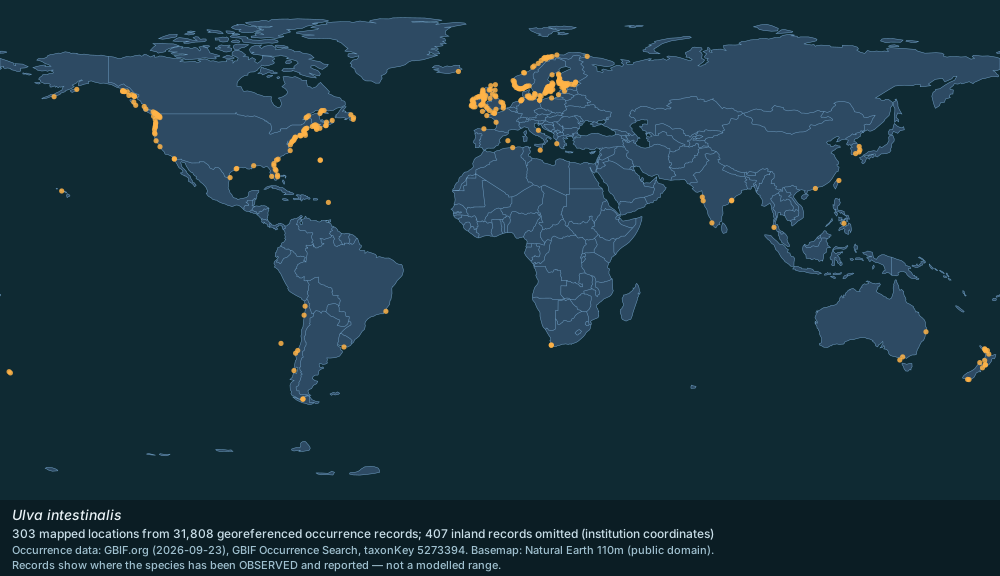
31,808 georeferenced occurrence records for Ulva intestinalis are published through GBIF from 98 countries or marine areas. The map above plots 303 distinct locations from a sample of 3,000 records, omitting 407 inland records that carry an institution's coordinates rather than a collection site; it shows where the species has been observed and reported, not a modelled range.
Most records by country or area: Netherlands (5,041); Estonia (4,567); United Kingdom of Great Britain and Northern Ireland (3,814); United States of America (3,742); Sweden (3,363).
The full country table, WoRMS marine regions and the sampling notes are on this species' Distribution page.
Source: GBIF Occurrence Search (taxonKey 5273394) — https://www.gbif.org/occurrence/search?taxon_key=5273394&has_coordinate=true (records CC0 / CC BY); WoRMS distribution records (MarineRegions) — https://www.marinespecies.org/aphia.php?p=taxdetails&id=234471 (CC BY 4.0); Natural Earth 110m basemap — https://www.naturalearthdata.com/ (public domain). Accessed 2026-09-23.
Description and natural history (Wikipedia)
This species has a generally world-wide distribution. In the Pacific Ocean, it can be found in the Bering Sea near Alaska, the Aleutian Islands, Puget Sound, Japan, Korea, Mexico, the Philippines, and Russia, as well as New Zealand. In the Atlantic Ocean, its range includes the Azores, the Baltic Sea, the Mediterranean Sea, and northern European countries such as Ireland, Belgium, Denmark, Norway, and Poland.
The branched fronds are completely tubular and expand in width to mid-thallus, reaching 15 cm long or more. The cells are irregularly arranged and the chloroplast is hood-shaped and placed to one side, generally with only one pyrenoid. The species may be 10 - 30 cm long and 6 - 18 mm wide. The fronds have rounded tips.
This alga may be reproductive at all times of the year, and has a life-cycle with alternation of generations, in which the gametophyte and sporophyte are isomorphic, having identical morphology.
In some references the species (Ulva intestinalis) is treated as two subspecies: ssp. intestinalis (L.) Link and ssp. compressa (L.) Link.
Source: Wikipedia: Ulva intestinalis — https://en.wikipedia.org/wiki/Ulva_intestinalis (CC BY-SA 4.0). Accessed 2026-09-23.
Gallery
Related in Hollow green nori
Links follow this subject's own source article.
Elsewhere in Hollow green nori
Spotted an error? Know more?
Reader corrections go straight into our review queue. Suggest an edit · How this site is sourced