Winding nori (Ulva flexuosa)
Source-cited species reference: taxonomy from WoRMS, biology from SeaLifeBase, occurrence map from GBIF, description from Wikipedia.
Last updated

Distribution map plotted from GBIF.org occurrence records; basemap Natural Earth 110m · GBIF records CC0 / CC BY; Natural Earth public domain
Ulva flexuosa now generally referred to as Enteromorpha flexuosa (Wulfen ex Roth) J. Agardh). is a species of seaweed in Ulvaceae family that can be found worldwide.
Scientific classification
- CladeEukaryota
- CladeArchaeplastida
- CladeViridiplantae
- ClassUlvophyceae
- OrderUlvales
- FamilyUlvaceae
- GenusUlva
- SpeciesUlva flexuosa
Named by Wulfen, 1803
Close relatives
Other species of Ulva with a Codexery entry.
- Ulva australis Ulva australis
- Ulva intestinalis Ulva intestinalis
- Ulva lactuca Ulva lactuca
- Ulva linza Ulva linza
- Ulva paschima
- Ulva prolifera
Sources: Wikipedia taxobox: Ulva flexuosa (CC BY-SA 4.0) · order, family and genus agree with WoRMS AphiaID 234468 (CC BY 4.0)
How big is it?
Largest length in the source, 0.2 m, next to a 1.8 m person.
Diagram: drawn by Codexery, schematic shapes to scale (not a likeness). Length: SeaLifeBase species summary
Where the winding nori (ulva flexuosa) has been recorded
Each dot is a place where the species has been observed and reported (2,921 records, half-degree grid) — not a modelled range. 244 inland records left out (institution coordinates).
Map: drawn by Codexery. Data: GBIF occurrence search (records CC0 / CC BY) · Natural Earth basemap (public domain) · place coordinates: Wikipedia (CC BY-SA 4.0)
Classification (WoRMS)
Full classification as recorded by WoRMS: Kingdom: Plantae · Phylum: Chlorophyta · Class: Ulvophyceae · Order: Ulvales · Family: Ulvaceae · Genus: Ulva.
Accepted name: Ulva flexuosa · Authority: Wulfen, 1803 · Taxonomic status: accepted · AphiaID: 234468.
Synonyms and superseded combinations recorded for this taxon: Conferva flexuosa Roth, 1800; Enteromorpha compressa var. lingulata (J.Agardh) Hauck, 1884; Enteromorpha flexuosa (Wulfen) J.Agardh, 1883; Enteromorpha intestinalis f. tubulosa (Kützing) V.J.Chapman, 1937; Enteromorpha intestinalis var. tubulosa Kützing, 1845; Enteromorpha lingulata J.Agardh, 1883; Enteromorpha prolifera var. tubulosa (Kützing) Batters, 1902; Enteromorpha tubulosa (Kützing) Kützing, 1856; Enteromorpha tubulosa var. ramosa Schiffner.
Source: World Register of Marine Species (WoRMS) — https://www.marinespecies.org/aphia.php?p=taxdetails&id=234468 (CC BY 4.0). Accessed 2026-09-25.
Biology and life history (SeaLifeBase)
Measured values published by SeaLifeBase for Ulva flexuosa. Only fields the database actually holds for this species are shown; these are database values, not aquarium guidance.
Maximum length: 20 cm · Habitat zone: epiphytic · Vulnerability index: 10 of 100.
SeaLifeBase notes: Fronds are up to 20 cm in height. This is used as bait in fish traps (Ref. 801). Occurs in shallow intertidal mangrove prop roots and wood, or epiphytic in brackish water of estuaries (Ref. 83908). Also on subtidal volcanic rocks (Ref. 80999).
Source: SeaLifeBase species summary (SpecCode 116907) — https://www.sealifebase.se/summary/Ulva-flexuosa.html (CC BY-NC 3.0 — non-commercial use only). Accessed 2026-09-25.
Distribution and occurrence records (GBIF)
2,921 georeferenced occurrence records for Ulva flexuosa are published through GBIF from 97 countries or marine areas. The map above plots 314 distinct locations from a sample of 2,921 records, omitting 405 inland records that carry an institution's coordinates rather than a collection site; it shows where the species has been observed and reported, not a modelled range.
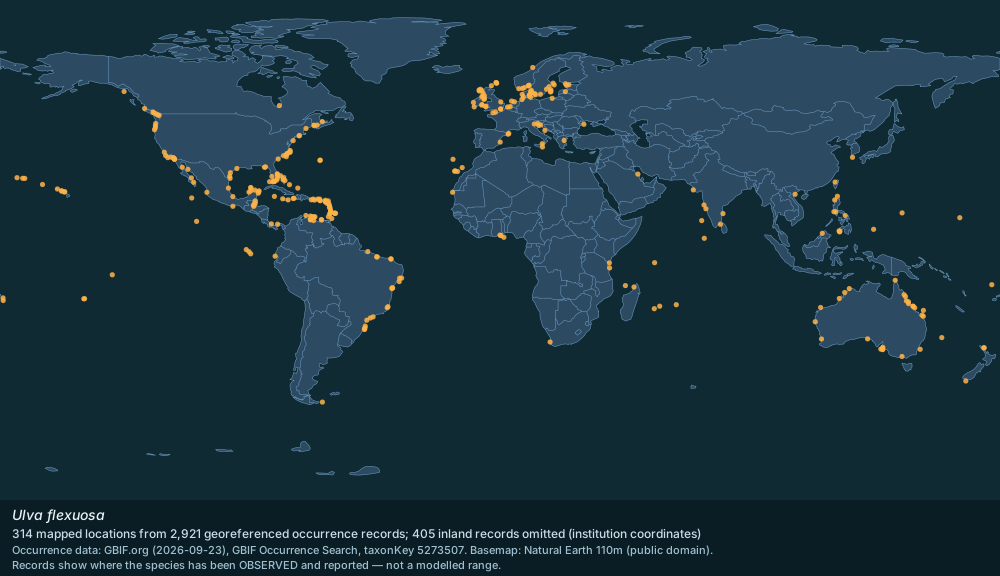
Most records by country or area: United States of America (762); Mexico (293); Brazil (292); United Kingdom of Great Britain and Northern Ireland (214); Sweden (195).
The full country table, WoRMS marine regions and the sampling notes are on this species' Distribution page.
Source: GBIF Occurrence Search (taxonKey 5273507) — https://www.gbif.org/occurrence/search?taxon_key=5273507&has_coordinate=true (records CC0 / CC BY); WoRMS distribution records (MarineRegions) — https://www.marinespecies.org/aphia.php?p=taxdetails&id=234468 (CC BY 4.0); Natural Earth 110m basemap — https://www.naturalearthdata.com/ (public domain). Accessed 2026-09-25.
Description and natural history (Wikipedia)
This large green alga may grow to 25 cm, it is tubular and similar to E. prolifera. It is very variable with branches showing cells in longitudinal and sometimes also in transverse rows.
The species can be found in such European countries as Ireland, Belgium, Bulgaria, France, Greece, Italy, Portugal, Romania, Slovenia, Spain, Sweden, Great Britain (Scotland), and on island of Corsica.
In Africa it can be found in Algeria, Cameroon, Egypt, Gabon, Guinea, Equatorial Guinea, Eritrea, Ethiopia, Liberia, Namibia, Nigeria, Senegal, Sierra Leone, Somalia, South Africa, Togo, Tunisia, and on the islands such as Canary Islands, Madagascar, Mauritius and São Tomé and Príncipe.
In Asia, it is found in Bahrain, China, India, Iran, Kuwait, Pakistan, Saudi Arabia, Taiwan and Yemen.
It is also have North and South American distribution, which includes countries such as Argentina, Brazil, Chile, Ecuador, Mexico, Uruguay and Venezuela. In Central America it can be found in such countries as Belize, Costa Rica, and Panama, while in Caribbean it can be found on Bahamas, Barbados, Cuba, Hispaniola, Jamaica, Martinique, Tobago, Virgin Islands, and on Lesser and Netherlands Antilles.
The species is distributed throughout the US states such as California, Florida, Mississippi, North Carolina, Oregon, Texas, and Washington.
Source: Wikipedia: Ulva flexuosa — https://en.wikipedia.org/wiki/Ulva_flexuosa (CC BY-SA 4.0). Accessed 2026-09-25.
Related in Winding nori
Links follow this subject's own source article.
Elsewhere in Winding nori
Sources
Compiled from Wikipedia and the sources listed below. Text from Wikipedia is available under CC BY-SA 4.0; this entry is adapted from it.
- Wikipedia: Ulva flexuosa (CC BY-SA 4.0).
- Classification: the source article's taxobox; order, family and genus checked against WoRMS, the World Register of Marine Species (CC BY 4.0).
- Occurrence records: GBIF (CC0 / CC BY). Basemap: Natural Earth (public domain).
- Biology values: SeaLifeBase species summary (CC BY-NC 3.0, non-commercial).
- Word definitions: the , each quoted from its Wikipedia article.
Spotted an error? Know more?
Reader corrections go straight into our review queue. Suggest an edit · How this site is sourced