
Ulothrix flacca
Source-cited species reference: taxonomy from WoRMS, biology from SeaLifeBase, occurrence map from GBIF, description from Wikipedia.
Ulothrix flacca is a species of green algae in the family Ulotrichaceae. It is a marine or brackish species, typically found in the intertidal zone.
- Scientific name
- Ulothrix flacca
- Authority
- (Dillwyn) Thuret, 1863
- Family
- Ulotrichaceae
- Order
- Ulotrichales
- Habitat zone
- benthic
- Gbif occurrence records
- 1,753
Classification (WoRMS)
Full classification as recorded by WoRMS: Kingdom: Plantae · Phylum: Chlorophyta · Class: Ulvophyceae · Order: Ulotrichales · Family: Ulotrichaceae · Genus: Ulothrix.
Accepted name: Ulothrix flacca · Authority: (Dillwyn) Thuret, 1863 · Taxonomic status: accepted · AphiaID: 145925.
Synonyms and superseded combinations recorded for this taxon: Conferva flacca Dillwyn, 1805; Hormotrichum fasciculare Kützing; Lyngbya carmichaelii Harvey, 1833; Lyngbya flacca (Dillwyn) Harvey, 1849; Ulothrix consociata Wille, 1901; Ulothrix consociata var. islandica Jónsson, 1903; Ulothrix islandica (H.Jónsson) Printz, 1926; Ulothrix pseudoflacca Wille, 1901; Ulothrix scutata H.Jónsson, 1904.
Source: World Register of Marine Species (WoRMS) — https://www.marinespecies.org/aphia.php?p=taxdetails&id=145925 (CC BY 4.0). Accessed 2026-09-23.
Biology and life history (SeaLifeBase)
Measured values published by SeaLifeBase for Ulothrix flacca. Only fields the database actually holds for this species are shown; these are database values, not aquarium guidance.
Habitat zone: benthic.
Source: SeaLifeBase species summary (SpecCode 109117) — https://www.sealifebase.se/summary/Ulothrix-flacca.html (CC BY-NC 3.0 — non-commercial use only). Accessed 2026-09-23.
Distribution and occurrence records (GBIF)
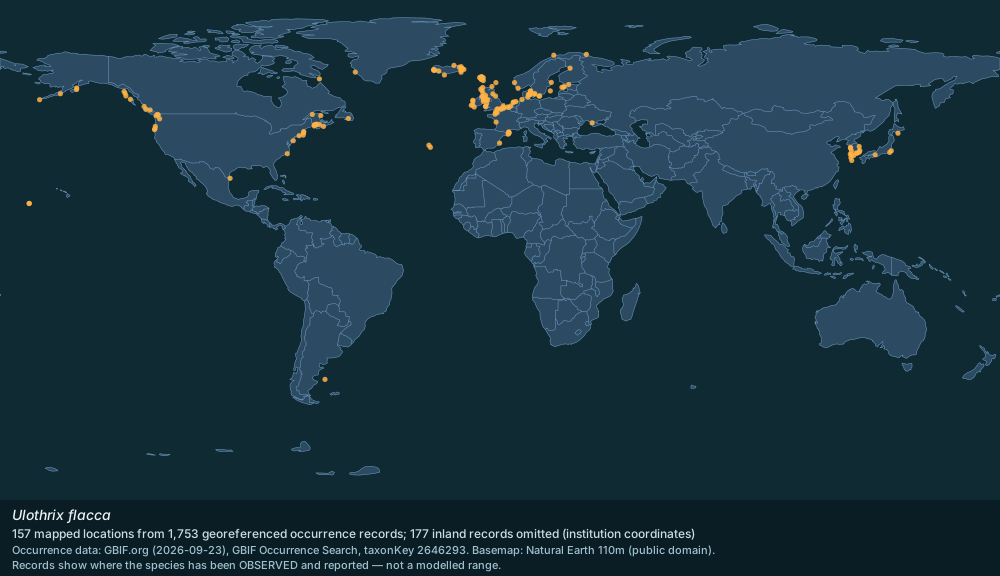
1,753 georeferenced occurrence records for Ulothrix flacca are published through GBIF from 34 countries or marine areas. The map above plots 157 distinct locations from a sample of 1,753 records, omitting 177 inland records that carry an institution's coordinates rather than a collection site; it shows where the species has been observed and reported, not a modelled range.
Most records by country or area: United Kingdom of Great Britain and Northern Ireland (386); Iceland (249); United States of America (237); Japan (124); Netherlands (117).
The full country table, WoRMS marine regions and the sampling notes are on this species' Distribution page.
Source: GBIF Occurrence Search (taxonKey 2646293) — https://www.gbif.org/occurrence/search?taxon_key=2646293&has_coordinate=true (records CC0 / CC BY); WoRMS distribution records (MarineRegions) — https://www.marinespecies.org/aphia.php?p=taxdetails&id=145925 (CC BY 4.0); Natural Earth 110m basemap — https://www.naturalearthdata.com/ (public domain). Accessed 2026-09-23.
Description and natural history (Wikipedia)
Ulothrix flacca grows as small tufts of green unbranched filaments growing to no more than 10 cm long, forming woolly masses attached to rocks. It consists of soft, long filaments which are uniseriate (very rarely a cell may undergo longitudinal division and become biseriate). Basal cells are elongated, or in mature filaments, differentiated into a complex rhizoidal branching system. Cells are cylindrical, 14.4–32.6 μm broad and 4.8–9.6 μm, Cells contain a single chloroplast, which is parietal and sometimes lobed. The chloroplast shape varies with age: in young cells, the chloroplasts tend to be shorter and covering less of the cell circumference. Chloroplasts typically have one to three pyrenoids.
Ulothrix pseudoflacca and Ulothrix consociata are considered to be forms of Ulothrix flacca by some biologists. Sometimes difficult to distinguish Ulothrix from Urospora.
Ulothrix flacca may reproduce vegetatively by fragmentation of filaments. It also reproduces asexually or sexually; in both cases, vegetative cells (except for those producing rhizoids) develop into zoosporangia or gametangia, respectively. Zoosporangia are yellow-green, somewhat longer than vegetative cells. Each zoosporangium produces typically 8–32 zoospores; the zoospores are typically 6.6–10.6 μm long, spindle-shaped and with two flagella, a cup-shaped chloroplast, pyrenoid and a small stigma. Zoospores are released through an opening in the cell wall of the zoosporangium; after swimming, they attach to a hard substrate, lose their flagella, and germinate into new filaments. Aplanospores may also be produced instead of zoospores; aplanospores may begin germination in the zoosporangium.
Gametangia are olive-brown, similar in morphology to zoospores but somewhat smaller. Gametic fusion is monoecious and isogamous. The resulting zygotes have four flagella; the zygotes develop into a small, single-celled sporophyte phase. The sporophyte then undergoes meiosis to form zoospores or aplanospores.
Ulothrix flacca is common all around the British Isles. It has been recorded from Scandinavia south to Portugal, in the Mediterranean and the Black Sea, and also all around the world into the Pacific.
It is found on rocks, stones and epiphytically on other algae. It has a wide habitat range in the littoral zone, but it is typically absent from beaches.
Source: Wikipedia: Ulothrix flacca — https://en.wikipedia.org/wiki/Ulothrix_flacca (CC BY-SA 4.0). Accessed 2026-09-23.
Gallery
Related in Ulothrix flacca
Links follow this subject's own source article.
Elsewhere in Ulothrix flacca
Spotted an error? Know more?
Reader corrections go straight into our review queue. Suggest an edit · How this site is sourced