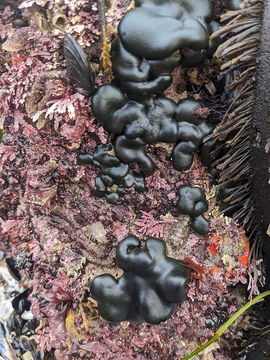
Ulothrix
A cosmopolitan genus of unbranched green algal filaments.

Ulothrix is a genus of green algae in the family Ulotrichaceae, common in fresh to marine habitats, particularly colder and temperate waters, with a cosmopolitan distribution. It consists of unbranched, uniseriate filaments attached to substrates via a basal cell, and is notable for its role in intertidal and freshwater environments.
Quick Facts
- Taxon
- Ulothrix
- Type Species
- Ulothrix tenuissima
- Type Species Authority
- Kützing
Facts from the source article.
Lore & Background
Ulothrix cells are arranged end-to-end to form unbranched, uniseriate filaments, attached to a substrate via a basal cell that may be rhizoidal. Cells are cylindrical or barrel-shaped, with a single girdle-like parietal chloroplast containing one pyrenoid surrounded by a starch envelope. The cell wall is thin and smooth in young cells but becomes thick and sometimes roughened with age. Species are identified based on presence or absence of mucilage, cell dimensions, cell wall characteristics, and akinete features, though the taxonomy of the genus is rather poorly known. A similar genus is Pearsoniella, which differs in having completely closed chloroplasts and sometimes multiseriate filaments.
Reader's Guide
Ulothrix is significant as a common genus in both freshwater and marine intertidal zones, where it forms tufts or mats up to a few centimeters long. Its life cycle is incompletely known and may vary by species, with a disputed sporophyte phase. Vegetative reproduction occurs via fragmentation, and asexual reproduction via quadriflagellate zoospores produced in winter, while sexual reproduction involves biflagellate isogamous gametes produced in summer. The genus is also notable for its ability to produce akinetes and aplanospores under certain conditions. Its presence in aerated freshwater sites and variable marine environments highlights its ecological adaptability, though its taxonomy remains poorly understood.
Did You Know?
- Ulothrix zoospores have four flagella and are positively phototactic.
- Gametes are biflagellate, spindle-shaped, and positively phototactic.
- The zygote forms a unicellular Codiolum-stage sporophyte.
- Ulothrix produces zoospores in winter and gametes in summer.
More in Marine Green Macroalgae 1-24
Spotted an error? Know more?
Reader corrections go straight into our review queue. Suggest an edit · How this site is sourced