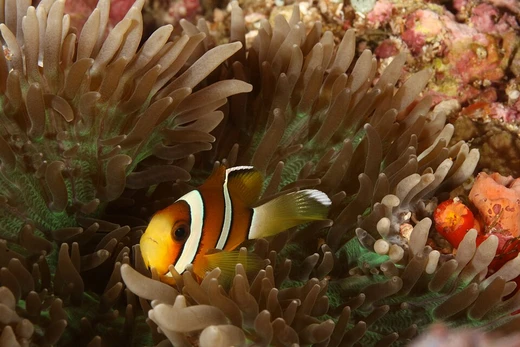
Three-band anemonefish (Amphiprion tricinctus)
Source-cited species reference: taxonomy from WoRMS, biology from FishBase, occurrence map from GBIF, conservation from IUCN Red List, description from Wikipedia.

Jerome Paillet (IFREMER, Laboratoire d'Océanographie Physique et Spatiale, Centr · CC BY 4.0
The three-band anemonefish (Amphiprion tricinctus) is a species of anemonefish endemic to the Marshall Islands in the western part of the Pacific Ocean. Like all anemonefishes, it forms a symbiotic mutualism with sea anemones and is unaffected by the stinging tentacles of its host. It is a sequential hermaphrodite with a strict size-based dominance hierarchy; the female is largest, the breeding male is second largest, and the male nonbreeders get progressively smaller as the hierarchy descends. They exhibit protandry, meaning the breeding male changes to female if the sole breeding female dies, with the largest nonbreeder becoming the breeding male. The fish's natural diet includes zooplankton.
- Scientific name
- Amphiprion tricinctus
- Authority
- Schultz & Welander, 1953
- Family
- Pomacentridae
- Order
- Ovalentaria incertae sedis
- Maximum length
- 12 cm
- Depth range
- 3–40 m
- Habitat zone
- reef-associated
- Iucn red list
- Least Concern
- Gbif occurrence records
- 250
Symbiotic Partnership with Sea Anemones
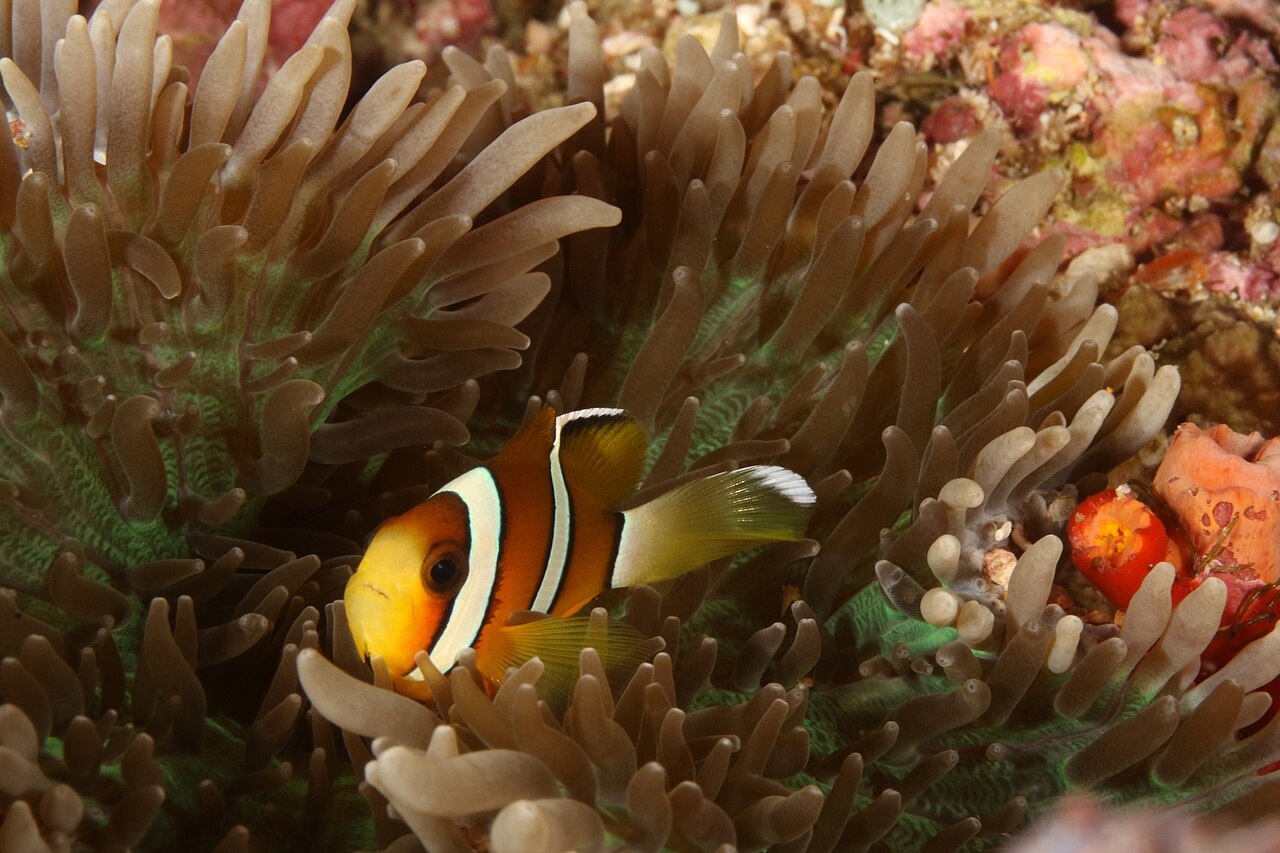
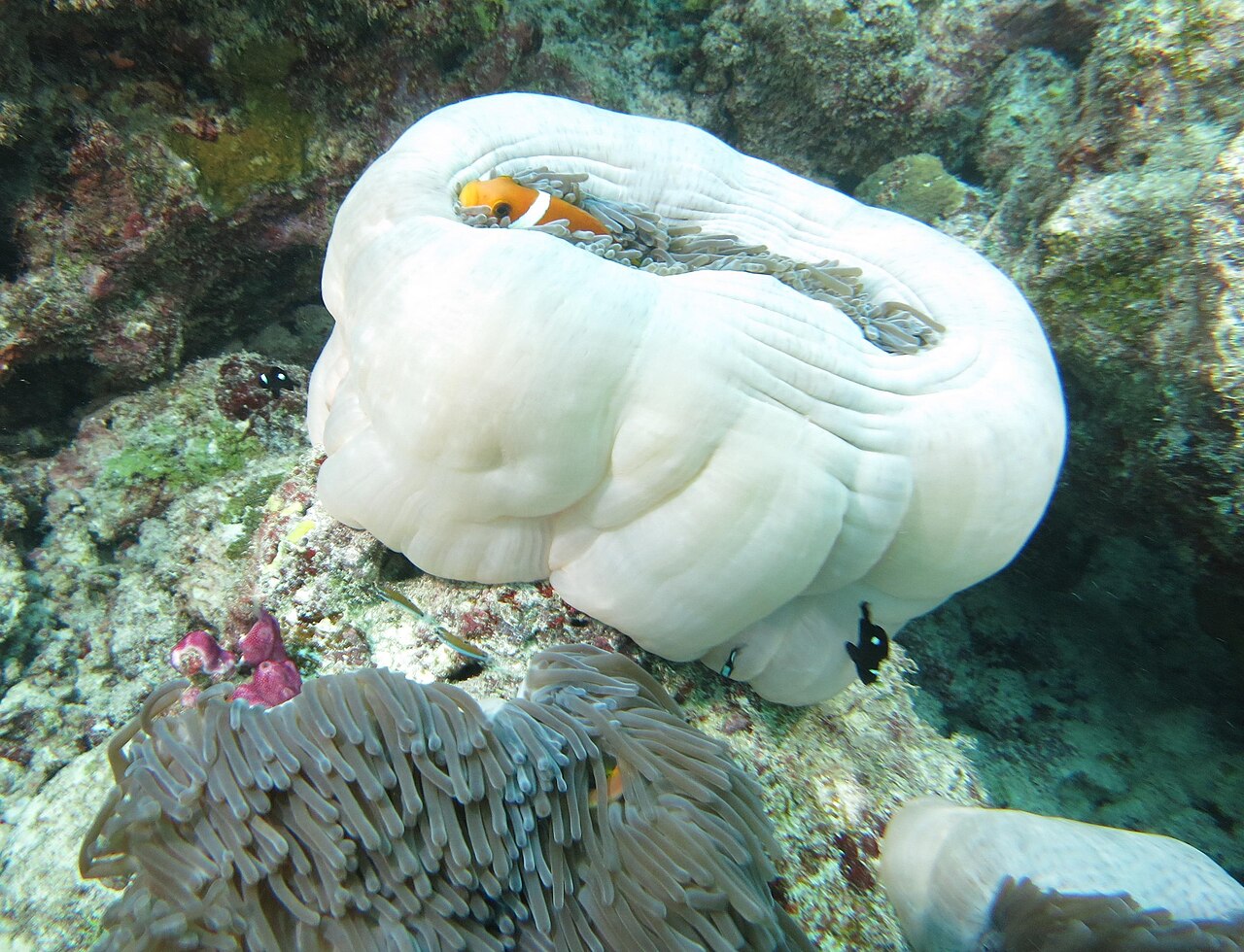
The Three-band anemonefish, a member of the genus Amphiprion, is a saltwater species that inhabits the warm, tropical waters of the Indo-Pacific, where it is most commonly found on coral reefs. At the heart of its ecological identity lies a mutually beneficial partnership with sea anemones. The fish depends on the anemone's stinging tentacles as a refuge, gaining shelter and protection from predators that would otherwise prey on it. In exchange, the anemonefish serves as a vigilant guardian, driving away anemone-eating fish, fanning and cleaning the anemone's tissues, and attracting beneficial microorganisms through its waste. This bond is so fundamental to the species' life cycle that newly hatched young, after a period of dispersal as larvae in the open ocean, must eventually settle on the seafloor and find a suitable anemone host before they can take their place in a reef community. Anemone availability thus becomes a linchpin of the Three-band anemonefish's survival and reproductive success.
Social Hierarchy and Sexual Plasticity
Like other members of the genus Amphiprion, the Three-band anemonefish lives in organised groups that include a breeding female, a breeding male, and a number of non-breeding individuals. A strict size-based dominance hierarchy structures these groups: the breeding female occupies the top position, followed by the breeding male, then the largest non-breeder, and so on down the line. One of the most remarkable features of this social system is its capacity for sexual change. When the dominant female is lost, the breeding male transforms into a female and assumes her reproductive role, while the remaining group members shift upward in the hierarchy to fill the gaps. Reproduction itself is a coordinated effort: the female deposits her eggs on a rock near the anemone, and the male fertilises them. After hatching, the young disperse into the open ocean as free-swimming larvae before eventually settling and seeking an anemone host. This blend of rigid social order and fluid sexual identity makes the Three-band anemonefish a compelling example of biological adaptability in marine ecosystems.
Taxonomic Journey and Phylogenetic Roots
The Three-band anemonefish belongs to the genus Amphiprion, a name coined in 1801 by Marcus Elieser Bloch and Johann Gottlob Theaenus Schneider. The genus name derives from the Greek words meaning 'on both sides' and 'saw,' a reference to the saw-shaped edges found along the gill covering and beneath the eyes. Taxonomically, clownfish sit within the damselfish family Pomacentridae, though their exact subfamily placement has shifted over the years: Gerald R. Allen created the subfamily Amphiprioninae in 1975, while a 2009 genetic study proposed the tribe Amphiprionini within Pomacentrinae. Phylogenetically, the clownfish lineage diverged from other living damselfishes roughly 35 million years ago during the late Eocene, and the most recent common ancestor of all extant species dates to about 10.5 million years ago in the Early Miocene. A 2014 study traced the group's origin to the Malay Archipelago, with species diversification accelerating around 5 million years ago through two major adaptive radiations. The Three-band anemonefish shares this deep evolutionary heritage, as well as genetic evidence of extensive interbreeding across species throughout its history.
Physical Design and Sensory World
Members of the genus Amphiprion, including the Three-band anemonefish, display a distinctive colouration of white vertical bars—typically zero to three, edged in black—set against a background of red, orange, yellow, brown, or black. Their bodies range from oval to streamlined, with rounded heads that lack scales between the snout and eyes. Teeth line both the oral and pharyngeal jaws but are absent on the palate, and may be either conical or chisel-shaped. The dorsal fin carries 10 spines followed by 14 to 20 soft rays, while pectoral fins bear 15 to 21 rays. Their sensory toolkit is equally specialised: eyes positioned on the sides of the head provide some binocular vision, and light enters through small gaps between the iris and lens, enabling perception of both colour and ultraviolet wavelengths. A single nostril opening houses an arrow-shaped olfactory organ with fork-like lamellae, a trait unique among fish. Their ears are attuned to relatively low frequencies between 75 and 900 Hz. Together, these anatomical and sensory features equip the Three-band anemonefish to forage on plankton, navigate its reef environment, and maintain its close association with anemone hosts.
Gallery
Spotted an error? Know more?
Reader corrections go straight into our review queue. Suggest an edit · How this site is sourced