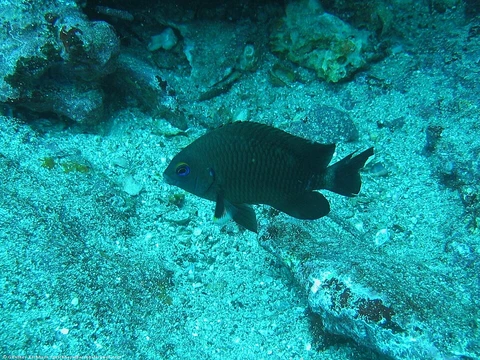
Southern whitetail major (Stegastes beebei)
Source-cited species reference: taxonomy from WoRMS, biology from FishBase, occurrence map from GBIF, conservation from IUCN Red List, description from Wikipedia.

Stegastes beebei (Galapagos ringtail damselfish or southern whitetail major), is a species of damselfish found on coral and rocky reefs at depths between 0 and 15 m. They are somewhat territorial, and chase away small intruders. They are omnivorous, grazing on algae and nibbling at small crustaceans and the tentacles of anemones. They are oviparous, with distinct pairing during breeding. The eggs are demersal and adhere to the substrate. Males guard and aerate the eggs.
- Scientific name
- Stegastes beebei
- Authority
- (Nichols, 1924)
- Family
- Pomacentridae
- Order
- Ovalentaria incertae sedis
- Maximum length
- 15 cm
- Depth range
- 1–5 m
- Habitat zone
- reef-associated
- Iucn red list
- Least Concern
- Gbif occurrence records
- 2,827
Classification (WoRMS)
Full classification as recorded by WoRMS: Kingdom: Animalia · Phylum: Chordata · Class: Teleostei · Order: Ovalentaria incertae sedis · Family: Pomacentridae · Genus: Stegastes.
Accepted name: Stegastes beebei · Authority: (Nichols, 1924) · Taxonomic status: accepted · AphiaID: 276665.
Synonyms and superseded combinations recorded for this taxon: Eupomacentrus beebei Nichols, 1924; Pomacentrus beebei (Nichols, 1924); Stegastes leucorus beebei (Nichols, 1924).
Source: World Register of Marine Species (WoRMS) — https://www.marinespecies.org/aphia.php?p=taxdetails&id=276665 (CC BY 4.0). Accessed 2026-09-23.
Biology and life history (FishBase)
Measured values published by FishBase for Stegastes beebei. Only fields the database actually holds for this species are shown; these are database values, not aquarium guidance.
Maximum length: 15 cm · Depth range: 1–5 m · Habitat zone: reef-associated · Body shape: short and / or deep · Vulnerability index: 22.8 of 100 · Aquarium trade: never/rarely.
FishBase notes: Adults inhabit coral and rocky reefs (Ref. 9334). Somewhat territorial, they chase away small intruders (Ref. 5227). Omnivorous, they graze on algae and nibbles at small crustaceans and the tentacles of anemones (Ref. 28023). Oviparous, distinct pairing during breeding (Ref. 205). Eggs are demersal and adhere to the substrate (Ref. 205). Males guard and aerate the eggs (Ref. 205).
Source: FishBase species summary (SpecCode 14285) — https://www.fishbase.se/summary/Stegastes-beebei.html (CC BY-NC 3.0 — non-commercial use only). Accessed 2026-09-23.
Distribution and occurrence records (GBIF)
2,827 georeferenced occurrence records for Stegastes beebei are published through GBIF from 6 countries or marine areas. The map above plots 34 distinct locations from a sample of 2,827 records, omitting 4 inland records that carry an institution's coordinates rather than a collection site; it shows where the species has been observed and reported, not a modelled range.
Most records by country or area: Ecuador (2,752); Mexico (55); Costa Rica (12); Colombia (5); Peru (2).
The full country table, WoRMS marine regions and the sampling notes are on this species' Distribution page.
Source: GBIF Occurrence Search (taxonKey 2398845) — https://www.gbif.org/occurrence/search?taxon_key=2398845&has_coordinate=true (records CC0 / CC BY); WoRMS distribution records (MarineRegions) — https://www.marinespecies.org/aphia.php?p=taxdetails&id=276665 (CC BY 4.0); Natural Earth 110m basemap — https://www.naturalearthdata.com/ (public domain). Accessed 2026-09-23.
Conservation status (IUCN Red List)
The IUCN Red List assesses Stegastes beebei (Nichols, 1924) as Least Concern (code LC). No trend, population estimate or threat analysis is given here, because none is available from this source without the Red List API; follow the source link for the full assessment, including its date.
Source: IUCN Red List of Threatened Species (taxon 183462) — https://www.iucnredlist.org/species/183462/0; GBIF IUCN Red List category endpoint (taxonKey 2398845) — https://api.gbif.org/v1/species/2398845/iucnRedListCategory. Accessed 2026-09-23.
Description and natural history (Wikipedia)
From: The body is oval and compressed, with one pair of nostrils. The margin of the preopercle is serrated; the margin of bone under the eyes is serrated, without a notch in it and the bone before it. The mouth is small and protrusible with teeth in a single row, long and close-set. About 11 (10–12) lower gill rakers are present. They have a single continuous dorsal fin, and no projecting short spines at upper and lower base of tail fin. The caudal fin is bluntly forked. The scales are moderately large and rough; the body is scaled, and the head is largely scaled (the snout is scaled to the nostrils), as are the basal parts of the median fins. The lateral line has 20 scales (rarely 19). It is incomplete and ends under the end of the dorsal fin base. They grow up to 17 cm in length.
Galapagos ringtail damselfish are dark brown with darker scale outlines, often with a white band on the caudal peduncle. They have blue irises and white or yellow outer edges of the pectoral fin. Juveniles are dark with a red nape, upper back and spiny dorsal fin, and a dark ocellus at the rear base of the dorsal fin.
They are found in the eastern Pacific off Panama, Malpelo Island (Colombia), Cocos Island (Panama), and the Galápagos Islands.
The specific name honours the American naturalist and explorer William Beebe (1877–1962) of the New York Zoological Society.
Source: Wikipedia: Stegastes beebei — https://en.wikipedia.org/wiki/Stegastes_beebei (CC BY-SA 4.0). Accessed 2026-09-23.
Related in Southern whitetail major
Links follow this subject's own source article.
Elsewhere in Southern whitetail major
Spotted an error? Know more?
Reader corrections go straight into our review queue. Suggest an edit · How this site is sourced