
Knobby brain coral (Pseudodiploria clivosa)
Source-cited species reference: taxonomy from WoRMS, biology from SeaLifeBase, occurrence map from GBIF, conservation from IUCN Red List, description from Wikipedia.

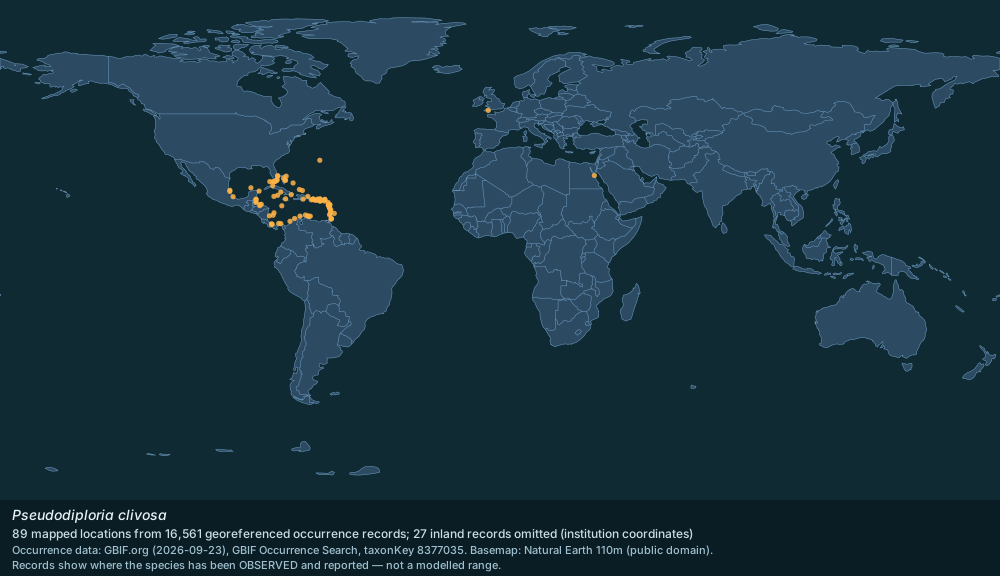
Distribution map plotted from GBIF.org occurrence records; basemap Natural Earth 110m · GBIF records CC0 / CC BY; Natural Earth public domain
Pseudodiploria clivosa, the knobby brain coral, is a colonial species of stony coral in the family Mussidae. It occurs in shallow water in the West Atlantic Ocean and Caribbean Sea.
- Scientific name
- Pseudodiploria clivosa
- Authority
- (Ellis & Solander, 1786)
- Family
- Faviidae
- Order
- Scleractinia
- Depth range
- 0–41 m
- Habitat zone
- reef-associated
- Iucn red list
- Near Threatened
- Gbif occurrence records
- 16,561
Classification (WoRMS)
Full classification as recorded by WoRMS: Kingdom: Animalia · Phylum: Cnidaria · Class: Hexacorallia · Order: Scleractinia · Family: Faviidae · Genus: Pseudodiploria.
Accepted name: Pseudodiploria clivosa · Authority: (Ellis & Solander, 1786) · Taxonomic status: accepted · AphiaID: 828326.
Synonyms and superseded combinations recorded for this taxon: Astraea agassizii Haime & Milne Edwards, 1857; Diploria clivosa (Ellis & Solander, 1786); Diploria mammosa (Dana, 1846); Leptoria hieroglyphica Duchassaing & Michelotti, 1860; Madrepora clivosa Ellis & Solander, 1786; Madrepora filograna Esper, 1789; Maeandra agassizii Haime & Milne Edwards, 1857; Maeandra clivosa (Ellis & Solander, 1786); Maeandra clivosa var. dispar Verrill, 1901; Maeandra clivosa var. explanata Verrill, 1901; Maeandrina clivosa (Ellis & Solander, 1786); Maeandrina filograna (Esper, 1789); Maeandrina grandilobata Milne Edwards & Haime, 1849; Meandrina clivosa (Ellis & Solander, 1786); Meandrina filograna (Esper, 1789); Meandrina grandiloba Milne Edwards & Haime, 1849; Meandrina grandilobata Milne Edwards & Haime, 1849; Meandrina mammosa Dana, 1846; Platygyra clivosa (Ellis & Solander, 1786).
Source: World Register of Marine Species (WoRMS) — https://www.marinespecies.org/aphia.php?p=taxdetails&id=828326 (CC BY 4.0). Accessed 2026-09-23.
Biology and life history (SeaLifeBase)
Measured values published by SeaLifeBase for Pseudodiploria clivosa. Only fields the database actually holds for this species are shown; these are database values, not aquarium guidance.
Depth range: 0–41 m · Habitat zone: reef-associated.
SeaLifeBase notes: Zooxanthellate (Ref. 116012).
Source: SeaLifeBase species summary (SpecCode 46690) — https://www.sealifebase.se/summary/Pseudodiploria-clivosa.html (CC BY-NC 3.0 — non-commercial use only). Accessed 2026-09-23.
Distribution and occurrence records (GBIF)
16,561 georeferenced occurrence records for Pseudodiploria clivosa are published through GBIF from 41 countries or marine areas. The map above plots 89 distinct locations from a sample of 3,000 records, omitting 27 inland records that carry an institution's coordinates rather than a collection site; it shows where the species has been observed and reported, not a modelled range.
Most records by country or area: Virgin Islands (U.S.) (5,809); United States of America (4,092); Puerto Rico (2,556); United Kingdom of Great Britain and Northern Ireland (1,080); Colombia (831).
The full country table, WoRMS marine regions and the sampling notes are on this species' Distribution page.
Source: GBIF Occurrence Search (taxonKey 8377035) — https://www.gbif.org/occurrence/search?taxon_key=8377035&has_coordinate=true (records CC0 / CC BY); WoRMS distribution records (MarineRegions) — https://www.marinespecies.org/aphia.php?p=taxdetails&id=828326 (CC BY 4.0); Natural Earth 110m basemap — https://www.naturalearthdata.com/ (public domain). Accessed 2026-09-23.
Conservation status (IUCN Red List)
The IUCN Red List assesses Pseudodiploria clivosa (Ellis & Solander, 1786) as Near Threatened (code NT). No trend, population estimate or threat analysis is given here, because none is available from this source without the Red List API; follow the source link for the full assessment, including its date.
Source: IUCN Red List of Threatened Species (taxon 133377) — https://www.iucnredlist.org/species/133377/0; GBIF IUCN Red List category endpoint (taxonKey 8377035) — https://api.gbif.org/v1/species/8377035/iucnRedListCategory. Accessed 2026-09-23.
Description and natural history (Wikipedia)
The knobby brain coral is a massive coral that either forms hemispherical domes or, particularly in areas of high wave action, forms plates and encrusts the seabed. It can grow to a diameter of about 1.3 m. The surface of the dome usually has a number of bulges or knobs but this species is not easy to distinguish from the symmetrical brain coral which tends to have a smoother outline. The surface consists of sharply delineated, convoluted ridges with valleys in between. There is no trough-like groove in the top of the ridge as is the case in the rather similar grooved brain coral (Diploria labyrinthiformis). The coral polyps are strung along the valley bottoms, each sitting in a little stony cup or corallite. The sides of these have minute walls called septa which come in four different sized cycles. They extend outside the corallites as costae that join one corallite to another but are discontinuous in this species, another distinguishing factor. The colour of the coral is usually some shade of yellowish or greenish brown and is caused by the presence of symbiotic dinoflagellates called zooxanthellae in the coral's tissues.
The knobby brain coral is a common species and occurs in southern Florida, the Caribbean Sea and the Bahamas. It is found growing on reefs, in seagrass (Thalassia testudinum) meadows, in lagoons and sometimes on mangroves. It grows at depths down to about 40 m but is most common at depths less than 5 m.
The fossilised remains of Pseudodiploria clivosa have been found alongside those of other massive corals Pseudodiploria strigosa, Siderastrea siderea and Solenastrea bouroni in marine deposits in Río Grande de Manatí, Puerto Rico that date back to the Pleistocene.
During the day the polyps of the knobby brain coral are retracted into the corallites but at night they emerge and extend their tentacles to feed. The zooxanthellae are photosynthetic and up to fifty percent of their production is transferred to the host while they make use of the coral's nitrogenous waste.
The knobby brain coral grows by the budding of new polyps and the deposition of new calcareous material. Growth is very slow and large corals may be over a hundred years old. Sexual reproduction occurs by the release of gametes into the water column. The planula larvae drift with the currents before settling on the seabed and undergoing metamorphosis into polyps. These begin to secrete their own skeletons and found new colonies.
Source: Wikipedia: Pseudodiploria clivosa — https://en.wikipedia.org/wiki/Pseudodiploria_clivosa (CC BY-SA 4.0). Accessed 2026-09-23.
Gallery
Related in Knobby brain coral
Links follow this subject's own source article.
Elsewhere in Knobby brain coral
Spotted an error? Know more?
Reader corrections go straight into our review queue. Suggest an edit · How this site is sourced