
Dome coral (Porites nodifera)
Source-cited species reference: taxonomy from WoRMS, biology from SeaLifeBase, occurrence map from GBIF, conservation from IUCN Red List, description from Wikipedia.
Porites nodifera, also known as dome coral, is a species of stony coral in the Poritidae family.
- Scientific name
- Porites nodifera
- Authority
- Klunzinger, 1879
- Family
- Poritidae
- Order
- Scleractinia
- Depth range
- 0–5 m
- Habitat zone
- reef-associated
- Iucn red list
- Least Concern
- Gbif occurrence records
- 82
Classification (WoRMS)
Full classification as recorded by WoRMS: Kingdom: Animalia · Phylum: Cnidaria · Class: Hexacorallia · Order: Scleractinia · Family: Poritidae · Genus: Porites.
Accepted name: Porites nodifera · Authority: Klunzinger, 1879 · Taxonomic status: accepted · AphiaID: 207224.
Synonyms and superseded combinations recorded for this taxon: Madrepora (Porites) clavaria (Lamarck, 1816); Porites clavaria Lamarck, 1816.
Source: World Register of Marine Species (WoRMS) — https://www.marinespecies.org/aphia.php?p=taxdetails&id=207224 (CC BY 4.0). Accessed 2026-09-23.
Biology and life history (SeaLifeBase)
Measured values published by SeaLifeBase for Porites nodifera. Only fields the database actually holds for this species are shown; these are database values, not aquarium guidance.
Depth range: 0–5 m · Habitat zone: reef-associated.
SeaLifeBase notes: Shallow waters. Typically a component of isolated Porites sp.-dominated patch reefs. Tolerant of high salinities (Ref.
Source: SeaLifeBase species summary (SpecCode 45608) — https://www.sealifebase.se/summary/Porites-nodifera.html (CC BY-NC 3.0 — non-commercial use only). Accessed 2026-09-23.
Distribution and occurrence records (GBIF)
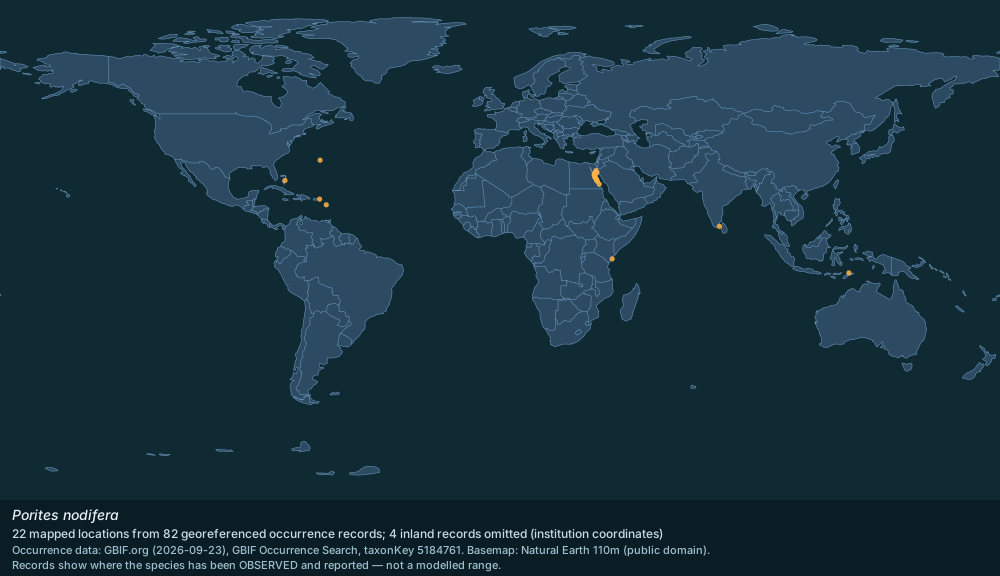
82 georeferenced occurrence records for Porites nodifera are published through GBIF from 13 countries or marine areas. The map above plots 22 distinct locations from a sample of 82 records, omitting 4 inland records that carry an institution's coordinates rather than a collection site; it shows where the species has been observed and reported, not a modelled range.
Most records by country or area: Egypt (62); Saudi Arabia (5); Israel (3); Costa Rica (2); Montserrat (2); Bermuda (1); Bahamas (1); Cuba (1); India (1); Jamaica (1); Kenya (1); Timor-Leste (1); Virgin Islands (U.S.) (1).
Marine regions with a valid WoRMS distribution record: Red Sea; Kenyan Exclusive Economic Zone.
Source: GBIF Occurrence Search (taxonKey 5184761) — https://www.gbif.org/occurrence/search?taxon_key=5184761&has_coordinate=true (records CC0 / CC BY); WoRMS distribution records (MarineRegions) — https://www.marinespecies.org/aphia.php?p=taxdetails&id=207224 (CC BY 4.0); Natural Earth 110m basemap — https://www.naturalearthdata.com/ (public domain). Accessed 2026-09-23.
Conservation status (IUCN Red List)
The IUCN Red List assesses Porites nodifera Klunzinger, 1879 as Least Concern (code LC). No trend, population estimate or threat analysis is given here, because none is available from this source without the Red List API; follow the source link for the full assessment, including its date.
Source: IUCN Red List of Threatened Species (taxon 132889) — https://www.iucnredlist.org/species/132889/0; GBIF IUCN Red List category endpoint (taxonKey 5184761) — https://api.gbif.org/v1/species/5184761/iucnRedListCategory. Accessed 2026-09-23.
Description and natural history (Wikipedia)
It was first described by Carl Benjamin Klunzinger, a German physician and zoologist active in the Red Sea region in the 1860s, and classifying its species in the 1870s and 1880s.
Porites nodifera have a hard substrate and grow in column-like structures toward the surface of the water. The surface of each column tends to take on a relatively flat, circular shape and the coral has a fairly smooth surface. Overall, the color of the coral ranges from a dark brown to a light brown. It takes on a similar appearance to Porites harrisoni, which is a popular Porites species that is also found in the Persian Gulf; however, Porites nodifera tend to form columns that are substantially thicker in comparison.
Porites nodifera is native to the northwestern Indian Ocean, including the Red Sea, Gulf of Aden, and Persian Gulf. It is found in shallow water, generally at depths less than 5 m, but up to 15 m deep.
It is tolerant of salinities of up to 4.8% and therefore is very common in areas of high salinities where sea grasses also dominate the habitat. Salinity is an ecological factor which limits the lower zones of coral reefs so the species is able to dominate the lowest zones of the Dahab Reef in Egypt in particular, forming a considerable single species stand. There is only one species in this area that co-exists in the lowest zone of the reef slope in very sparse numbers; Millepora sp. Porites nodifera can also be found in areas of normal Red Sea salinities (4.0-4.2%), but does not tend to dominate these zones because of interspecific competition from a variety of other coral species.
In the Persian Gulf, Porites nodifera and other Porites species are the dominant corals present. This may be as a result of coral bleaching affecting Acropora coral species to a greater extent, and Porites filling in resulting gaps in the reef.
Porites nodifera can become infected with a disease known as Arabian Yellow Band Disease, also referred to as AYBD, in their lifetime as it common amongst several coral species in the Persian Gulf. Species who contrast AYBD are seen having a yellow band encompassing the coral. This yellow band encroaches on uninfected tissue, thereby killing the healthy tissue. Corals, especially those of the Porites nodifera species, are able to overcome AYBD as it is often seen to halt its manifestation and become inactive prior to infecting the entire coral, allowing the coral to rejuvenate itself by building new skeletons.
This coral is an IUCN Red List Least concern species currently. The most important known threat for this species is the extensive reduction of coral reef habitat due to a combination of threats, including climate change and ocean acidification.
In 2020, a study conducted in the Red Sea suggested that this species has a high tolerance to the increasing environmental temperature, and perhaps, will be used by other species as a refuge due to this ability.
Source: Wikipedia: Porites nodifera — https://en.wikipedia.org/wiki/Porites_nodifera (CC BY-SA 4.0). Accessed 2026-09-23.
Gallery
Spotted an error? Know more?
Reader corrections go straight into our review queue. Suggest an edit · How this site is sourced