
Porites lutea
Source-cited species reference: taxonomy from WoRMS, biology from SeaLifeBase, occurrence map from GBIF, conservation from IUCN Red List, description from Wikipedia.
Porites lutea is a species of stony coral in the family Poritidae. It is found growing in very shallow water on reefs in the Indo-Pacific region. It sometimes forms "microatolls" in the intertidal zone and these massive structures have been used to study trends in sea levels and sea water temperature.
- Scientific name
- Porites lutea
- Authority
- Milne Edwards & Haime, 1851
- Family
- Poritidae
- Order
- Scleractinia
- Depth range
- 0–59 m
- Habitat zone
- reef-associated
- Iucn red list
- Least Concern
- Gbif occurrence records
- 2,168
Classification (WoRMS)
Full classification as recorded by WoRMS: Kingdom: Animalia · Phylum: Cnidaria · Class: Hexacorallia · Order: Scleractinia · Family: Poritidae · Genus: Porites.
Accepted name: Porites lutea · Authority: Milne Edwards & Haime, 1851 · Taxonomic status: accepted · AphiaID: 207246.
Synonyms and superseded combinations recorded for this taxon: Madrepora arenosa Esper, 1797; Matrepora arenosa (Esper, 1797); Porites (Porites) lutea Milne Edwards & Haime, 1851; Porites arenacea Lamarck, 1816; Porites arenosa (Esper, 1797); Porites arenosa lutea Milne Edwards & Haime, 1851; Porites arenosa parvicellata Gardiner, 1898; Porites arenosa var. lutea Milne Edwards & Haime, 1851; Porites arenosa var. parvicellata Gardiner, 1898; Porites arenosa var. parvistella Gardiner, 1898; Porites conglomerata var. lutea Milne Edwards & Haime, 1851; Porites haddoni Vaughan, 1918; Porites lutea haddoni Vaughan, 1918; Porites tenuis Verrill, 1866; Synaraea lutea (Milne Edwards & Haime, 1851).
Source: World Register of Marine Species (WoRMS) — https://www.marinespecies.org/aphia.php?p=taxdetails&id=207246 (CC BY 4.0). Accessed 2026-09-23.
Biology and life history (SeaLifeBase)
Measured values published by SeaLifeBase for Porites lutea. Only fields the database actually holds for this species are shown; these are database values, not aquarium guidance.
Depth range: 0–59 m · Habitat zone: reef-associated.
SeaLifeBase notes: Maximum depth from Ref. 100943. Has moderate bleaching level and moderate estimated mortality (10-40%) in Palau (Ref. 66144). Primary frame-building coral of fringing and offshore reefs in UAE (Ref. 102838).
Source: SeaLifeBase species summary (SpecCode 45721) — https://www.sealifebase.se/summary/Porites-lutea.html (CC BY-NC 3.0 — non-commercial use only). Accessed 2026-09-23.
Distribution and occurrence records (GBIF)
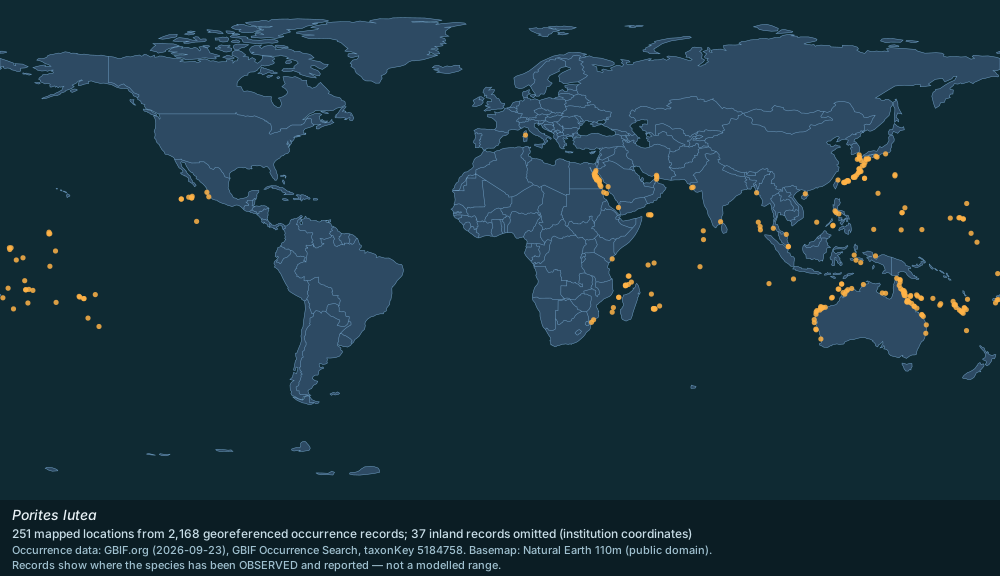
2,168 georeferenced occurrence records for Porites lutea are published through GBIF from 55 countries or marine areas. The map above plots 251 distinct locations from a sample of 2,168 records, omitting 37 inland records that carry an institution's coordinates rather than a collection site; it shows where the species has been observed and reported, not a modelled range.
Most records by country or area: United States Minor Outlying Islands (684); Australia (444); Japan (308); Egypt (85); Réunion (79).
The full country table, WoRMS marine regions and the sampling notes are on this species' Distribution page.
Source: GBIF Occurrence Search (taxonKey 5184758) — https://www.gbif.org/occurrence/search?taxon_key=5184758&has_coordinate=true (records CC0 / CC BY); WoRMS distribution records (MarineRegions) — https://www.marinespecies.org/aphia.php?p=taxdetails&id=207246 (CC BY 4.0); Natural Earth 110m basemap — https://www.naturalearthdata.com/ (public domain). Accessed 2026-09-23.
Conservation status (IUCN Red List)
The IUCN Red List assesses Porites lutea Milne Edwards & Haime, 1851 as Least Concern (code LC). No trend, population estimate or threat analysis is given here, because none is available from this source without the Red List API; follow the source link for the full assessment, including its date.
Source: IUCN Red List of Threatened Species (taxon 133082) — https://www.iucnredlist.org/species/133082/0; GBIF IUCN Red List category endpoint (taxonKey 5184758) — https://api.gbif.org/v1/species/5184758/iucnRedListCategory. Accessed 2026-09-23.
Description and natural history (Wikipedia)
Porites lutea forms massive, smooth, hemispherical mounds or helmet-shaped colonies up to 4 m across. The corallites have thin walls and are closely packed, some 1 to 1.5 mm in diameter. In contrast to Porites lobata, the corallites are well-filled with skeletal elements, including five tall pali near the centre. The colour of this coral is usually cream or yellow, but other bright colours sometimes occur in shallow-water habitats.
Porites lutea is native to the tropical Indo-Pacific region. Its range extends from Madagascar and the east coast of Africa to Malaysia, Indonesia, the Philippines, Japan and northern and eastern Australia. It occurs on back reef margins, in lagoons and on fringing reefs. It is a common species, often occurring with Porites australiensis and Porites lobata.
This coral can form "microatolls" in the intertidal zone; these are disc-shaped mounds with dead coral material at the top and living material round the perimeter which continues to grow sideways. Sometimes these structures remain as fossil microatolls in which no living polyps survive but the colony morphology is retained. Fossil microatolls of Porites lutea, combined with precise dating of individual annual growth rings using the uranium–thorium dating method, allows these structures to be used to determine past relative changes in sea-level. Their use for this purpose on reefs in the South China Sea has shown that during the period 7000–6550 years before 2000, the sea level was about 170 to 220 cm higher than now, with four or more cycles of fluctuations.
In Yemen, the non-native, invasive, encrusting red sponge Clathria aceratoobtusa grows over the surface of the coral, at the rate of about 1 cm per month, smothering and killing it. A thin white line of dead tissue separates the healthy coral tissues from the advancing sponge.
Sometimes fragments of Porites lutea become detached from colonies. These may remain alive and end up further down the reef slope, or moved to a new location by currents or waves; in this way new colonies or even new reefs may form in locations unsuitable for larval settlement.
The growth rate of corals is influenced by environmental conditions; massive corals lay down a band of calcium carbonate each year, and the thickness of the band indicates the rate of growth. Researchers in Indonesia have studied the growth rate of Porites lutea and correlated it with the El Niño phenomenon. Growth rates were higher on windward slopes with greater wave action, and lower on lee slopes with less water movement. Rates were at their highest in 1992, when the sea temperature was about 28 °C, and at their lowest in 1998 when it was 29.6 °C. The correlation between water temperature and growth rate was complex, but in general growth rates of the coral were lower when the coral was stressed by higher water temperatures.
Exposure of Porites lutea to increased concentration of iron causes bleaching through loss of symbiotic zooxanthellae; however the effect is less marked in corals previously exposed to raised levels of iron, suggesting the development of tolerance to the metal.
Source: Wikipedia: Porites lutea — https://en.wikipedia.org/wiki/Porites_lutea (CC BY-SA 4.0). Accessed 2026-09-23.
Gallery
Related in Porites lutea
Links follow this subject's own source article.
Elsewhere in Porites lutea
Spotted an error? Know more?
Reader corrections go straight into our review queue. Suggest an edit · How this site is sourced