
Branched finger coral (Porites furcata)
Source-cited species reference: taxonomy from WoRMS, biology from SeaLifeBase, occurrence map from GBIF, conservation from IUCN Red List, description from Wikipedia.
Porites furcata, commonly known as hump coral, thin finger coral or branched finger coral, is a species of stony coral in the genus Porites. It is found in the Caribbean Sea and western Atlantic Ocean.
- Scientific name
- Porites furcata
- Authority
- Lamarck, 1816
- Family
- Poritidae
- Order
- Scleractinia
- Depth range
- 0–50 m
- Habitat zone
- sessile
- Iucn red list
- Least Concern
- Gbif occurrence records
- 11,263
Classification (WoRMS)
Full classification as recorded by WoRMS: Kingdom: Animalia · Phylum: Cnidaria · Class: Hexacorallia · Order: Scleractinia · Family: Poritidae · Genus: Porites.
Accepted name: Porites furcata · Authority: Lamarck, 1816 · Taxonomic status: accepted · AphiaID: 288902.
Synonyms and superseded combinations recorded for this taxon: Heliopora furcata (Lamarck, 1816); Porites furcata var. conglomerata (Esper, 1792); Porites furcata var. dumetosa Duchassaing & Michelotti, 1864; Porites porites f. furcata Lamarck, 1816; Porites porites var. furcata Lamarck, 1816.
Source: World Register of Marine Species (WoRMS) — https://www.marinespecies.org/aphia.php?p=taxdetails&id=288902 (CC BY 4.0). Accessed 2026-09-23.
Biology and life history (SeaLifeBase)
Measured values published by SeaLifeBase for Porites furcata. Only fields the database actually holds for this species are shown; these are database values, not aquarium guidance.
Depth range: 0–50 m · Habitat zone: sessile.
Source: SeaLifeBase species summary (SpecCode 45711) — https://www.sealifebase.se/summary/Porites-furcata.html (CC BY-NC 3.0 — non-commercial use only). Accessed 2026-09-23.
Distribution and occurrence records (GBIF)
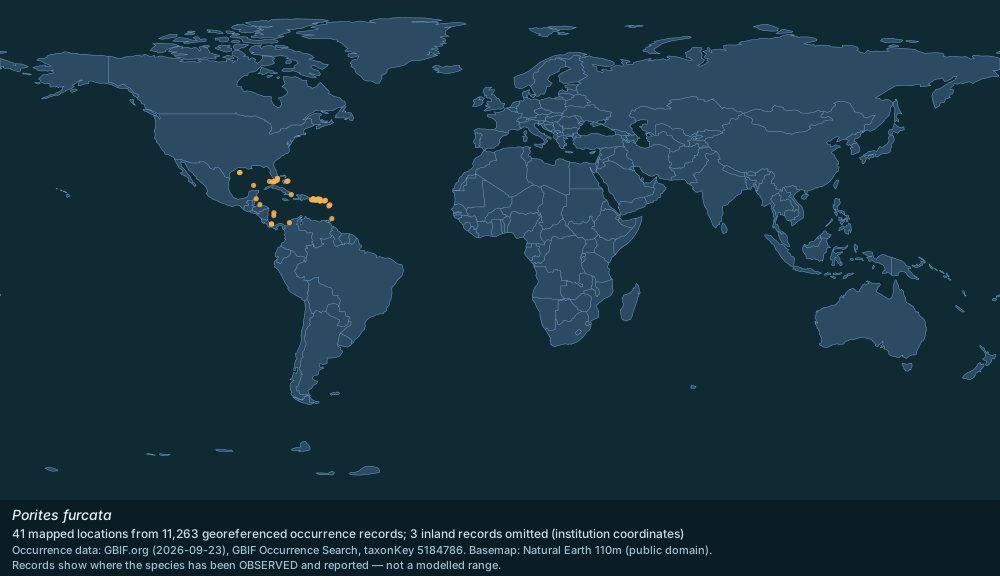
11,263 georeferenced occurrence records for Porites furcata are published through GBIF from 34 countries or marine areas. The map above plots 41 distinct locations from a sample of 3,000 records, omitting 3 inland records that carry an institution's coordinates rather than a collection site; it shows where the species has been observed and reported, not a modelled range.
Most records by country or area: Virgin Islands (U.S.) (5,751); Puerto Rico (2,479); United States of America (1,671); Panama (666); Colombia (154).
The full country table, WoRMS marine regions and the sampling notes are on this species' Distribution page.
Source: GBIF Occurrence Search (taxonKey 5184786) — https://www.gbif.org/occurrence/search?taxon_key=5184786&has_coordinate=true (records CC0 / CC BY); WoRMS distribution records (MarineRegions) — https://www.marinespecies.org/aphia.php?p=taxdetails&id=288902 (CC BY 4.0); Natural Earth 110m basemap — https://www.naturalearthdata.com/ (public domain). Accessed 2026-09-23.
Conservation status (IUCN Red List)
The IUCN Red List assesses Porites furcata Lamarck, 1816 as Least Concern (code LC). No trend, population estimate or threat analysis is given here, because none is available from this source without the Red List API; follow the source link for the full assessment, including its date.
Source: IUCN Red List of Threatened Species (taxon 133504) — https://www.iucnredlist.org/species/133504/0; GBIF IUCN Red List category endpoint (taxonKey 5184786) — https://api.gbif.org/v1/species/5184786/iucnRedListCategory. Accessed 2026-09-23.
Description and natural history (Wikipedia)
Porites furcata is a colonial coral forming clumps of short, slender lobes with rounded tips, often densely packed together. It sometimes forms extensive patches several square metres (yards) in area. The colour of this coral is yellow or pale brown and the lobes grow to a diameter of 1 to 2 cm. The interior parts of the coral often have a purplish tinge and are dead, perhaps killed off by the increased shading and lack of water circulation caused by newer growth above. This species is intermediate in appearance between Porites porites which has branches 2.5 cm wide and Porites divaricata, the branches of which are under 1 cm wide.
Porites furcata is found in the Caribbean Sea, the Gulf of Mexico, the Bahamas and southern Florida from low water mark down to depths of about 20 m. It has not been found in Bermuda. Its preferred habitat is back reefs but it also occurs in other parts of the reef. In areas where this species is common, the dead, basal parts of the coral are responsible for most of the coral rubble on the reef. Grooves can sometimes be seen cutting across the colonies of this species. These are caused by heavy detached chunks of massive coral being moved across the reef during severe storms. Fossils of this species have been found in Florida dating back to the Pleistocene.
Porites furcata is a zooxanthellate coral, the tissues containing unicellular green algae living symbiotically within the cells. These are photosynthetic and use the carbon dioxide and waste products of the coral while at the same time supplying oxygen and organic compounds to their host. The polyps are often extended during the day.
The niches and crevices in this coral are home to a range of invertebrates and other organisms including brittle stars, sea urchins, polychaete worms, chitons and algae.
Porites furcata is listed as being of "Least Concern" in the IUCN Red List of Threatened Species. This is because it is a common species throughout its range and the population seems stable. It is a fairly adaptable species being found in a range of habitats but it is particularly susceptible to bleaching. Its chief threat is the loss of reef habitat through mechanical damage, violent storms, a rise in sea temperatures, ocean acidification, pollution, increased sedimentation and tourism.
Source: Wikipedia: Porites furcata — https://en.wikipedia.org/wiki/Porites_furcata (CC BY-SA 4.0). Accessed 2026-09-23.
Gallery
Related in Branched finger coral
Links follow this subject's own source article.
Elsewhere in Branched finger coral
Spotted an error? Know more?
Reader corrections go straight into our review queue. Suggest an edit · How this site is sourced