
Yellow finger coral (Porites cylindrica)
Source-cited species reference: taxonomy from WoRMS, biology from SeaLifeBase, occurrence map from GBIF, conservation from IUCN Red List, description from Wikipedia.
Porites cylindrica, commonly known as Hump coral, is a stony coral belonging to the subclass Hexacorallia in the class Anthozoa. Hexacorallia differ from other subclasses in that they have six or fewer axes of symmetry. Members of this class possess colonial polyps which can be reef-building, secreting a calcium carbonate skeleton. They are dominant in both inshore reefs and midshelf reefs.
- Scientific name
- Porites cylindrica
- Authority
- Dana, 1846
- Family
- Poritidae
- Order
- Scleractinia
- Depth range
- 0–48 m
- Habitat zone
- reef-associated
- Iucn red list
- Least Concern
- Gbif occurrence records
- 2,487
Classification (WoRMS)
Full classification as recorded by WoRMS: Kingdom: Animalia · Phylum: Cnidaria · Class: Hexacorallia · Order: Scleractinia · Family: Poritidae · Genus: Porites.
Accepted name: Porites cylindrica · Authority: Dana, 1846 · Taxonomic status: accepted · AphiaID: 207229.
Synonyms and superseded combinations recorded for this taxon: Porites (Porites) cylindrica Dana, 1846; Porites andrewsi Vaughan, 1918; Porites capricornis Rehberg, 1892; Porites galeata Nemenzo, 1955; Porites laevis Dana, 1846; Porites levis Dana, 1846; Porites planocella Nemenzo, 1955.
Source: World Register of Marine Species (WoRMS) — https://www.marinespecies.org/aphia.php?p=taxdetails&id=207229 (CC BY 4.0). Accessed 2026-09-23.
Biology and life history (SeaLifeBase)
Measured values published by SeaLifeBase for Porites cylindrica. Only fields the database actually holds for this species are shown; these are database values, not aquarium guidance.
Depth range: 0–48 m · Habitat zone: reef-associated.
Source: SeaLifeBase species summary (SpecCode 45702) — https://www.sealifebase.se/summary/Porites-cylindrica.html (CC BY-NC 3.0 — non-commercial use only). Accessed 2026-09-23.
Distribution and occurrence records (GBIF)
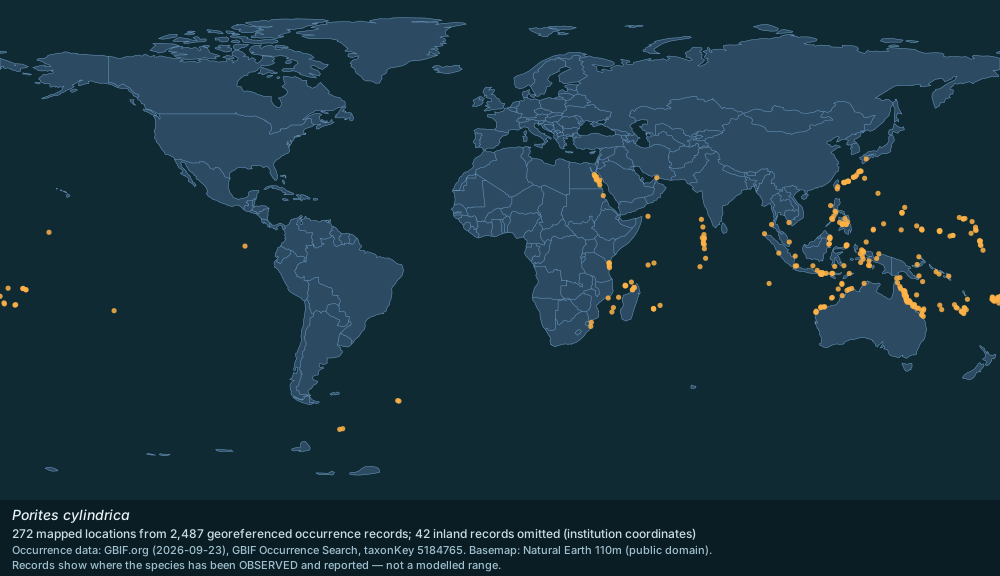
2,487 georeferenced occurrence records for Porites cylindrica are published through GBIF from 52 countries or marine areas. The map above plots 272 distinct locations from a sample of 2,487 records, omitting 42 inland records that carry an institution's coordinates rather than a collection site; it shows where the species has been observed and reported, not a modelled range.
Most records by country or area: Australia (868); Micronesia (Federated States of) (546); Japan (293); Indonesia (117); Marshall Islands (110).
The full country table, WoRMS marine regions and the sampling notes are on this species' Distribution page.
Source: GBIF Occurrence Search (taxonKey 5184765) — https://www.gbif.org/occurrence/search?taxon_key=5184765&has_coordinate=true (records CC0 / CC BY); WoRMS distribution records (MarineRegions) — https://www.marinespecies.org/aphia.php?p=taxdetails&id=207229 (CC BY 4.0); Natural Earth 110m basemap — https://www.naturalearthdata.com/ (public domain). Accessed 2026-09-23.
Conservation status (IUCN Red List)
The IUCN Red List assesses Porites cylindrica Dana, 1846 as Least Concern (code LC). No trend, population estimate or threat analysis is given here, because none is available from this source without the Red List API; follow the source link for the full assessment, including its date.
Source: IUCN Red List of Threatened Species (taxon 133496) — https://www.iucnredlist.org/species/133496/0; GBIF IUCN Red List category endpoint (taxonKey 5184765) — https://api.gbif.org/v1/species/5184765/iucnRedListCategory. Accessed 2026-09-23.
Description and natural history (Wikipedia)
P. cylindrica is a hermatypic (reef-building) coral that can grow to a few square meters wide and form micro-atolls. They are typically cream colored, yellow, blue, pale brown or green. Like all stony corals, P. cylindrica consists of very small polyps (1-3mm) that secrete calcium carbonate, with which they build a skeleton. Over time, entire colonies of reef-building corals can grow large, (weighing several tons), and create structural habitats. They are a branching coral, which are characterized by having numerous branches, some with secondary branches, growing in different directions. These types of corals tend to grow faster, allowing them to better find favorable microenvironments than corals with slower growth forms. However, their branching growth form also means that they are more vulnerable to breakage and injury.
P. cylindrica is common to abundant in shallow water areas 1–11 meters deep. They have also been observed 20 meters below surface waters. P. Cylindrica is found in back reefs and lagoons located in the waters of the oceanic West Pacific, Australia, the South China Sea, Japan, South-east Asia and the Indian Ocean.
Porites cylindrica is a gonochoric coral species, featuring distinct male and female colonies, releasing sperm and egg respectively, as opposed to releasing sperm-egg bundles. Like all shallow-dwelling corals, P. cylindrica gametes are buoyant, and float to the surface of the water to merge. The brooding coral internally fertilizes its eggs, which contain the algae zooxanthellae evenly distributed within, allowing the new coral larvae to be born having already established a relationship with their symbiotic algal partners. The larvae then settle on hard substrate, where they develop into a coral polyp. Once fully developed, the coral polyp replicates itself through budding, dividing into two genetically identical polyps and growing in size and number whilst secreting calcium carbonate in order to form the coral's skeleton, eventually forming into a proper coral colony. However, P. cylindrica relies primarily on asexual reproduction through fragmentation, with new corals growing and developing from pieces of coral broken off from a "parent" coral. Once settled on hard substrate, the polyps making up the broken coral grow and develop naturally and eventually mature into a coral colony that is genetically identical to the parent.
P. cylindrica, like all corals, is sessile, capturing food particles that are suspended in the water column. They build fields of branching colonies, split into populations of males and females, and grow branches resembling fingers measuring about half an inch thick, typically in a light brown or dark green hue. The coral obtains its nutrients through its mutualistic relationship with the algae zooxanthellae, which acts as the cornerstone for its ecological role. Zooxanthellae, a photosynthetic dinoflagellate, is able to obtain its nutrients from the sun through photosynthesis, turning light energy into chemical energy stored in the form of carbohydrates, which it passes on to the coral polyps it inhabits. As with most shallow coral holobionts, P. cylindrica obtains the rest of its necessary nutrients, such as nitrogen, from detritus caught by the current, and the transfer of energy and nutrients through waste and decomposition from organisms higher up the food chain, like fish and marine mammals.
P. cylindrica, as a reef-building coral, assists in providing key reef habitats for many species of fish, invertebrates, plants, sea turtles, birds, and marine mammals. Shallow reef ecosystems also provide coastlines with protection against storms and erosion. They are also economically important, offering a source of food and recreational activities such as fishing, diving, and snorkeling. P. cylindrica is an ideal species for coral rehabilitation efforts because they are able to tolerate environmental extremes and successfully disperse via fragmentation.
P. cylindrica is susceptible to many changes in their surrounding environments, which may pose a threat to its well being and survival. To begin, as carbon dioxide becomes increasingly prevalent in our atmosphere, P. cylindrica struggles to adapt. When exposed to elevated levels of carbon dioxide, their rates of respiration and photosynthesis experience a significant decrease. Additionally, zooxanthellae densities decline with harmful environmental changes. Zooxanthellae are important members of the coral holobiont, contributing to the construction of the coral's calcium-carbonate skeleton and assisting in health maintenance. As sea water temperatures continue to rise, zooxanthellae struggle to adapt, often resulting in coral bleaching. Sea water temperatures above 34 °C pose risks to zooxanthellae populations, which in turn cause the coral to become increasingly susceptible to disease and death. The IUCN Red list of Threatened Species classified P. cylindrica as Near Threatened on January 3, 2008.
Source: Wikipedia: Porites cylindrica — https://en.wikipedia.org/wiki/Porites_cylindrica (CC BY-SA 4.0). Accessed 2026-09-23.
Gallery
Related in Yellow finger coral
Links follow this subject's own source article.
Elsewhere in Yellow finger coral
Spotted an error? Know more?
Reader corrections go straight into our review queue. Suggest an edit · How this site is sourced