
Pocillopora meandrina
Source-cited species reference: taxonomy from WoRMS, biology from SeaLifeBase, occurrence map from GBIF, conservation from IUCN Red List, description from Wikipedia.
Pocillopora meandrina, commonly known as cauliflower coral, is a species of coral occurring in the Indo-Pacific and Pacific oceans. This coral lives in shallow reef environments.
- Scientific name
- Pocillopora meandrina
- Authority
- Dana, 1846
- Family
- Pocilloporidae
- Order
- Scleractinia
- Depth range
- 0–98 m
- Habitat zone
- reef-associated
- Iucn red list
- Endangered
- Gbif occurrence records
- 3,294
Classification (WoRMS)
Full classification as recorded by WoRMS: Kingdom: Animalia · Phylum: Cnidaria · Class: Hexacorallia · Order: Scleractinia · Family: Pocilloporidae · Genus: Pocillopora.
Accepted name: Pocillopora meandrina · Authority: Dana, 1846 · Taxonomic status: accepted · AphiaID: 206964.
Synonyms and superseded combinations recorded for this taxon: Pocillopora meandrina var. nobilis Verrill, 1864; Pocillopora meandrina var. tuberosa Verrill, 1869; Pocillopora nobilis Verill, 1864; Pocillopora nobilis var. tuberosa Verrill, 1869.
Source: World Register of Marine Species (WoRMS) — https://www.marinespecies.org/aphia.php?p=taxdetails&id=206964 (CC BY 4.0). Accessed 2026-09-23.
Biology and life history (SeaLifeBase)
Measured values published by SeaLifeBase for Pocillopora meandrina. Only fields the database actually holds for this species are shown; these are database values, not aquarium guidance.
Depth range: 0–98 m · Habitat zone: reef-associated.
SeaLifeBase notes: Found on shallow reef environments and is more common on exposed reef fronts than elsewhere (Ref. 847). Particularly found on fore-reefs (Ref. 87903) and rocky reefs (Ref. 98471).
Source: SeaLifeBase species summary (SpecCode 45593) — https://www.sealifebase.se/summary/Pocillopora-meandrina.html (CC BY-NC 3.0 — non-commercial use only). Accessed 2026-09-23.
Distribution and occurrence records (GBIF)
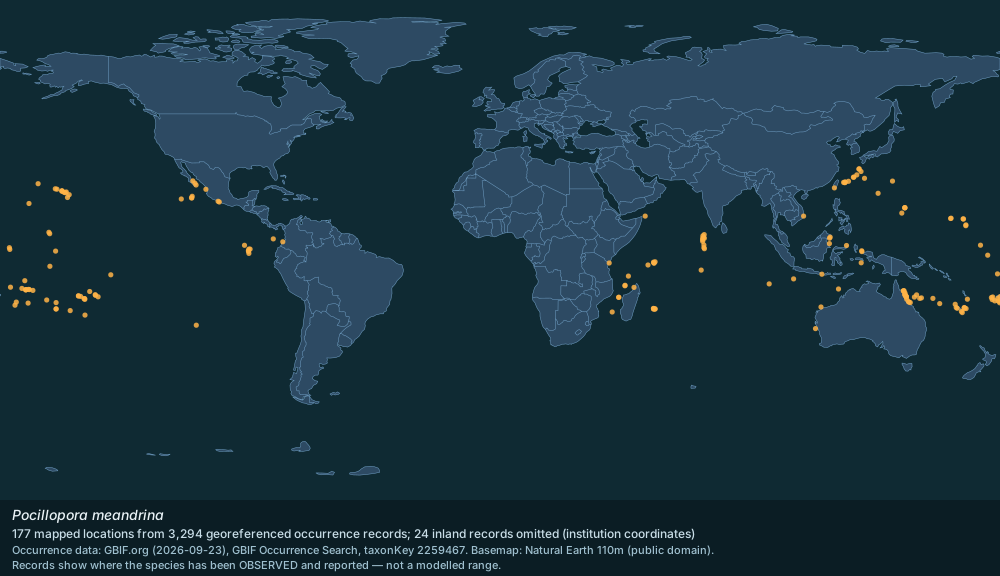
3,294 georeferenced occurrence records for Pocillopora meandrina are published through GBIF from 46 countries or marine areas. The map above plots 177 distinct locations from a sample of 3,000 records, omitting 24 inland records that carry an institution's coordinates rather than a collection site; it shows where the species has been observed and reported, not a modelled range.
Most records by country or area: American Samoa (1,243); United States of America (593); United States Minor Outlying Islands (462); Mexico (344); Australia (116).
The full country table, WoRMS marine regions and the sampling notes are on this species' Distribution page.
Source: GBIF Occurrence Search (taxonKey 2259467) — https://www.gbif.org/occurrence/search?taxon_key=2259467&has_coordinate=true (records CC0 / CC BY); WoRMS distribution records (MarineRegions) — https://www.marinespecies.org/aphia.php?p=taxdetails&id=206964 (CC BY 4.0); Natural Earth 110m basemap — https://www.naturalearthdata.com/ (public domain). Accessed 2026-09-23.
Conservation status (IUCN Red List)
The IUCN Red List assesses Pocillopora meandrina Dana, 1846 as Endangered (code EN). No trend, population estimate or threat analysis is given here, because none is available from this source without the Red List API; follow the source link for the full assessment, including its date.
Source: IUCN Red List of Threatened Species (taxon 133095) — https://www.iucnredlist.org/species/133095/0; GBIF IUCN Red List category endpoint (taxonKey 2259467) — https://api.gbif.org/v1/species/2259467/iucnRedListCategory. Accessed 2026-09-23.
Description and natural history (Wikipedia)
The colonies of P. meandrina can be fairly solid and dome-shaped or branching with areas that are either flattened and ridge-like or fine and convoluted. The colonies are covered by wart-like growths called verrucae. The colour ranges from brown to pink and the polyps with their extended tentacles are usually visible only at night.
P. meandrina occurs in the Indian and Pacific Oceans and is found across a range of habitats that include exposed reefs, protected lagoons and lower reef slopes.
P. meandrina is a hermaphrodite and each polyp contains four sets of male and four sets of female gonads. The larvae develop inside the body of the polyp and are not expelled into the water until they are mature. They remain free swimming for a number of weeks before settling and starting to build a hard matrix. The polyps can also reproduce asexually by fragmentation.
The polyps feed by capturing tiny prey with their tentacles. They also contain zooxanthellae, microscopic algae, which are able to photosynthesise. These symbionts produce energy-rich compounds which the polyps metabolise while the rigid structure of the shallow water coral provides a stable, well-lit, protective environment for the algae to flourish.
Source: Wikipedia: Pocillopora meandrina — https://en.wikipedia.org/wiki/Pocillopora_meandrina (CC BY-SA 4.0). Accessed 2026-09-23.
Gallery
Related in Pocillopora meandrina
Links follow this subject's own source article.
Elsewhere in Pocillopora meandrina
Spotted an error? Know more?
Reader corrections go straight into our review queue. Suggest an edit · How this site is sourced