
Cauliflower coral (Pocillopora damicornis)
Source-cited species reference: taxonomy from WoRMS, biology from SeaLifeBase, occurrence map from GBIF, conservation from IUCN Red List, description from Wikipedia.
Pocillopora damicornis, commonly known as the cauliflower coral or lace coral, is a species of stony coral in the family Pocilloporidae. It is native to tropical and subtropical parts of the Indian and Pacific Oceans.
- Scientific name
- Pocillopora damicornis
- Authority
- (Linnaeus, 1758)
- Family
- Pocilloporidae
- Order
- Scleractinia
- Maximum length
- 30 cm
- Depth range
- 0–26 m
- Habitat zone
- reef-associated
- Iucn red list
- Endangered
- Gbif occurrence records
- 34,988
Classification (WoRMS)
Full classification as recorded by WoRMS: Kingdom: Animalia · Phylum: Cnidaria · Class: Hexacorallia · Order: Scleractinia · Family: Pocilloporidae · Genus: Pocillopora.
Accepted name: Pocillopora damicornis · Authority: (Linnaeus, 1758) · Taxonomic status: accepted · AphiaID: 206953.
Synonyms and superseded combinations recorded for this taxon: Acropora damicornis (Linnaeus, 1758); Madrepora damicornis (Linnaeus, 1758); Millepora damicornis Linnaeus, 1758; Pocillopora caespitosa laysanensis Vaughan, 1907; Pocillopora caespitosa stylophoroides Vaughan, 1907; Pocillopora caespitosa tumida Vaughan, 1907; Pocillopora cespitosa Dana, 1846; Pocillopora cespitosa f. laysanensis Vaughan, 1907; Pocillopora cespitosa f. stylophoroides Vaughan, 1907; Pocillopora cespitosa f. tumida Vaughan, 1907; Pocillopora damicornis caespitosa Dana, 1846; Pocillopora damicornis cespitosa Dana, 1846; Pocillopora damicornis var. caespitosa Dana, 1846; Pocillopora damicornis var. cespitosa Dana, 1846; Pocillopora diomedeae Vaughan, 1906; Pocillopora lacera Verrill, 1869.
Source: World Register of Marine Species (WoRMS) — https://www.marinespecies.org/aphia.php?p=taxdetails&id=206953 (CC BY 4.0). Accessed 2026-09-23.
Biology and life history (SeaLifeBase)
Measured values published by SeaLifeBase for Pocillopora damicornis. Only fields the database actually holds for this species are shown; these are database values, not aquarium guidance.
Maximum length: 30 cm · Depth range: 0–26 m · Habitat zone: reef-associated · Vulnerability index: 20 of 100 · Fishery importance: of potential interest.
SeaLifeBase notes: Fisheries: Used directly as construction material, to make lime, used to make concrete, and to sell as curios; Live coral collected for aquarium trade; no report of direct consumption as food (Ref. 269). Maximum depth from Ref. 83917. Can be found in shallow waters (Ref. 122680). Forms low, compact colonies; in mono-specific or multi-species reefs throughout its range from shallow depths until 20 m; common, relatively tolerant of sedimentation and low salinity as long as there is adequate water motion (Ref. 269). Also in mangrove swamps and wharf piles (Ref. 98471). Has variable (0-50%) bleaching level and low estimated mortality in Palau (Ref. 66144).
Source: SeaLifeBase species summary (SpecCode 45584) — https://www.sealifebase.se/summary/Pocillopora-damicornis.html (CC BY-NC 3.0 — non-commercial use only). Accessed 2026-09-23.
Distribution and occurrence records (GBIF)
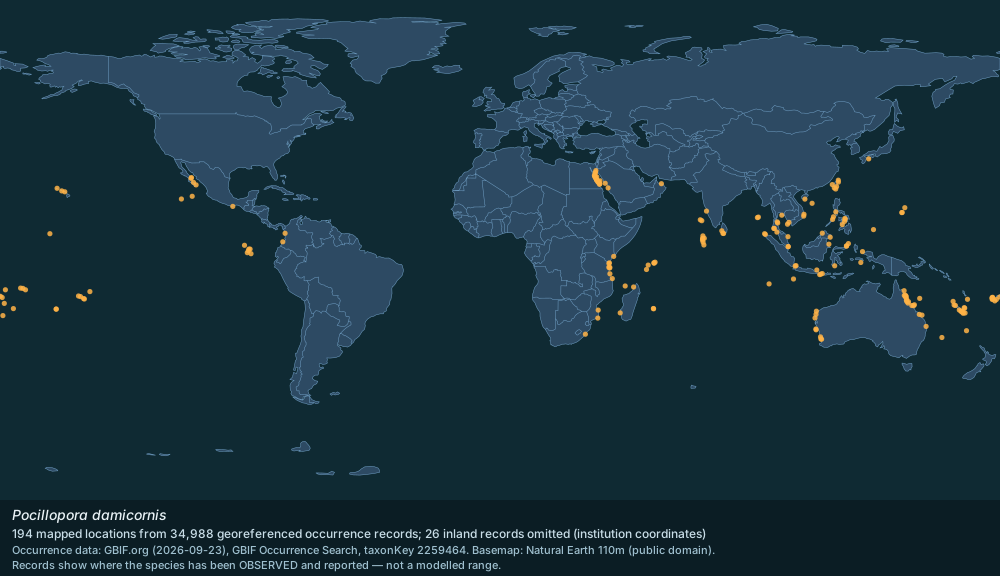
34,988 georeferenced occurrence records for Pocillopora damicornis are published through GBIF from 70 countries or marine areas. The map above plots 194 distinct locations from a sample of 3,000 records, omitting 26 inland records that carry an institution's coordinates rather than a collection site; it shows where the species has been observed and reported, not a modelled range.
Most records by country or area: Colombia (29,722); Australia (1,987); Mexico (756); New Caledonia (375); United States Minor Outlying Islands (289).
The full country table, WoRMS marine regions and the sampling notes are on this species' Distribution page.
Source: GBIF Occurrence Search (taxonKey 2259464) — https://www.gbif.org/occurrence/search?taxon_key=2259464&has_coordinate=true (records CC0 / CC BY); WoRMS distribution records (MarineRegions) — https://www.marinespecies.org/aphia.php?p=taxdetails&id=206953 (CC BY 4.0); Natural Earth 110m basemap — https://www.naturalearthdata.com/ (public domain). Accessed 2026-09-23.
Conservation status (IUCN Red List)
The IUCN Red List assesses Pocillopora damicornis (Linnaeus, 1758) as Endangered (code EN). No trend, population estimate or threat analysis is given here, because none is available from this source without the Red List API; follow the source link for the full assessment, including its date.
Source: IUCN Red List of Threatened Species (taxon 133222) — https://www.iucnredlist.org/species/133222/0; GBIF IUCN Red List category endpoint (taxonKey 2259464) — https://api.gbif.org/v1/species/2259464/iucnRedListCategory. Accessed 2026-09-23.
Description and natural history (Wikipedia)
P. damicornis is a colonial coral and can grow into clumps up to 30 cm high. It is distinguishable from other members of the genus by the verrucae (wart-like growths) on its surface being more irregularly arranged. It is more branched than the otherwise similar P. verrucosa. Its form varies according to its habitat and is more open and branched in calm positions and more compact on the upper parts of reefs where water movement is greater. Its colour varies and may be greenish, pink, yellowish-brown or pale brown.
Cauliflower coral is native to the tropical and subtropical parts of the Indian and Pacific Oceans. Its wide range extends from East Africa and the Red Sea to Japan, Indonesia, Australia, Hawaii, Easter Island, and the western coast of Central America. It is found at depths to about 40 m, but is most common between 5 and 20 m, often forming dense patches. It is equally found on reef slopes and in lagoons, among mangroves and on wharves, but not in areas with strong water movement. With such a wide range, it is one of the most abundant of corals.
P. damicornis is a reef-building coral, grows fast, and is a strong competitor. The polyps extend their tentacles at night to feed on plankton. When colonies are broken apart, chunks can become lodged on the seabed and grow into new individuals, a form of asexual reproduction by fragmentation. This coral also reproduces by sexual means. It is a simultaneous hermaphrodite, and eggs and sperm are retained inside the coral and batches of planular larvae are released into the sea around the time of the new moon. These have a lipid-rich yolk and great dispersal abilities, as they remain viable for as much as 100 days. Although brooding of larvae occurs over most of its range, in Western Australia P. damicornis both broods planular larvae and releases gametes by broadcast spawning, while in the Eastern Pacific, only broadcast spawning takes place.
Cauliflower coral contains microscopic symbiotic dinoflagellate algae (zooxanthellae) living within its tissues. Through photosynthesis, these algae produce energy-rich molecules the coral can assimilate. The density of the dinoflagellates varies depending on seasonal changes in water temperature, light levels, and dissolved nitrate concentration. It is a dynamic process and in extreme environmental conditions results in the complete expulsion of the algae and the bleaching of the coral. However, compared to other corals, this species is resistant to bleaching.
Based on the GeoSymbio Database, Pocillopora damicornis has been known to interact with 30 species (or subclade types) of Symbiodinium, the highest interaction rate of any known coral species along with Stylophora pistillata.
In general, coral reefs around the world are being destroyed and although this coral is common and relatively resilient, populations likely are in decline along with their habitat. This coral is collected for the aquarium trade and in some regions, it is mined for conversion into cement. The IUCN has listed it as being endangered, as it susceptible to reef degradation. Like all corals, it is listed on CITES Appendix II.
Source: Wikipedia: Pocillopora damicornis — https://en.wikipedia.org/wiki/Pocillopora_damicornis (CC BY-SA 4.0). Accessed 2026-09-23.
Gallery
Related in Cauliflower coral
Links follow this subject's own source article.
Elsewhere in Cauliflower coral
Spotted an error? Know more?
Reader corrections go straight into our review queue. Suggest an edit · How this site is sourced