
Black sea rod (Plexaura homomalla)
Source-cited species reference: taxonomy from WoRMS, biology from SeaLifeBase, occurrence map from GBIF, description from Wikipedia.
Plexaura homomalla, commonly known as the black sea rod or Caribbean sea whip, is a species of gorgonian-type octocoral in the family Plexauridae. It is widely distributed in the Caribbean from the Florida Keys to the northern coast of Venezuela. P. homomalla contains the bioactive lipid prostaglandin A2 15-acetate methyl ester at about 3% of total wet weight.
- Scientific name
- Plexaura homomalla
- Authority
- (Esper, 1794)
- Family
- Plexauridae
- Order
- Malacalcyonacea
- Depth range
- 1–15 m
- Habitat zone
- sessile
- Gbif occurrence records
- 1,847
Classification (WoRMS)
Full classification as recorded by WoRMS: Kingdom: Animalia · Phylum: Cnidaria · Class: Octocorallia · Order: Malacalcyonacea · Family: Plexauridae · Genus: Plexaura.
Accepted name: Plexaura homomalla · Authority: (Esper, 1794) · Taxonomic status: accepted · AphiaID: 290797.
Synonyms and superseded combinations recorded for this taxon: Eunicea humosa (Esper, 1794); Gorgonia homomalla Esper, 1794; Gorgonia humosa Esper, 1794; Plexaura homomalla f. homomalla (Esper, 1794); Plexaura macrocythara Lamouroux, 1816; Plexauropsis tricolor Stiasny, 1935.
Source: World Register of Marine Species (WoRMS) — https://www.marinespecies.org/aphia.php?p=taxdetails&id=290797 (CC BY 4.0). Accessed 2026-09-23.
Biology and life history (SeaLifeBase)
Measured values published by SeaLifeBase for Plexaura homomalla. Only fields the database actually holds for this species are shown; these are database values, not aquarium guidance.
Depth range: 1–15 m · Habitat zone: sessile.
SeaLifeBase notes: It develops a chemical defense against other invertebrates from the high concentration of prostaglandins in its soft tissues (Ref. 100527).
Source: SeaLifeBase species summary (SpecCode 43966) — https://www.sealifebase.se/summary/Plexaura-homomalla.html (CC BY-NC 3.0 — non-commercial use only). Accessed 2026-09-23.
Distribution and occurrence records (GBIF)
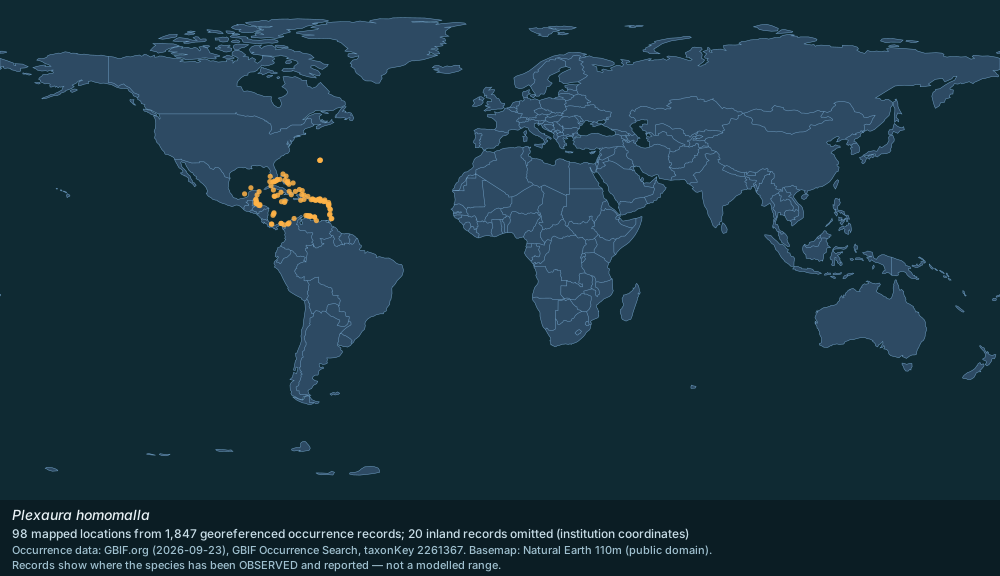
1,847 georeferenced occurrence records for Plexaura homomalla are published through GBIF from 32 countries or marine areas. The map above plots 98 distinct locations from a sample of 1,847 records, omitting 20 inland records that carry an institution's coordinates rather than a collection site; it shows where the species has been observed and reported, not a modelled range.
Most records by country or area: Puerto Rico (1,163); Mexico (121); Bonaire, Sint Eustatius and Saba (101); United States of America (66); Colombia (56).
The full country table, WoRMS marine regions and the sampling notes are on this species' Distribution page.
Source: GBIF Occurrence Search (taxonKey 2261367) — https://www.gbif.org/occurrence/search?taxon_key=2261367&has_coordinate=true (records CC0 / CC BY); WoRMS distribution records (MarineRegions) — https://www.marinespecies.org/aphia.php?p=taxdetails&id=290797 (CC BY 4.0); Natural Earth 110m basemap — https://www.naturalearthdata.com/ (public domain). Accessed 2026-09-23.
Description and natural history (Wikipedia)
P. homomalla forms a bushy or candelabra-like colony of upright branches. It has a tendency to branch in a single plane with a few dichotomous forks, but mostly bears lateral branches. It grows to a height of about 35 cm and has two forms; P. h. forma kuekenthali is taller and slimmer, with narrow terminal branches, and P. h. forma homomalla is shorter with more robust terminal branches. The central stalk and branches are black or dark brown, and the polyps are cream-coloured, yellow, or pale brown. The calyces from which the polyps protrude are typically not projecting, but may be slightly raised above the surface of the coral.
P. homomalla is found growing on reefs in the Caribbean Sea, the Gulf of Mexico, the Bahamas, and Florida. It grows at depths down to about 55 m with P. h.forma homomalla being more abundant in shallow waters and P. h.forma kuekenthali occurring mostly at greater depths.
P. homomalla contains a high level of the lipid prostaglandin A. This physiologically active substance is a million times more abundant in its tissues than in those of most other animals. The function of this large amount of prostaglandin in the coral is unknown. Its function in mammals is to act as a muscle relaxant. It is used to induce labour and it causes nausea and vomiting. P. homomalla contains 2 to 3% by weight of prostaglandin and was used as a source for the drug until methods for its synthesis became available in the 1970s. Killifish, family Cyprinodontidae, and yellowhead wrasse (Halichoeres garnoti) vomit after being fed gelatine pellets containing prostaglandin. In feeding trials, the fish quickly learned to avoid these pellets while accepting control pellets. The prostaglandin produced by the coral seems to offer a chemical defence and act as a deterrent to predatory fishes.
Source: Wikipedia: Plexaura homomalla — https://en.wikipedia.org/wiki/Plexaura_homomalla (CC BY-SA 4.0). Accessed 2026-09-23.
Gallery
Related in Black sea rod
Links follow this subject's own source article.
Elsewhere in Black sea rod
Spotted an error? Know more?
Reader corrections go straight into our review queue. Suggest an edit · How this site is sourced