
Rounded bubblegum coral (Plerogyra sinuosa)
Source-cited species reference: taxonomy from WoRMS, biology from SeaLifeBase, occurrence map from GBIF, conservation from IUCN Red List, description from Wikipedia.
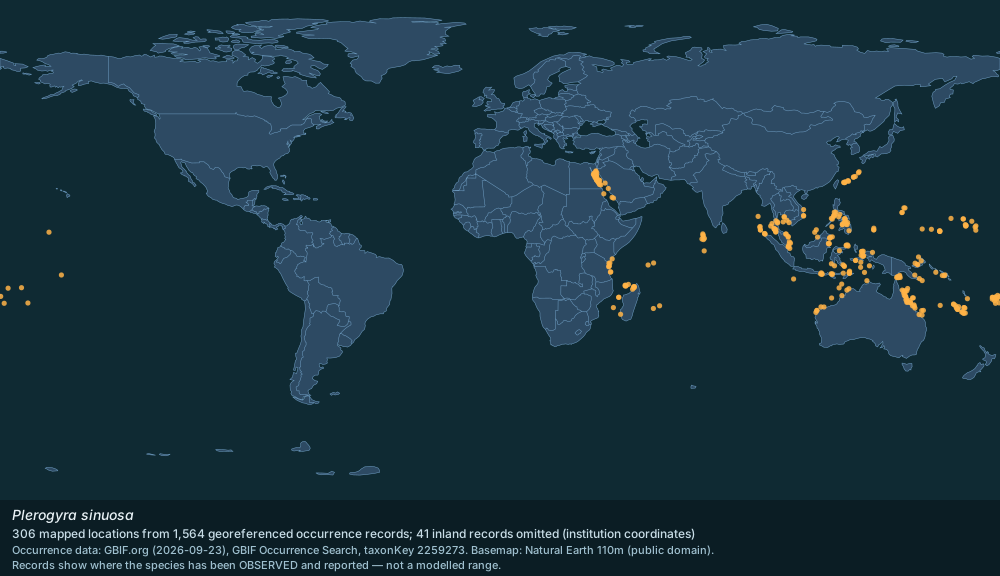
Plerogyra sinuosa is a coral species of the phylum Cnidaria. It is commonly called "bubble coral" due to its bubbly appearance. The "bubbles" are grape-sized which increase their surface area according to the amount of light available: they are larger during the day, but smaller during the night, when tentacles reach out to capture food. This species requires low light and a gentle water flow. Common names for Plerogyra sinuosa include "grape coral", bladder coral, and pearl coral. According to the IUCN, Plerogyra sinuosa ranges from the Red Sea and Madagascar in the western Indian Ocean to Okinawa and the Line Islands in the Pacific.
- Scientific name
- Plerogyra sinuosa
- Authority
- (Dana, 1846)
- Family
- Plerogyridae
- Order
- Scleractinia
- Depth range
- 0–40 m
- Habitat zone
- reef-associated
- Iucn red list
- Least Concern
- Gbif occurrence records
- 1,564
Classification (WoRMS)
Full classification as recorded by WoRMS: Kingdom: Animalia · Phylum: Cnidaria · Class: Hexacorallia · Order: Scleractinia · Family: Plerogyridae · Genus: Plerogyra.
Accepted name: Plerogyra sinuosa · Authority: (Dana, 1846) · Taxonomic status: accepted · AphiaID: 207498.
Synonyms and superseded combinations recorded for this taxon: Euphyllia cultrifera Dana, 1846; Euphyllia sinuosa Dana, 1846; Plerogyra cultrifera (Dana, 1846); Plerogyra excavata Milne Edwards & Haime, 1848; Plerogyra laxa Milne Edwards & Haime, 1848.
Source: World Register of Marine Species (WoRMS) — https://www.marinespecies.org/aphia.php?p=taxdetails&id=207498 (CC BY 4.0). Accessed 2026-09-23.
Biology and life history (SeaLifeBase)
Measured values published by SeaLifeBase for Plerogyra sinuosa. Only fields the database actually holds for this species are shown; these are database values, not aquarium guidance.
Depth range: 0–40 m · Habitat zone: reef-associated.
SeaLifeBase notes: Found in protected reef environments usually in turbid waters (Ref. 847).
Source: SeaLifeBase species summary (SpecCode 46664) — https://www.sealifebase.se/summary/Plerogyra-sinuosa.html (CC BY-NC 3.0 — non-commercial use only). Accessed 2026-09-23.
Distribution and occurrence records (GBIF)
1,564 georeferenced occurrence records for Plerogyra sinuosa are published through GBIF from 45 countries or marine areas. The map above plots 306 distinct locations from a sample of 1,564 records, omitting 41 inland records that carry an institution's coordinates rather than a collection site; it shows where the species has been observed and reported, not a modelled range.
Most records by country or area: Australia (311); Indonesia (184); Philippines (174); New Caledonia (158); Egypt (116).
The full country table, WoRMS marine regions and the sampling notes are on this species' Distribution page.
Source: GBIF Occurrence Search (taxonKey 2259273) — https://www.gbif.org/occurrence/search?taxon_key=2259273&has_coordinate=true (records CC0 / CC BY); WoRMS distribution records (MarineRegions) — https://www.marinespecies.org/aphia.php?p=taxdetails&id=207498 (CC BY 4.0); Natural Earth 110m basemap — https://www.naturalearthdata.com/ (public domain). Accessed 2026-09-23.
Conservation status (IUCN Red List)
The IUCN Red List assesses Plerogyra sinuosa (Dana, 1846) as Least Concern (code LC). No trend, population estimate or threat analysis is given here, because none is available from this source without the Red List API; follow the source link for the full assessment, including its date.
Source: IUCN Red List of Threatened Species (taxon 133258) — https://www.iucnredlist.org/species/133258/0; GBIF IUCN Red List category endpoint (taxonKey 2259273) — https://api.gbif.org/v1/species/2259273/iucnRedListCategory. Accessed 2026-09-23.
Description and natural history (Wikipedia)
Colonies of Plerogyra sinuosa are in the form of an inverted cone that may be as much as a metre (yard) across. The corallites in small colonies are monocentric and trochoid, but become flabellomeandroiid (arranged in valleys, the neighbouring valleys having separate walls) in larger colonies. The septa have smooth margins and are irregularly arranged. The costae on young colonies sometimes form lobes which develop spines. These spines then elongate and a new polyp develops, this budding method being an unusual occurrence among corals.
In the living coral, Plerogyra sinuosa has vesicles resembling bubbles up to 2.5 cm in diameter. These enlarge during the day but retract to a certain extent during the night to expose the polyps and their tentacles.
Plerogyra sinuosa is a zooxanthellate species of coral. It obtains most of its nutritional needs from the symbiotic dinoflagellates that live inside its soft tissues including the walls of the vesicles. These photosynthetic organisms provide the coral with organic carbon and nitrogen, sometimes providing up to 90% of their host's energy needs for metabolism and growth. Its remaining needs are met by the planktonic organisms caught by the polyps.
This is a common, widely distributed species in shallow Indo-Pacific reef environments. It is subject to the threats of climate change and destruction of its reef habitat common to other coral species, and the International Union for Conservation of Nature has assessed its conservation status as being "Least Concern".
Source: Wikipedia: Plerogyra sinuosa — https://en.wikipedia.org/wiki/Plerogyra_sinuosa (CC BY-SA 4.0). Accessed 2026-09-23.
Gallery
Related in Rounded bubblegum coral
Links follow this subject's own source article.
Elsewhere in Rounded bubblegum coral
Spotted an error? Know more?
Reader corrections go straight into our review queue. Suggest an edit · How this site is sourced