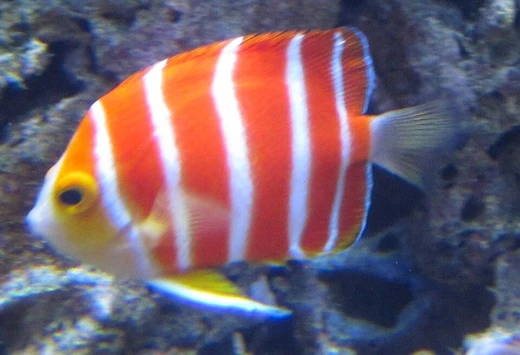
Peppermint angelfish (Centropyge boylei)
Source-cited species reference: taxonomy from WoRMS, biology from FishBase, conservation from IUCN Red List, description from Wikipedia.

Wmpearl · CC0
The peppermint angelfish (Centropyge boylei) is a relatively small species of marine ray-finned fish, a marine angelfish belonging to the family Pomacanthidae. It is found in the Central area of the South Pacific Ocean, and is known to be native to the Cook Islands. They are called Taputapu in Cook Islands Māori.
- Scientific name
- Centropyge boylei
- Authority
- Pyle & Randall, 1992
- Family
- Pomacanthidae
- Order
- Acanthuriformes
- Maximum length
- 7 cm
- Depth range
- 53–120 m
- Habitat zone
- reef-associated
- Iucn red list
- Least Concern
Physical Appearance and Taxonomic Identity
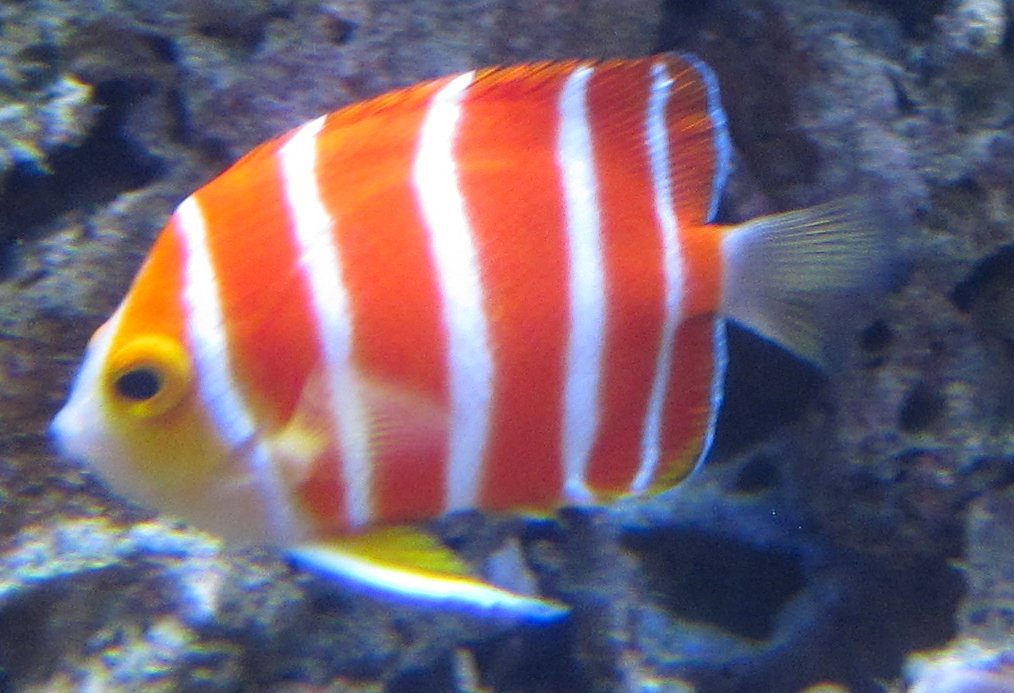
The peppermint angelfish is a compact marine ray-finned fish classified within the family Pomacanthidae, and some taxonomic authorities further place it in the subgenus Paracentropyge. Standing out in the crowded world of angelfish, this species is instantly recognizable by its striking coloration: a deep, oval body painted in reddish-orange, broken up by five crisp white vertical bands. The face and chin are entirely white, creating a bold contrast against the warm body tones. The dorsal and anal fins carry clean white margins, while the caudal fin takes on a delicate translucent quality. Despite its vivid appearance, the fish remains modest in size, reaching a maximum total length of just seven centimetres (about 2.8 inches). In the Cook Islands, where it is native, local Māori speakers know the species by the name Taputapu, a designation that reflects the fish's deep cultural roots in that small Pacific island nation.
Range, Habitat, and Daily Life
The peppermint angelfish is a creature of the deep, dwelling at depths between 55 and 120 metres (roughly 180 to 394 feet) on the steep outer slopes of coral reefs in the eastern central Pacific Ocean. Its preferred microhabitats include coral rubble, rocky overhangs, and caves, giving it a sheltered existence far below the sunlit shallows where most reef fish are observed. Geographically, the species has so far been recorded only from Rarotonga in the Cook Islands, though researchers consider it likely that the fish occurs elsewhere in the region as well. Very little is known about its daily biology. Its diet is believed to consist of worms, crustaceans, sponges, tunicates, and detritus, suggesting an opportunistic foraging strategy among the reef structure. Socially, the peppermint angelfish has been observed in pairs or small groups rather than in large schools, hinting at a relatively low-key social structure.
Discovery and the Story Behind the Name
For decades, the peppermint angelfish likely swam through the deep waters around the Cook Islands without ever being formally catalogued by science. That changed in 1992, when ichthyologists John Ernest Randall (1924–2020) and Richard Pyle published the first formal description of the species, giving it the binomial name Centropyge boylei. The specific epithet boylei was chosen to honour Charles "Chip" J. Boyle, the individual who collected the type specimen that made the scientific description possible. This naming convention highlights how much of deep-water ichthyology depends on skilled collectors venturing into habitats that are difficult to access. Randall, who passed away in 2020, was a towering figure in Pacific fish taxonomy, and his collaboration with Pyle on this small, elusive angelfish is a fitting example of the meticulous work that builds our understanding of marine biodiversity. The species' placement within the subgenus Paracentropyge by some authorities further reflects the ongoing taxonomic refinement of the Pomacanthidae family.
Rarity, Value, and the Aquarium Trade
Because the peppermint angelfish has been documented from only a single location—Rarotonga in the Cook Islands—and inhabits depths that are challenging to access, it remains one of the rarer and less-studied marine angelfish known to science. This scarcity translates directly into the aquarium trade, where the species is only occasionally exported as a live specimen. When a peppermint angelfish does appear on the market, it commands extraordinary attention and price. One documented case involved a single individual being offered for a staggering $30,000, a figure that underscores just how rare and desirable this small, beautifully banded fish is to serious collectors. The fact that such a modest creature, no longer than seven centimetres, can carry a price tag in the tens of thousands speaks to the intersection of deep-sea rarity, limited availability, and the passionate demand of the ornamental fish hobby. Its appearance at institutions like the Waikiki Aquarium further illustrates how unusual a public sighting of this species truly is.
Gallery
Spotted an error? Know more?
Reader corrections go straight into our review queue. Suggest an edit · How this site is sourced