
Small polyped gorgonian (Paramuricea clavata)
Source-cited species reference: taxonomy from WoRMS, biology from SeaLifeBase, occurrence map from GBIF, description from Wikipedia.
Paramuricea clavata, the violescent sea-whip, is a species of colonial soft coral in the family Plexauridae. It is found in shallow seas of the north-eastern Atlantic Ocean and the north-western Mediterranean Sea as well as Ionian Sea. This species was first described by the French naturalist Antoine Risso in 1826.
- Scientific name
- Paramuricea clavata
- Authority
- (Risso, 1827)
- Family
- Acanthogorgiidae
- Order
- Malacalcyonacea
- Depth range
- 20–42 m
- Habitat zone
- sessile
- Gbif occurrence records
- 7,176
Classification (WoRMS)
Full classification as recorded by WoRMS: Kingdom: Animalia · Phylum: Cnidaria · Class: Octocorallia · Order: Malacalcyonacea · Family: Acanthogorgiidae · Genus: Paramuricea.
Accepted name: Paramuricea clavata · Authority: (Risso, 1827) · Taxonomic status: accepted · AphiaID: 125387.
Synonyms and superseded combinations recorded for this taxon: Anthomuricea chamaeleon (von Koch, 1882); Clematissa chamaeleon (von Koch, 1882); Gorgonia clavata Risso, 1827; Muricea chamaeleon von Koch, 1882; Muriceides chamaeleon (von Koch, 1882); Paramuricea chamaeleon (von Koch, 1887); Paramuricea chamaeleon (von Koch, 1882).
Source: World Register of Marine Species (WoRMS) — https://www.marinespecies.org/aphia.php?p=taxdetails&id=125387 (CC BY 4.0). Accessed 2026-09-23.
Biology and life history (SeaLifeBase)
Measured values published by SeaLifeBase for Paramuricea clavata. Only fields the database actually holds for this species are shown; these are database values, not aquarium guidance.
Depth range: 20–42 m · Habitat zone: sessile.
SeaLifeBase notes: Maximum depth from Ref. 125720. Habitat: Generally with side of wall or rock ground. According to the specialized works, this species is widespread in all the Mediterranean Basin (Ref. 358).
Source: SeaLifeBase species summary (SpecCode 44015) — https://www.sealifebase.se/summary/Paramuricea-clavata.html (CC BY-NC 3.0 — non-commercial use only). Accessed 2026-09-23.
Distribution and occurrence records (GBIF)
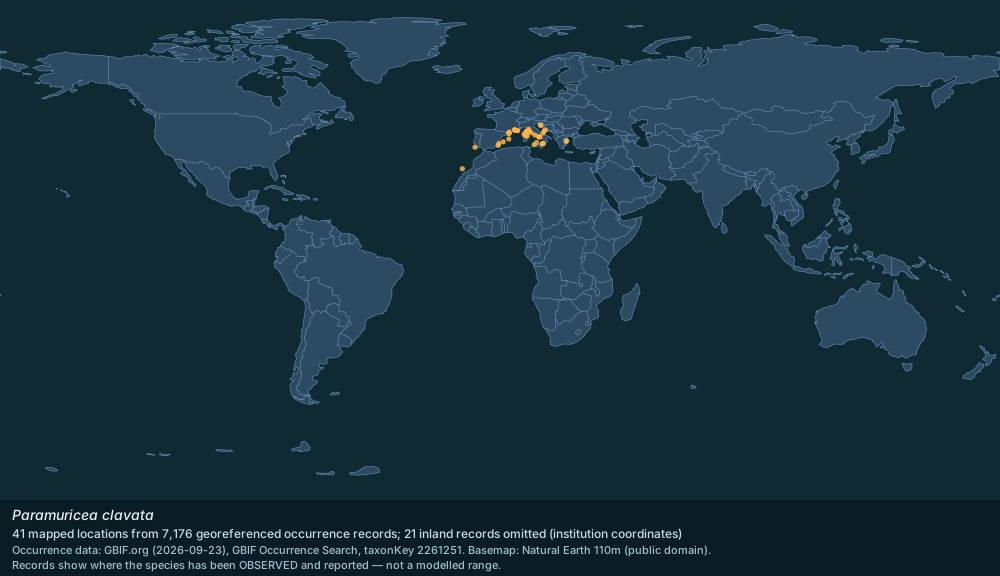
7,176 georeferenced occurrence records for Paramuricea clavata are published through GBIF from 13 countries or marine areas. The map above plots 41 distinct locations from a sample of 3,000 records, omitting 21 inland records that carry an institution's coordinates rather than a collection site; it shows where the species has been observed and reported, not a modelled range.
Most records by country or area: France (5,454); Spain (1,006); Italy (376); Portugal (213); Croatia (61).
The full country table, WoRMS marine regions and the sampling notes are on this species' Distribution page.
Source: GBIF Occurrence Search (taxonKey 2261251) — https://www.gbif.org/occurrence/search?taxon_key=2261251&has_coordinate=true (records CC0 / CC BY); WoRMS distribution records (MarineRegions) — https://www.marinespecies.org/aphia.php?p=taxdetails&id=125387 (CC BY 4.0); Natural Earth 110m basemap — https://www.naturalearthdata.com/ (public domain). Accessed 2026-09-23.
Description and natural history (Wikipedia)
P. clavata has a branching structure forming a fan-shaped colony in a single plane. The stem and branches are stiffened by gorgonin, a complex protein that produces a horny skeleton. The coenenchyme, a thin living layer of cells, covers the skeleton and the polyps protrude from this, each with eight feeding tentacles surrounding a central mouth. The polyps are up to 10 mm high and the whole colony up to one m (3 ft) high and 1 m across. The colour is usually red, but may be partly yellow.
The violescent sea-whip is native to the coasts of Spain and Portugal in the eastern Atlantic Ocean, and to the western Mediterranean Sea. It grows on reefs with its base buried in the sediment at depths between 10 and 100 m, but usually between 15 and 40 m. It is considered to be an ecosystem engineer, as its presence alters the flow of water, changes sedimentation rates, and alters the distribution of nutrients, thus affecting many organisms in its vicinity.
P. clavata is a filter feeder, the polyps extending their tentacles to catch food particles floating past. Its diet includes copepods, diatoms, dinoflagellates, ciliates, and organic carbon particles in suspension.
Each colony is either male or female. Sperm is liberated into the sea by the male colonies and fertilisation occurs on the surface of the female colonies. The embryos are brooded there before being released as planula larvae into the water column. The larvae are photophobic and soon settle on the seabed. Once there, they develop into polyps and start secreting gorgonin to form the skeleton. Further growth of the colony is by budding of new polyps. Some new colonies may be formed from fragments that become detached from existing colonies. P. clavata is a slow-growing species and colonies probably live for well over 50 years.
Source: Wikipedia: Paramuricea clavata — https://en.wikipedia.org/wiki/Paramuricea_clavata (CC BY-SA 4.0). Accessed 2026-09-23.
Gallery
Related in Small polyped gorgonian
Links follow this subject's own source article.
Elsewhere in Small polyped gorgonian
Spotted an error? Know more?
Reader corrections go straight into our review queue. Suggest an edit · How this site is sourced