
Lesser star coral (Paragoniastrea australensis)
Source-cited species reference: taxonomy from WoRMS, biology from SeaLifeBase, occurrence map from GBIF, conservation from IUCN Red List, description from Wikipedia.

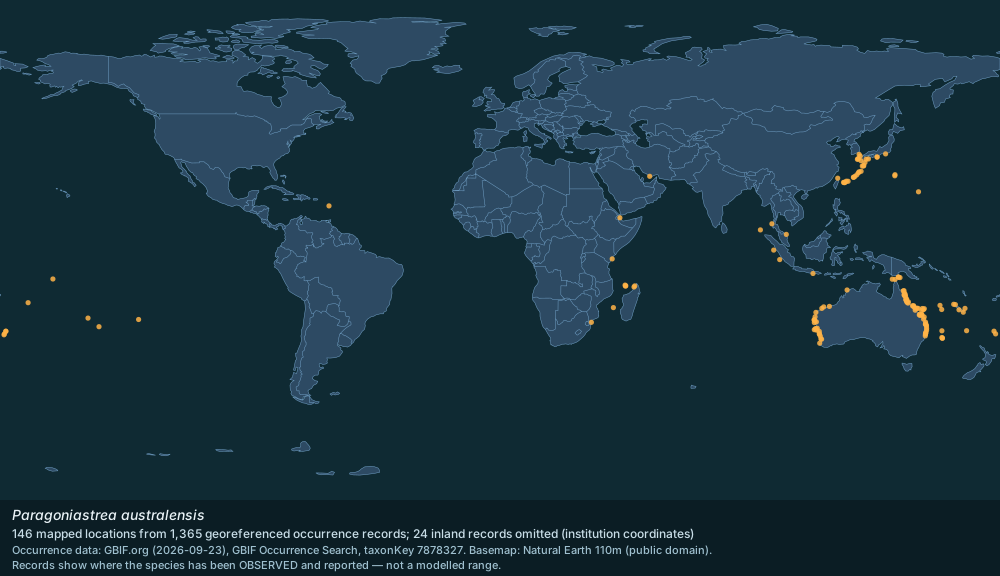
Distribution map plotted from GBIF.org occurrence records; basemap Natural Earth 110m · GBIF records CC0 / CC BY; Natural Earth public domain
Paragoniastrea australensis, also known as the Lesser star coral, is a species of stony corals in the family Merulinidae. It occurs in shallow water in the Indo-Pacific region.
- Scientific name
- Paragoniastrea australensis
- Authority
- (Haime & Milne Edwards, 1857)
- Family
- Merulinidae
- Order
- Scleractinia
- Depth range
- 0–40 m
- Habitat zone
- reef-associated
- Iucn red list
- Least Concern
- Gbif occurrence records
- 1,365
Classification (WoRMS)
Full classification as recorded by WoRMS: Kingdom: Animalia · Phylum: Cnidaria · Class: Hexacorallia · Order: Scleractinia · Family: Merulinidae · Genus: Paragoniastrea.
Accepted name: Paragoniastrea australensis · Authority: (Haime & Milne Edwards, 1857) · Taxonomic status: accepted · AphiaID: 817177.
Synonyms and superseded combinations recorded for this taxon: Coeloria australensis (Haime & Milne Edwards, 1857); Goniastraea pectinata var. benhami Vaughan, 1917; Goniastrea australensis (Haime & Milne Edwards, 1857); Goniastrea benhami Vaughan, 1917; Prionastraea australensis Haime & Milne Edwards, 1857; Prionastrea australensis (Haime & Milne Edwards, 1857).
Source: World Register of Marine Species (WoRMS) — https://www.marinespecies.org/aphia.php?p=taxdetails&id=817177 (CC BY 4.0). Accessed 2026-09-23.
Biology and life history (SeaLifeBase)
Measured values published by SeaLifeBase for Paragoniastrea australensis. Only fields the database actually holds for this species are shown; these are database values, not aquarium guidance.
Depth range: 0–40 m · Habitat zone: reef-associated.
SeaLifeBase notes: Found on rocky and gravel bottom at depths between 1.8 to 21.6 m. Also on volcanic submarine beds (Ref. 88968) and most tropical coral reef environments (Ref. 85244).
Source: SeaLifeBase species summary (SpecCode 46750) — https://www.sealifebase.se/summary/Paragoniastrea-australensis.html (CC BY-NC 3.0 — non-commercial use only). Accessed 2026-09-23.
Distribution and occurrence records (GBIF)
1,365 georeferenced occurrence records for Paragoniastrea australensis are published through GBIF from 23 countries or marine areas. The map above plots 146 distinct locations from a sample of 1,365 records, omitting 24 inland records that carry an institution's coordinates rather than a collection site; it shows where the species has been observed and reported, not a modelled range.
Most records by country or area: Australia (990); Norfolk Island (150); Japan (116); New Zealand (27); New Caledonia (20).
The full country table, WoRMS marine regions and the sampling notes are on this species' Distribution page.
Source: GBIF Occurrence Search (taxonKey 7878327) — https://www.gbif.org/occurrence/search?taxon_key=7878327&has_coordinate=true (records CC0 / CC BY); WoRMS distribution records (MarineRegions) — https://www.marinespecies.org/aphia.php?p=taxdetails&id=817177 (CC BY 4.0); Natural Earth 110m basemap — https://www.naturalearthdata.com/ (public domain). Accessed 2026-09-23.
Conservation status (IUCN Red List)
The IUCN Red List assesses Paragoniastrea australensis (Milne Edwards & Haime, 1857) as Least Concern (code LC). No trend, population estimate or threat analysis is given here, because none is available from this source without the Red List API; follow the source link for the full assessment, including its date.
Source: IUCN Red List of Threatened Species (taxon 132883) — https://www.iucnredlist.org/species/132883/0; GBIF IUCN Red List category endpoint (taxonKey 7878327) — https://api.gbif.org/v1/species/7878327/iucnRedListCategory. Accessed 2026-09-23.
Description and natural history (Wikipedia)
Colonies of Paragoniastrea australensis can be massive, submassive or encrusting. The corallites are arranged in deep valleys with steep walls. The valleys are meandroid and may be short or long, depending on the habitat in which the coral grows. The septa are even and regularly spaced and extend over the valley walls into the next valley. They are finely toothed and have paliform lobes, and the columella are large. This coral is quite variable in colour, most often being some shade of green or brown, with the valley floor often contrasting with the rest of the surface.
This widespread and common species can be found in shallow or clear waters in the Indo-West Pacific (Red Sea, Gulf of Aden, Indian Ocean, Australia, Southeast Asia, Japan and China Sea).
Paragoniastrea australensis is a zooxanthellate species of coral. It obtains most of its nutritional needs from the symbiotic dinoflagellates that live within its soft tissues, supplementing this with the planktonic organisms caught by the polyps.
This coral is a common species with a wide range and large total population size which makes it more resilient than some other species of coral. The main threats faced by corals are related to the mechanical destruction of their coral reef habitats and climate change; these include increasing damage from extreme weather events, rising sea water temperatures and ocean acidification. The International Union for Conservation of Nature has assessed the conservation status of this species as being of "least concern". All corals receive protection by being listed on CITES Appendix II.
Source: Wikipedia: Paragoniastrea australensis — https://en.wikipedia.org/wiki/Paragoniastrea_australensis (CC BY-SA 4.0). Accessed 2026-09-23.
Gallery
Related in Lesser star coral
Links follow this subject's own source article.
Elsewhere in Lesser star coral
Spotted an error? Know more?
Reader corrections go straight into our review queue. Suggest an edit · How this site is sourced