
Baltic prawn (Palaemon adspersus)
Source-cited species reference: taxonomy from WoRMS, biology from SeaLifeBase, occurrence map from GBIF, description from Wikipedia.

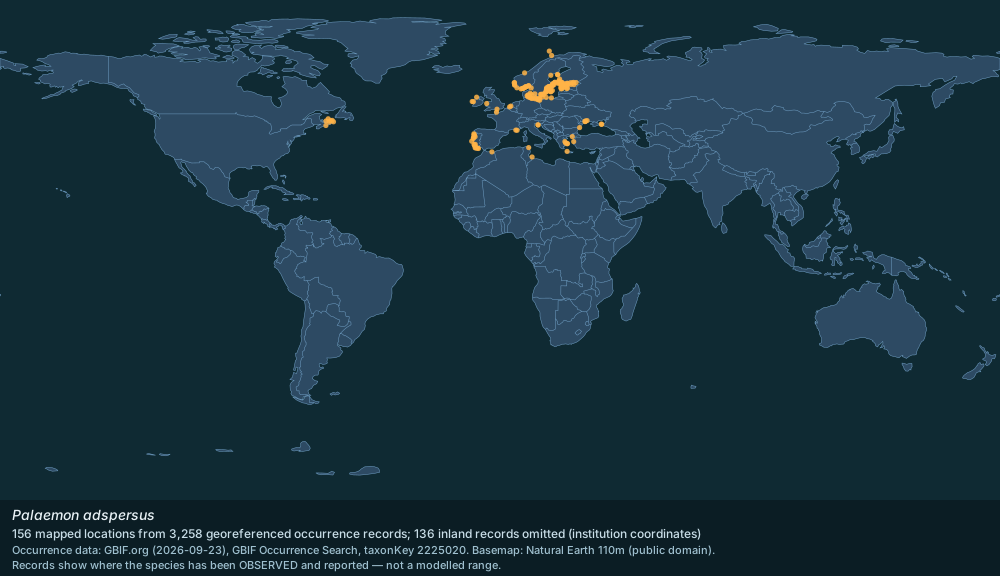
Distribution map plotted from GBIF.org occurrence records; basemap Natural Earth 110m · GBIF records CC0 / CC BY; Natural Earth public domain
Palaemon adspersus, commonly called Baltic prawn, is a species of shrimp that is frequent in the Baltic Sea, and is the subject of fisheries in Denmark. It is up to 70 mm long, and lives in Zostera beds.
- Scientific name
- Palaemon adspersus
- Authority
- Rathke, 1836
- Family
- Palaemonidae
- Order
- Decapoda
- Maximum length
- 8 cm
- Depth range
- 0–10 m
- Habitat zone
- benthic
- Gbif occurrence records
- 3,258
Classification (WoRMS)
Full classification as recorded by WoRMS: Kingdom: Animalia · Phylum: Arthropoda · Class: Malacostraca · Order: Decapoda · Family: Palaemonidae · Genus: Palaemon.
Accepted name: Palaemon adspersus · Authority: Rathke, 1836 · Taxonomic status: accepted · AphiaID: 107613.
Synonyms and superseded combinations recorded for this taxon: Astacus squilla (Linnaeus, 1758); Cancer squilla Linnaeus, 1758; Leander adspersus (Rathke, 1836); Leander adspersus var. Fabricii De Man, 1915; Leander Brandti Czerniavsky, 1884; Leander edwardsi f. intermedia Czerniavsky, 1884; Leander rectirostris (Zaddach, 1844); Leander rectirostris var. transitans Czerniavsky, 1884; Leander squilla (Linnaeus, 1758); Palaemon communis Anslijn, 1826; Palaemon fabricii Rathke, 1843; Palaemon foliirostris Phan, 1971; Palaemon imbellis Fischer, 1872; Palaemon leachii Bell, 1851; Palaemon rectirostris Zaddach, 1844; Palaemon rectirostris var. octodentata Neumann, 1878; Palaemon rectirostris var. octodentatus Neumann, 1878; Palaemon squilla (Linnaeus, 1758); Palemon squilla (Linnaeus, 1758).
Source: World Register of Marine Species (WoRMS) — https://www.marinespecies.org/aphia.php?p=taxdetails&id=107613 (CC BY 4.0). Accessed 2026-09-23.
Biology and life history (SeaLifeBase)
Measured values published by SeaLifeBase for Palaemon adspersus. Only fields the database actually holds for this species are shown; these are database values, not aquarium guidance.
Maximum length: 8 cm · Depth range: 0–10 m · Habitat zone: benthic · Vulnerability index: 10 of 100 · Fishery importance: commercial.
SeaLifeBase notes: Introduced in the Caspian Sea in the 1930s and 1980s and in Aral Sea in the 1950s (Ref. 2756). Found along the littoral zone, in areas with algal cover. Euryhaline. Omnivorous (Ref. 2756).
Source: SeaLifeBase species summary (SpecCode 24525) — https://www.sealifebase.se/summary/Palaemon-adspersus.html (CC BY-NC 3.0 — non-commercial use only). Accessed 2026-09-23.
Distribution and occurrence records (GBIF)
3,258 georeferenced occurrence records for Palaemon adspersus are published through GBIF from 34 countries or marine areas. The map above plots 156 distinct locations from a sample of 3,000 records, omitting 136 inland records that carry an institution's coordinates rather than a collection site; it shows where the species has been observed and reported, not a modelled range.
Most records by country or area: Sweden (852); Portugal (741); Estonia (244); Norway (227); Canada (205).
The full country table, WoRMS marine regions and the sampling notes are on this species' Distribution page.
Source: GBIF Occurrence Search (taxonKey 2225020) — https://www.gbif.org/occurrence/search?taxon_key=2225020&has_coordinate=true (records CC0 / CC BY); WoRMS distribution records (MarineRegions) — https://www.marinespecies.org/aphia.php?p=taxdetails&id=107613 (CC BY 4.0); Natural Earth 110m basemap — https://www.naturalearthdata.com/ (public domain). Accessed 2026-09-23.
Description and natural history (Wikipedia)
Palaemon adspersus is up to 70 mm long, with a plain yellowish-grey body. The rostrum bears distinctive spots of pigment on its lower half.
Palaemon adspersus is uncommon over most of north-western Europe, but forms the basis of a significant fishery in the Danish Straits. In the Baltic Sea, it can tolerate salinities as low as 5‰, but it overwinters in deeper, more saline waters offshore. In Denmark, P. adspersus is closely associated with Zostera (eelgrass) beds, and is replaced by Palaemon elegans where the eelgrass is lacking.
Carl Linnaeus described this species under the name Cancer squilla in his Systema Naturae (1758, 1761). As more genera were split from Linnaeus' Cancer, this species became known as Leander squilla, while the genus Palaemon was used for other species. In 1897, Mary Jane Rathbun realised that a type species for the genus Palaemon had been made in 1810 by Pierre André Latreille, and that the chosen species was Cancer squilla. This required the genus then known as Leander to become Palaemon, while the genus then known as Palaemon had to become Macrobrachium. Not all biologists followed the new nomenclature, and the confusion was eventually resolved by a ruling from the International Commission on Zoological Nomenclature (ICZN), which stated that the type species of Palaemon would be Palaemon adspersus.
In 1958, Lipke Holthuis petitioned the ICZN to suppress the Linnaean name Cancer squilla because it had come to be used for the species Palaemon elegans even though the original description was of a different species. Despite opposition from some carcinologists, including Robert Gurney, the ICZN concurred, leaving Palaemon adspersus Rathke, 1837 the oldest available name for the species.
Source: Wikipedia: Palaemon adspersus — https://en.wikipedia.org/wiki/Palaemon_adspersus (CC BY-SA 4.0). Accessed 2026-09-23.
Gallery
Related in Baltic prawn
Links follow this subject's own source article.
Elsewhere in Baltic prawn
Spotted an error? Know more?
Reader corrections go straight into our review queue. Suggest an edit · How this site is sourced