
Large polyp stone coral (Oulophyllia crispa)
Source-cited species reference: taxonomy from WoRMS, biology from SeaLifeBase, occurrence map from GBIF, conservation from IUCN Red List, description from Wikipedia.

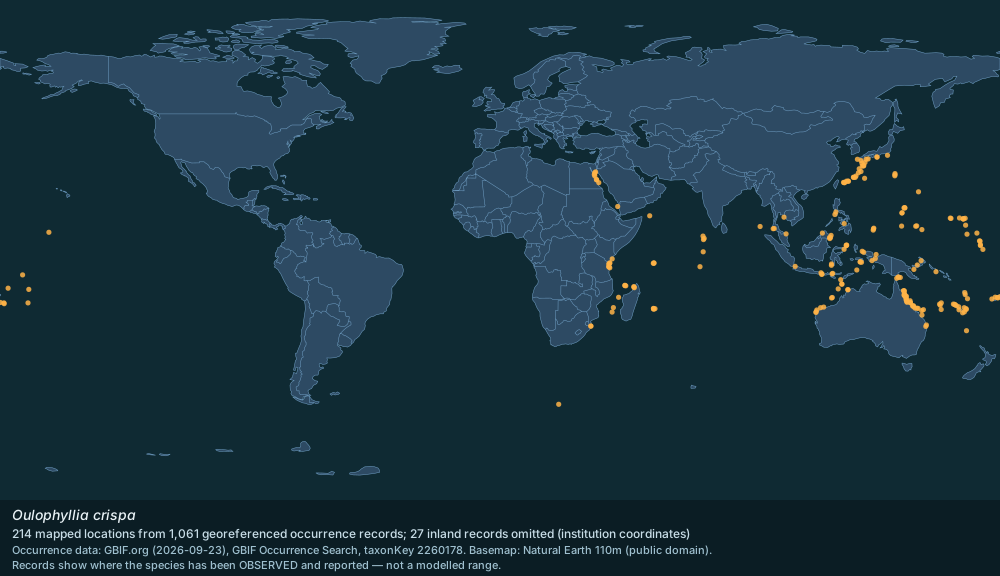
Distribution map plotted from GBIF.org occurrence records; basemap Natural Earth 110m · GBIF records CC0 / CC BY; Natural Earth public domain
Oulophyllia crispa, sometimes called the intermediate valley coral, is a species of stony coral in the family Merulinidae. It is native to the tropical western and central Indo-Pacific region. Although this coral has a wide range, it is generally uncommon and seems to be decreasing in abundance, and the International Union for Conservation of Nature has rated its conservation status as being "near threatened".
- Scientific name
- Oulophyllia crispa
- Authority
- Lamarck, 1816
- Family
- Merulinidae
- Order
- Scleractinia
- Depth range
- 0–40 m
- Habitat zone
- sessile
- Iucn red list
- Endangered
- Gbif occurrence records
- 1,061
Classification (WoRMS)
Full classification as recorded by WoRMS: Kingdom: Animalia · Phylum: Cnidaria · Class: Hexacorallia · Order: Scleractinia · Family: Merulinidae · Genus: Oulophyllia.
Accepted name: Oulophyllia crispa · Authority: Lamarck, 1816 · Taxonomic status: accepted · AphiaID: 207485.
Synonyms and superseded combinations recorded for this taxon: Coeloria cooperi Gardiner, 1904; Coeloria gigantea Yabe & Sugiyama, 1935; Coeloria magna Gardiner, 1904; Maeandrina crispa (Lamarck, 1816); Meandrina crispa Lamarck, 1816; Oulophyllia aspera (Quelch, 1886); Oulophyllia cellulosa (Quelch, 1886); Platygyra gigantea (Yabe & Sugiyama, 1935); Ulophyllia aspera Quelch, 1886; Ulophyllia bonhourei Gravier, 1910; Ulophyllia cellulosa Quelch, 1886; Ulophyllia crispa (Lamarck, 1816); Ulophyllia maxima Rehberg, 1892; Ulophyllia stokesiana Haime & Milne Edwards, 1857; Ulophyllia stuhlmanni Rehberg, 1892.
Source: World Register of Marine Species (WoRMS) — https://www.marinespecies.org/aphia.php?p=taxdetails&id=207485 (CC BY 4.0). Accessed 2026-09-23.
Biology and life history (SeaLifeBase)
Measured values published by SeaLifeBase for Oulophyllia crispa. Only fields the database actually holds for this species are shown; these are database values, not aquarium guidance.
Depth range: 0–40 m · Habitat zone: sessile.
Source: SeaLifeBase species summary (SpecCode 46787) — https://www.sealifebase.se/summary/Oulophyllia-crispa.html (CC BY-NC 3.0 — non-commercial use only). Accessed 2026-09-23.
Distribution and occurrence records (GBIF)
1,061 georeferenced occurrence records for Oulophyllia crispa are published through GBIF from 39 countries or marine areas. The map above plots 214 distinct locations from a sample of 1,061 records, omitting 27 inland records that carry an institution's coordinates rather than a collection site; it shows where the species has been observed and reported, not a modelled range.
Most records by country or area: Australia (497); Japan (154); Indonesia (69); Mayotte (41); Réunion (30).
The full country table, WoRMS marine regions and the sampling notes are on this species' Distribution page.
Source: GBIF Occurrence Search (taxonKey 2260178) — https://www.gbif.org/occurrence/search?taxon_key=2260178&has_coordinate=true (records CC0 / CC BY); WoRMS distribution records (MarineRegions) — https://www.marinespecies.org/aphia.php?p=taxdetails&id=207485 (CC BY 4.0); Natural Earth 110m basemap — https://www.naturalearthdata.com/ (public domain). Accessed 2026-09-23.
Conservation status (IUCN Red List)
The IUCN Red List assesses Oulophyllia crispa (Lamarck, 1816) as Endangered (code EN). No trend, population estimate or threat analysis is given here, because none is available from this source without the Red List API; follow the source link for the full assessment, including its date.
Source: IUCN Red List of Threatened Species (taxon 133200) — https://www.iucnredlist.org/species/133200/0; GBIF IUCN Red List category endpoint (taxonKey 2260178) — https://api.gbif.org/v1/species/2260178/iucnRedListCategory. Accessed 2026-09-23.
Description and natural history (Wikipedia)
Colonies of this coral form massive hemispherical domes, stacks or plates that can be a metre (yard) or more across, but in the Red Sea, it seldom exceeds 20 cm. The corallites are arranged in broad meandering valleys with acute-edged ridges separating them. The septa are thin and evenly spaced, and slope uniformly to the central columella. The polyps only expand at night; they are large and fleshy and have white-tipped tentacles. The colour of this coral is usually some shade of brown, grey or green, sometimes with contrasting oral discs. This coral is somewhat similar in appearance to Platygyra daedalea.
This coral is found in the tropical western and central Indo-Pacific region. Its range extends from the Red Sea, Gulf of Aden and East Africa to Australia, Japan, the East China Sea and the island groups of the West Pacific Ocean. It is found on reefs at depths down to about 30 m, mostly occurring on subtidal rocks and in lagoons.
Oulophyllia crispa is a zooxanthellate coral that has unicellular dinoflagellates embedded in its soft, transparent tissues. These use sunlight to create organic carbon molecules that the coral can use. As this coral grows, the polyps do not divide completely, resulting in several mouths being present in each large corallite. Boring sponges (Cliona spp.), polychaete worms and bivalve molluscs bore holes into colonies of this coral, causing bioerosion.
Source: Wikipedia: Oulophyllia crispa — https://en.wikipedia.org/wiki/Oulophyllia_crispa (CC BY-SA 4.0). Accessed 2026-09-23.
Gallery
Related in Large polyp stone coral
Links follow this subject's own source article.
Elsewhere in Large polyp stone coral
Spotted an error? Know more?
Reader corrections go straight into our review queue. Suggest an edit · How this site is sourced