
Boulder star coral (Orbicella franksi)
Source-cited species reference: taxonomy from WoRMS, biology from SeaLifeBase, occurrence map from GBIF, conservation from IUCN Red List, description from Wikipedia.

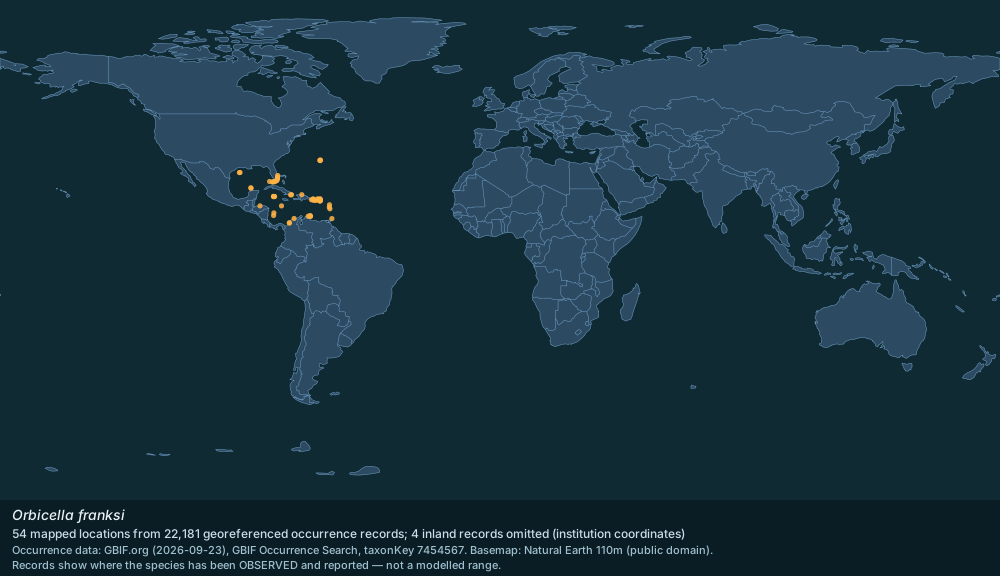
Distribution map plotted from GBIF.org occurrence records; basemap Natural Earth 110m · GBIF records CC0 / CC BY; Natural Earth public domain
Orbicella franksi, commonly known as boulder star coral, is a colonial stony coral in the family Merulinidae. It is native to shallow waters in the Caribbean Sea, the Gulf of Mexico, the Bahamas, Bermuda and Florida, and is listed as a near-threatened species by the International Union for Conservation of Nature.
- Scientific name
- Orbicella franksi
- Authority
- (Gregory, 1895)
- Family
- Merulinidae
- Order
- Scleractinia
- Depth range
- 2–50 m
- Habitat zone
- reef-associated
- Iucn red list
- Near Threatened
- Gbif occurrence records
- 22,181
Classification (WoRMS)
Full classification as recorded by WoRMS: Kingdom: Animalia · Phylum: Cnidaria · Class: Hexacorallia · Order: Scleractinia · Family: Merulinidae · Genus: Orbicella.
Accepted name: Orbicella franksi · Authority: (Gregory, 1895) · Taxonomic status: accepted · AphiaID: 758262.
Synonyms and superseded combinations recorded for this taxon: Echinopora franksi Gregory, 1895; Montastraea franksi (Gregory, 1895); Montastrea franksi (Gregory, 1895).
Source: World Register of Marine Species (WoRMS) — https://www.marinespecies.org/aphia.php?p=taxdetails&id=758262 (CC BY 4.0). Accessed 2026-09-23.
Biology and life history (SeaLifeBase)
Measured values published by SeaLifeBase for Orbicella franksi. Only fields the database actually holds for this species are shown; these are database values, not aquarium guidance.
Depth range: 2–50 m · Habitat zone: reef-associated.
SeaLifeBase notes: Zooxanthellate (Ref. 116012).
Source: SeaLifeBase species summary (SpecCode 46777) — https://www.sealifebase.se/summary/Orbicella-franksi.html (CC BY-NC 3.0 — non-commercial use only). Accessed 2026-09-23.
Distribution and occurrence records (GBIF)
22,181 georeferenced occurrence records for Orbicella franksi are published through GBIF from 31 countries or marine areas. The map above plots 54 distinct locations from a sample of 3,000 records, omitting 4 inland records that carry an institution's coordinates rather than a collection site; it shows where the species has been observed and reported, not a modelled range.
Most records by country or area: Colombia (7,942); Virgin Islands (U.S.) (7,868); United States of America (2,453); Puerto Rico (1,408); Bahamas (513).
The full country table, WoRMS marine regions and the sampling notes are on this species' Distribution page.
Source: GBIF Occurrence Search (taxonKey 7454567) — https://www.gbif.org/occurrence/search?taxon_key=7454567&has_coordinate=true (records CC0 / CC BY); WoRMS distribution records (MarineRegions) — https://www.marinespecies.org/aphia.php?p=taxdetails&id=758262 (CC BY 4.0); Natural Earth 110m basemap — https://www.naturalearthdata.com/ (public domain). Accessed 2026-09-23.
Conservation status (IUCN Red List)
The IUCN Red List assesses Orbicella franksi (Gregory, 1895) as Near Threatened (code NT). No trend, population estimate or threat analysis is given here, because none is available from this source without the Red List API; follow the source link for the full assessment, including its date.
Source: IUCN Red List of Threatened Species (taxon 133012) — https://www.iucnredlist.org/species/133012/0; GBIF IUCN Red List category endpoint (taxonKey 7454567) — https://api.gbif.org/v1/species/7454567/iucnRedListCategory. Accessed 2026-09-23.
Description and natural history (Wikipedia)
Until recently this coral, along with Orbicella faveolata, was thought to be a variety of Orbicella annularis. There is very little morphological difference between them but studies have shown differences in corallite structure, life history, allozymes and distribution. All three members of this species complex used to be placed in the genus Montastraea.
Colonies of Orbicella franksi usually form massive clumps with uneven surfaces, but sometimes forms plates, and in shady positions, may be encrusting. The general colour is orange-brown, greenish-brown or greyish-brown, but the extremities of the lumps are often pale or white. The corallites (the cups in which the polyps sit) are small, measuring 3.5 mm across. The growing edges of this coral bear both large and small corallites which is in contrast to the closely related Orbicella faveolata, which has regularly spaced corallites at its growing edges.
Orbicella franksi is native to the Caribbean Sea and the Gulf of Mexico, including Florida, the Bahamas and Bermuda. It typically grows on fore reefs (where it may be the most common species of coral) and its depth range is 5 to 50 m but it is typically found at depths of between 15 and 30 m.
Orbicella franksi seems to be more resistant to coral diseases than some members of its genus, but is still susceptible to coral plague, yellow-band disease, black band disease and coral bleaching. The major threats it faces include climate change, ocean acidification and destruction of its reef habitat. The International Union for Conservation of Nature has rated its conservation status as being near threatened.
Source: Wikipedia: Orbicella franksi — https://en.wikipedia.org/wiki/Orbicella_franksi (CC BY-SA 4.0). Accessed 2026-09-23.
Gallery
Related in Boulder star coral
Links follow this subject's own source article.
Elsewhere in Boulder star coral
Spotted an error? Know more?
Reader corrections go straight into our review queue. Suggest an edit · How this site is sourced