
Mountainous star coral (Orbicella faveolata)
Source-cited species reference: taxonomy from WoRMS, biology from SeaLifeBase, occurrence map from GBIF, conservation from IUCN Red List, description from Wikipedia.

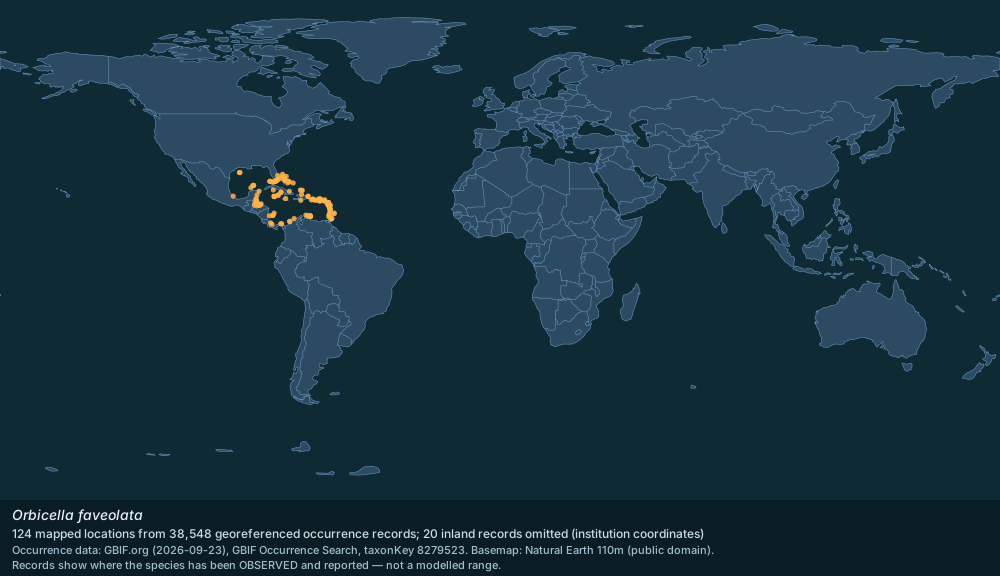
Distribution map plotted from GBIF.org occurrence records; basemap Natural Earth 110m · GBIF records CC0 / CC BY; Natural Earth public domain
Orbicella faveolata, commonly known as mountainous star coral, is a colonial stony coral in the family Merulinidae. Orbicella faveolata is native to the coral coast of the Caribbean Sea and the Gulf of Mexico and is listed as endangered by the International Union for Conservation of Nature. O. faveolata was formerly known as Montastraea faveolata.
- Scientific name
- Orbicella faveolata
- Authority
- (Ellis & Solander, 1786)
- Family
- Merulinidae
- Order
- Scleractinia
- Depth range
- 2–40 m
- Habitat zone
- reef-associated
- Iucn red list
- Endangered
- Gbif occurrence records
- 38,548
Classification (WoRMS)
Full classification as recorded by WoRMS: Kingdom: Animalia · Phylum: Cnidaria · Class: Hexacorallia · Order: Scleractinia · Family: Merulinidae · Genus: Orbicella.
Accepted name: Orbicella faveolata · Authority: (Ellis & Solander, 1786) · Taxonomic status: accepted · AphiaID: 758261.
Synonyms and superseded combinations recorded for this taxon: Madrepora faveolata Ellis & Solander, 1786; Montastraea faveolata (Ellis & Solander, 1786); Montastrea faveolata (Ellis & Solander, 1786).
Source: World Register of Marine Species (WoRMS) — https://www.marinespecies.org/aphia.php?p=taxdetails&id=758261 (CC BY 4.0). Accessed 2026-09-23.
Biology and life history (SeaLifeBase)
Measured values published by SeaLifeBase for Orbicella faveolata. Only fields the database actually holds for this species are shown; these are database values, not aquarium guidance.
Depth range: 2–40 m · Habitat zone: reef-associated.
SeaLifeBase notes: Zooxanthellate (Ref. 116012).
Source: SeaLifeBase species summary (SpecCode 46776) — https://www.sealifebase.se/summary/Orbicella-faveolata.html (CC BY-NC 3.0 — non-commercial use only). Accessed 2026-09-23.
Distribution and occurrence records (GBIF)
38,548 georeferenced occurrence records for Orbicella faveolata are published through GBIF from 38 countries or marine areas. The map above plots 124 distinct locations from a sample of 3,000 records, omitting 20 inland records that carry an institution's coordinates rather than a collection site; it shows where the species has been observed and reported, not a modelled range.
Most records by country or area: Colombia (18,934); Virgin Islands (U.S.) (7,255); United States of America (2,870); Puerto Rico (1,722); Mexico (1,155).
The full country table, WoRMS marine regions and the sampling notes are on this species' Distribution page.
Source: GBIF Occurrence Search (taxonKey 8279523) — https://www.gbif.org/occurrence/search?taxon_key=8279523&has_coordinate=true (records CC0 / CC BY); WoRMS distribution records (MarineRegions) — https://www.marinespecies.org/aphia.php?p=taxdetails&id=758261 (CC BY 4.0); Natural Earth 110m basemap — https://www.naturalearthdata.com/ (public domain). Accessed 2026-09-23.
Conservation status (IUCN Red List)
The IUCN Red List assesses Orbicella faveolata (Ellis & Solander, 1786) as Endangered (code EN). No trend, population estimate or threat analysis is given here, because none is available from this source without the Red List API; follow the source link for the full assessment, including its date.
Source: IUCN Red List of Threatened Species (taxon 133373) — https://www.iucnredlist.org/species/133373/0; GBIF IUCN Red List category endpoint (taxonKey 8279523) — https://api.gbif.org/v1/species/8279523/iucnRedListCategory. Accessed 2026-09-23.
Description and natural history (Wikipedia)
Colonies of this coral are solid and very large, forming a mound with a skirt. The surface is smooth and undulating, with small lumps, bulges or lobes. The corallites, the stony cups in which the polyps sit, are about 5 mm in diameter and cover the entire surface of the coral. The colour is usually a pale brown, yellowish green and grey but may be deep brown, with fluorescent green highlights. This coral is part of a species complex including the closely related Orbicella annularis and Orbicella franksi, but the former has more distinct nodules or small columns and the latter has a more irregular, lumpy surface.
Orbicella faveolata occurs in shallow waters in the Caribbean Sea and the Gulf of Mexico, its range including Florida, united states, the Bahamas, Venezuela and possibly Bermuda. It is found on both the back reef and fore reef slopes of fringing reefs at depths of up to 40 m. It is often the most abundant coral species on fore reef slopes between 10 and 20 m.
Like other corals, Orbicella faveolata has a symbiotic relationship with dinoflagellates in the family Symbiodiniaceae. These symbionts are commonly known as zooxanthellae and large numbers are present in the coral's living tissue. Several different species of Symbiodiniaceae associate with the coral, depending on the degree of light intensity reaching the part of the surface where they reside. When artificial shading was applied by researchers to corals for some weeks, the endosymbionts died out in the shaded portion. When the light was restored, zooxanthellae became reinstated, but in many instances, the original species was replaced by a different species of Symbiodiniaceae.
A coral has a very diverse microbiome, an ecological community of micro-organisms. The zooxanthellae, bacteria and archaea present are quite dynamic and are affected by the health of the coral. Orbicella corals are affected by multiple diseases including yellow-band disease.
Orbicella faveolata is related to the coral species lobed star coral (Orbicella annularis) and the species boulder star coral (Orbicella franksi), all exist in the Caribbean Sea and the Gulf of Mexico in areas such as the Bahamas and Bermuda. The species Paramontastraea saleborsa and Astrea curta have similarly sized corallites. The species P. saleborsa was also formally placed in the coral genus Montastraea.
Orbicella faveolata is a slow-growing species and the rate at which new colonies are formed is less than the rate at which mature colonies die. It is susceptible to bleaching and to several coral diseases including stony coral tissue loss disease, yellow-band disease, black band disease and white plague. Numbers of individuals are believed to have declined by over 50% in the last thirty years and the International Union for Conservation of Nature lists its conservation status as being endangered.
Source: Wikipedia: Orbicella faveolata — https://en.wikipedia.org/wiki/Orbicella_faveolata (CC BY-SA 4.0). Accessed 2026-09-23.
Gallery
Related in Mountainous star coral
Links follow this subject's own source article.
Elsewhere in Mountainous star coral
Spotted an error? Know more?
Reader corrections go straight into our review queue. Suggest an edit · How this site is sourced